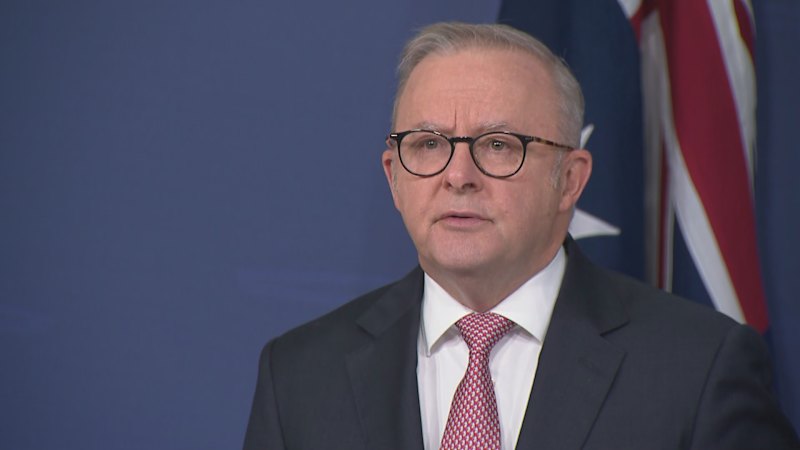
Anthony Albanese’s recent declaration that Australia stands shoulder-to-shoulder with the United States regarding military action against Iran isn't just predictable diplomacy. It’s a masterclass in strategic obsolescence. While the press gallery focuses on the "strength of the alliance," they’re ignoring the fact that Canberra is signing a blank check for a conflict that offers Australia zero upside and massive economic blowback.
The lazy consensus suggests that by backing Washington, we secure our own "protection." In reality, we are outsourcing our national interest to a superpower that is increasingly distracted and domestically fractured. We aren't being a "loyal ally"; we’re being a sacrificial buffer.
The Myth of the Integrated Defense
The prevailing narrative argues that Australia’s security is inextricably linked to the US military presence in the Middle East. This is a logic error of the highest order.
The Strait of Hormuz is a choke point for global energy, yes. But who suffers most if it closes? Not the US, which has become a net exporter of oil and gas thanks to the Permian Basin. The victims are the Asian economies that Australia relies on for its own prosperity. By cheerleading a confrontation, Albanese is effectively supporting the disruption of our own primary customers in China, Japan, and South Korea.
We’re told that "stability" is the goal. Yet, since 2003, every major US-led intervention in the region has resulted in a power vacuum that was immediately filled by more radical actors. Doubling down on this strategy and expecting a different result is the textbook definition of insanity.
Middle Power or Middle Management?
I’ve spent years watching policy analysts in Canberra mistake proximity to power for actual influence. Being in the room when the US decides to strike a target is not the same as having a seat at the table.
Australia’s current posture is that of a middle manager—eager to please the CEO (Washington) without questioning if the company’s product line is failing. A true middle power uses its position to de-escalate and find diplomatic backchannels. Instead, we’re behaving like an echo chamber.
Consider the "Force Posture Initiatives." We are opening our doors to more US rotations, bombers, and logistical hubs. This doesn't make us safer; it makes us a target. In any kinetic conflict involving Iran that draws in the US, Australia’s northern bases become legitimate military objectives for any actor wanting to disrupt US Pacific capabilities. We are assuming 100% of the risk for 0% of the strategic autonomy.
The Economic Mirage of Conflict
There is a subset of the business community that believes war is good for the "defense industrial base." They see the AUKUS deals and the guided weapons programs and see dollar signs. This is a short-sighted delusion.
A hot war with Iran would send insurance premiums for maritime trade into the stratosphere. It would trigger a global inflationary spike that would make the post-COVID "cost of living crisis" look like a minor inconvenience. For an economy like Australia’s—built on the movement of heavy commodities across oceans—this is economic self-immolation.
The Real Cost of "Action"
- Energy Volatility: Australia might produce gas, but we are price-takers. Local prices will skyrocket regardless of how much we dig up.
- Supply Chain Decimation: Modern manufacturing relies on "just-in-time" logistics. A conflict in the Middle East ripples through every shipping lane on the planet.
- Opportunity Cost: Every billion spent on "taking action" is a billion not spent on hardening our own domestic infrastructure against the actual threats of the 21st century: cyber warfare and sovereign manufacturing.
Challenging the "Special Relationship" Premise
The most dangerous lie in Australian politics is that we "owe" the US for WWII. This historical debt has been paid a dozen times over in Korea, Vietnam, Iraq, and Afghanistan.
The US doesn't have "friends"; it has interests. Currently, the US interest is to contain any regional hegemon that threatens its hegemony. Australia’s interest, conversely, is to maintain a multipolar world where trade can flow without being held hostage by the ideological crusades of a distant capital.
When Albanese says we support "action," he is signaling that Australia has no independent foreign policy. He is telling the world that Canberra is a subsidiary, not a state.
The Nuclear Submarine Distraction
While the government talks tough on Iran, they are pinning our long-term defense on the AUKUS submarines—vessels that won't see the water in significant numbers for decades. This is "vibrant" rhetoric masking a hollowed-out force.
If we were serious about national defense, we wouldn't be worried about "taking action" against a country 12,000 kilometers away. we would be focused on:
- Massive Drone Proliferation: Cheap, attrittable systems that can deny our sea approaches.
- Cyber Sovereignty: Protecting the grid and the banking system from state-sponsored attacks.
- Energy Independence: Actually using our own resources to insulate the domestic market from global shocks.
Instead, we are buying into the "Global Policeman" fantasy just as the policeman is looking to retire or go rogue.
The Thought Experiment: The Neutral Alternative
Imagine a scenario where Australia responded to US requests for support with a polite but firm "No."
What would actually happen? Would the US stop selling us jets? Unlikely—they need the export revenue. Would they stop sharing intelligence? No—we are a vital node in the Five Eyes network that benefits them as much as us.
The "consequences" of independence are largely a ghost story told by career bureaucrats who are terrified of losing their invitations to DC garden parties. A neutral, or at least highly skeptical, Australia would be a more valuable partner because we would provide a reality check rather than a cheer squad.
Stop Asking "How Can We Help?"
The question the Australian public should be asking is not "How can we support our allies?" but "Why is this our problem?"
Iran is a complex, often bad-faith actor. No one is arguing they are "the good guys." But the world is full of bad-faith actors. Australia does not have the blood or the treasure to be the moral arbiter of the Middle East.
Every time we join one of these "coalitions of the willing," we erode our standing with our actual neighbors in Indonesia, Malaysia, and Vietnam. They see a country that is culturally and politically tethered to a fading Atlantic order, unable to reconcile with its own geography.
The "lazy consensus" says that being a good ally means saying "yes." The hard truth is that being a good ally means having the courage to say "this is a mistake."
Albanese’s support isn't a sign of strength. It’s a symptom of a nation that has forgotten how to think for itself. We are sleepwalking into a regional firestorm, and we’re bringing our own gasoline.
Stop looking for the approval of the Oval Office. Start looking at the map.
Would you like me to analyze the specific economic impacts of a Strait of Hormuz closure on the ASX 200?