The coffee was still hot when the world unraveled.
Morning light does not care about jurisdiction. It spills over suburban lawns, catches the dew on manicured hedges, and illuminates the ordinary debris of a Tuesday: a truncheon-shaped garden gnome, a scatter of oak leaves, a blue sedan parked with its front wheels slightly turned toward the curb. To anyone walking down that sidewalk, the scene whispered normalcy. It hummed with the quiet rhythm of people getting ready to leave, packing lunches, clicking seatbelts, trusting an invisible social contract that says the door of your home is a threshold the outside world cannot cross without a key.
Then came the weight.
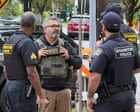
Not a metaphoric weight, but the physical, bruising impact of armed men in tactical vests hitting asphalt at a dead sprint. Doors do not merely open under federal battering rams; they splinter. Steel yields to hydraulic pressure. Within seconds, the hallway is choked with synthetic smoke, heavy boots, and shouted commands that outpace the human brain's ability to translate them.
Ask yourself what you would do if the floor beneath your feet suddenly turned into a combat zone. You would freeze. Your hands would fly up. Your heart would hammer against your ribs like a trapped bird. You would open your mouth to explain, to offer a driver's license, a birth certificate, a social security card, a piece of paper that proves you belong to the earth beneath your soles.
And you would learn, in the span of a single fractured breath, that paper is terribly fragile against a loaded rifle.
This is the story of a citizen who discovered that legal paperwork is only as good as the eyes reading it. Or, more precisely, the eyes failing to read it.
The Anatomy of an Identity Error
We live in an era of biometric supremacy. Every movement we make is logged, tracked, categorized, and cross-referenced. Algorithms purportedly know our credit scores, our commuting habits, our medical histories, and the last time we bought groceries. Data is absolute. Data is supposed to be a shield.
Except when human panic overrides the database.
According to reports surrounding the incident, federal Immigration and Customs Enforcement agents converged on a target with a singular mission: apprehend a fugitive. Intelligence files had pointed them to a specific address, a specific demographic, a specific target. But operations in the field rarely mirror the neat spreadsheets of a downtown office. In the fog of tactical anticipation—where adrenaline acts as both a fuel and a blinding agent—confirmation bias takes the wheel.
If you go looking for a monster, every shadow starts looking like fangs.
The man they pinned to the floor was not the fugitive. He was a United States citizen. He possessed the exact passport, the exact constitutional protections, the exact birthright that millions take for granted until a pair of heavy boots presses their cheek into the carpet.
Let us be entirely clear about the mechanics of this failure. This was not a computer glitch. The databases did not invent a fake identity out of thin air. This was an error born of velocity. When enforcement agencies prioritize speed over verification—when the mandate is to move fast, strike hard, and secure the perimeter—caution becomes an impediment. And when caution is viewed as an impediment, collateral damage becomes inevitable.
The physical injuries sustained during the encounter were treated at local hospitals. Bruises fade. Fractured ribs mend. Lacerations heal into thin, silvery lines of scar tissue that eventually fade into the background of a person's skin.
The psychological infrastructure, however, does not heal so cleanly.
The Invisible Geometry of Fear
Fear is a structural hazard. Once it enters a neighborhood, it alters the architecture of daily life.
Consider what happens next on that street. The sirens fade. The vans rumble away, taillights bleeding red into the twilight. The yellow crime scene tape is pulled down, rolled into plastic bags, and tossed into the back of a utility truck. The neighbors come out of their homes. They step onto their porches. They look at the splintered doorframe across the street, and something inside them shifts.
The social contract has a tear in it.
Before that morning, a knock on the door carried a predictable set of probabilities: a neighbor returning a dropped baseball, a delivery driver dropping off a box, a salesman pushing vacuum cleaners. After that morning, every knock is loaded with dread. Every shadow by the side of the house is scrutinized.
This is the hidden tax of administrative error. It is paid not just by the individual who ends up in the emergency room with bruised ribs and a bewildered expression, but by the entire community whose baseline sense of safety is quietly dismantled.
We talk about border enforcement, about national security, about the logistical behemoth of immigration policy as if they were abstract lines on a political map. We debate them on cable news panels with split screens and raised voices. We treat them as sports matches where points are scored for rhetorical cleverness.
But policy has a physical body. Policy walks down suburban sidewalks wearing body armor. Policy carries firearms. And when policy stumbles, it leaves real, breathing human beings in the dirt, trying to explain to armed strangers that they were born three counties over and have never broken a law in their lives.
The Burden of Infallibility
In any high-stakes profession, error is treated with rigorous post-mortems. When a surgeon makes a mistake, medical boards review every incision. When an airline pilot miscalculates an approach, federal investigators dissect the black box down to the millisecond. Accountability is the price of wielding extraordinary power.
Yet, federal immigration enforcement operates in a strange, insulated twilight. Agents are granted extraordinary authorities—the power to detain, to enter spaces, to disrupt lives based on administrative warrants that do not carry the same judicial oversight as criminal search warrants. When those authorities are executed with catastrophic inaccuracy, the response is too often met with institutional shoulder-shrugs.
An apology issued via a press statement does not reset a broken door. A bureaucratic review board meeting behind closed doors does not restore the trust of a family waking up from nightmares.
To wield the immense machinery of the state requires a standard of precision that matches the weight of the tools being used. If you are going to kick down a door in the dead of morning, you damn well better make sure you have the right house. You better make sure the face matches the file. You better make sure that the constitutional rights you swore an oath to uphold are not being treated as inconvenient speed bumps on the way to a quota.
The man lying on that floor didn't ask to be a headline. He didn't ask to become a cautionary tale in the ongoing national debate over federal oversight and civil liberties. He was simply living his life, drinking his morning coffee, trusting the world to make sense.
The world failed him.
And until the institutions tasked with protecting us learn the profound difference between moving fast and acting right, every single one of us remains just one mistaken address away from waking up on the wrong side of a rifle barrel.



