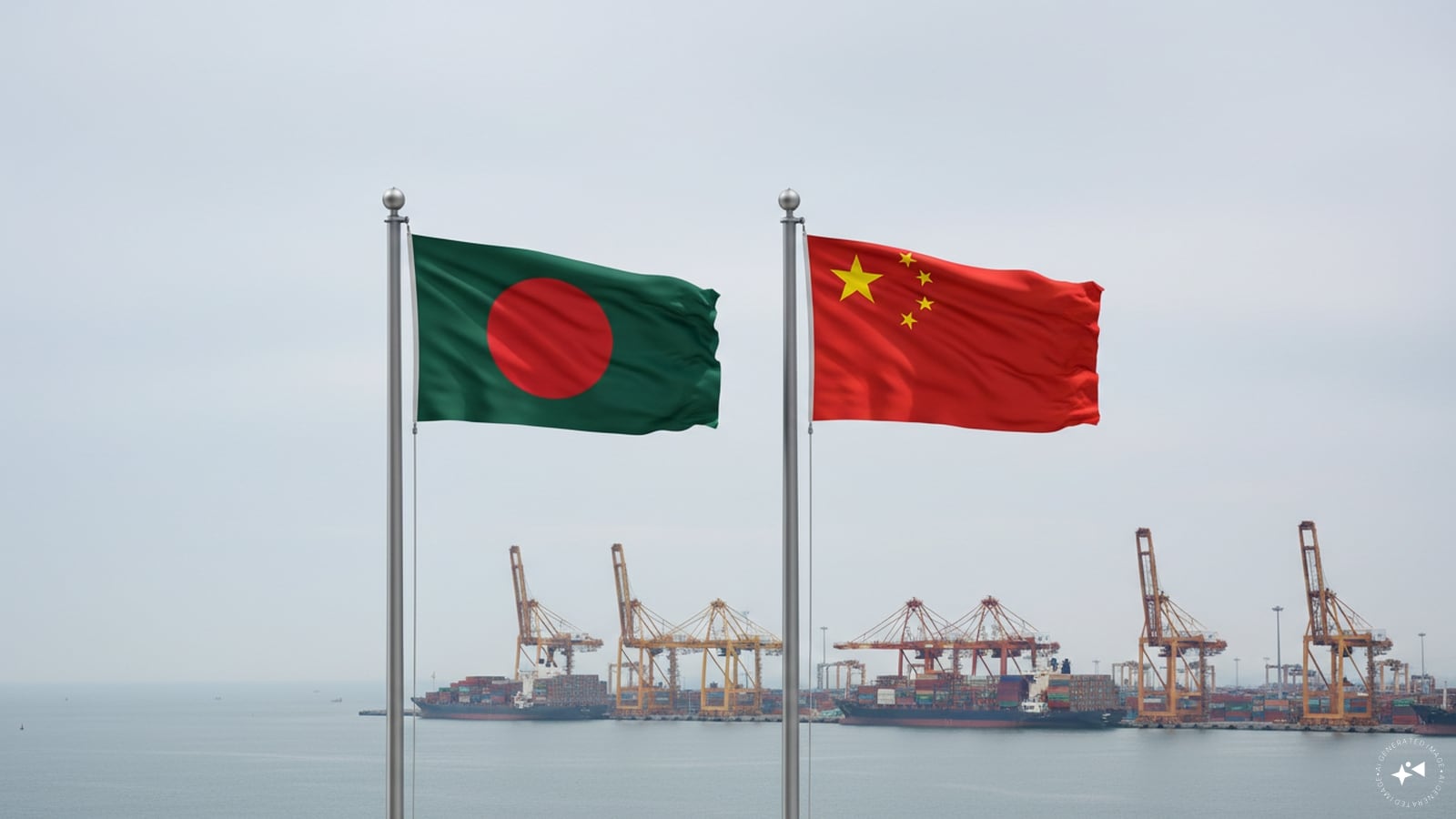
Geopolitical chess matches in South Asia rarely happen quietly. When money changes hands across borders, the ripple effects hit regional supply chains, naval strategies, and cross-border diplomacy all at once. Bangladesh recently inked a massive $335.78 million concessional loan agreement with the Export-Import Bank of China to upgrade Mongla Port, its second-largest coastal gateway.
If you look past the standard diplomatic statements, this project exposes a much larger story about shifting regional alliances, infrastructure competition, and economic survival. Let's break down what's actually happening on the ground and why this deal matters so much right now. Don't miss our earlier coverage on this related article.
Inside the Mongla Port Agreement
The financial arrangement itself is straightforward on paper, but heavy on long-term commitment. Beijing is backing the port expansion through a Renminbi-denominated loan—about 2.404 billion yuan, equivalent to roughly 3,592.8975 crores in Bangladeshi currency. The terms include a 2 percent interest rate spread across a 20-year repayment schedule, backed by a five-year grace period.
The core objective is physical expansion. The funding targets the construction of two new container terminals and dedicated cargo-handling yards. Mongla Port has long played second fiddle to Chattogram, but congestion and capacity limits have choked its potential. Upgrading the infrastructure aims to transform it into a competitive commercial hub along the Bay of Bengal, capable of handling modern shipping demands and larger cargo vessels. To read more about the history of this, The New York Times offers an in-depth summary.
The Strategic Realities Behind the Deal
You can't separate maritime infrastructure in South Asia from regional security dynamics. Mongla sits roughly 80 kilometers from the Indian border, putting it in close geographical proximity to West Bengal and sensitive eastern defense corridors. When Chinese state-backed entities secure major logistics contracts this close to strategic bottlenecks like the Siliguri Corridor, neighboring capitals pay close attention.
This financial pact didn't happen in a vacuum, either. It follows a turbulent period for foreign investments in the area. The interim government led by Muhammad Yunus previously scrapped an Indian Economic Zone project slated for 110 acres near Mongla Port. Officials cited stagnant construction timelines and a failure by developers to break ground within agreed windows. With that space cleared, Dhaka pivoted toward Chinese financing to push its long-delayed maritime modernization forward.
What This Means for Regional Trade
From a pure logistics standpoint, upgrading Mongla Port makes total sense for Dhaka. Bangladesh needs diversified trade routes to support its growing export economy. Relying on a single major port creates dangerous bottlenecks whenever labor disputes, technical glitches, or capacity spikes occur.
A modernized Mongla provides shipping lines with an alternative entry point, easing congestion and lowering transit delays for businesses operating in the country's southwestern regions. Regional trade networks across the Bay of Bengal are expanding fast, and coastal nations are racing to upgrade their harbor capacity before traffic outpaces infrastructure.
Yet, balancing economic necessity with diplomatic equilibrium remains a tightrope walk. Dhaka has maintained that its infrastructure partnerships are driven by commercial utility rather than military alignment. Even so, every major crane installed and every container terminal built by foreign contractors alters the strategic balance of the region.
Expect deeper scrutiny over how these construction phases unfold and whether local firms retain meaningful oversight. As global supply chains face ongoing volatility, ports like Mongla will dictate how fast local economies can scale—making every multi-million dollar loan a high-stakes gamble for the future.
China signs $335 Million port deal with Bangladesh near Indian
This video provides an on-the-ground visual breakdown of the $335 million loan agreement between Bangladesh and China to modernize Mongla Port near the Indian border.