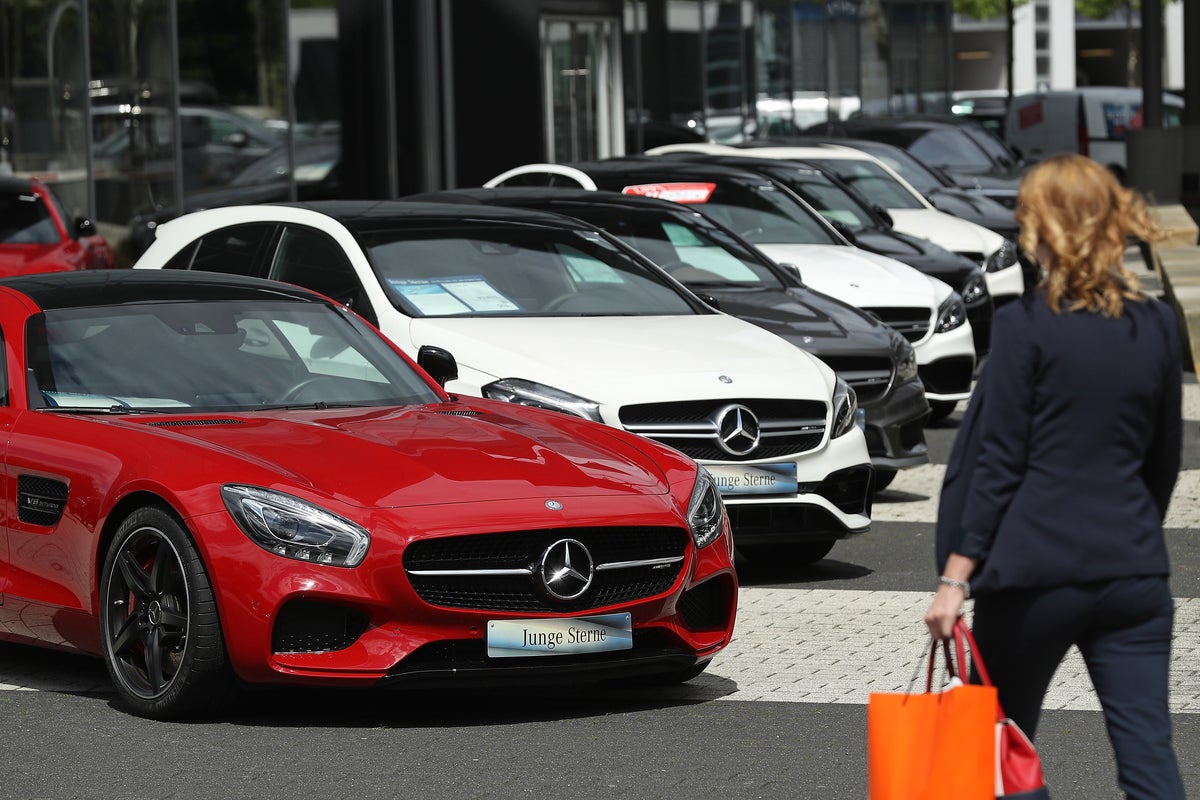
The panic over the Motor Vehicle Modernization Act of 2026 has reached a predictable, hysterical pitch. Mainstream business commentators are wringing their hands over the discovery that a bill designed to ban Chinese-made vehicles might accidentally obliterate Mercedes-Benz's presence in the United States. They call it an "unintended consequence." They call it a blunder. They claim that a technical quirk in the bill's 15% foreign-adversary ownership threshold is unfairly ensnaring an iconic German luxury brand because Beijing Automotive Industrial Corporation (BAIC) and Geely’s Li Shufu hold a combined 19.67% stake in Mercedes-Benz Group AG.
This analysis is completely wrong.
Excluding Mercedes-Benz from the American market is not a legislative oversight. It is the logical, necessary, and inevitable endpoint of the current global trade trajectory. For years, Western automakers have attempted a dangerous corporate strategy: capitalizing on Western consumer trust while heavily relying on Chinese capital, supply chains, and joint ventures to fuel their growth. Now, the bill has arrived.
If Washington blinks and carves out a special loophole for Mercedes-Benz simply because its vehicles sport a three-pointed star instead of a BYD badge, the entire American protectionist framework collapses into hypocrisy.
The Myth of the Innocent European Car
The lazy consensus dominating the automotive press rests on a naive premise: that a car's nationality is determined by where its corporate headquarters is located. In this view, Mercedes-Benz is thoroughly German, and its assembly plants in Tuscaloosa, Alabama, make it practically American. Therefore, punishing it for its shareholder roster is considered collateral damage.
This reflects a fundamental misunderstanding of modern automotive hardware and software architecture.
A modern vehicle is no longer a collection of stamped steel and mechanical valves. It is an internet-connected, data-harvesting server cluster on wheels. The Department of Commerce’s Bureau of Industry and Security made this clear when finalizing rules against foreign connected vehicle technology. Cars continuously scan their surroundings, track driver biometrics, map critical infrastructure, and beam that telemetry back to corporate servers.
When a foreign adversary's state-owned enterprise holds the largest individual voting stake in a parent company, the boundary between Western management and hostile state influence disappears. BAIC is not a passive portfolio investor; it is an arm of the Chinese state.
I have watched global corporations spend millions trying to establish firewalls between their Chinese joint ventures and their Western operations. It is a corporate fiction. When geopolitical tensions escalate, fiduciary duties to a Western board matter far less than the directives of the state providing the capital, the batteries, and the manufacturing scale.
The Subsidized Shell Game
Critics of the bill argue that since Mercedes-Benz has manufactured millions of SUVs in Alabama since 1997, it should receive a legacy exemption. The bill actually allows for this, but explicitly revokes the hall pass if the manufacturer maintains direct or indirect equity ties to a foreign-adversary government.
This structural rigidity is exactly what makes the legislation effective. Consider the reality of how global automotive funding works:
| Automaker | Chinese State/Insider Ownership Stake | Key US Manufacturing Footprint |
|---|---|---|
| Mercedes-Benz | 19.67% (BAIC & Li Shufu) | Tuscaloosa, AL; Ladson, SC |
| Volvo Car AB | Majority-owned by Geely | Ridgeville, SC |
| Lotus Technology | Majority-controlled by Geely | None (US Distribution Only) |
If the United States bans BYD, Geely, and NIO on national security grounds but allows Mercedes-Benz to import platforms heavily subsidized by Chinese supply chains, it achieves nothing. It merely tells Beijing that the path to the American consumer requires laundering capital through European balance sheets.
The competitive distortion is massive. Chinese electric vehicle and connected car technology is cheaper not because of superior Western-style corporate efficiency, but because of massive, direct state capitalization. If Mercedes-Benz benefits from these cheaper supply chains, joint-venture engineering, and shared battery architectures via its Chinese partnerships, it brings those subsidized distortions directly into the American market.
Allowing this to continue while claiming to protect American industrial capacity is an economic contradiction.
The Flawed Questions Everyone Is Asking
When examining the debate surrounding this legislation, the public discussion frequently addresses the wrong issues. Consider the flawed assumptions embedded in standard industry questions:
People Also Ask: Won't banning Mercedes-Benz cost thousands of American manufacturing jobs?
👉 See also: The Steel Pulse of a Nation in the Dark
This question looks at the issue backward. Yes, Mercedes-Benz employs roughly 11,000 workers in Alabama and South Carolina. But allowing foreign-subsidized entities to operate unhindered undercuts the domestic capital investments required to build a resilient, independent industrial base. Protectionism always requires a trade-off. If the goal is absolute economic isolation from foreign adversaries, assuming that transition will be painless is a delusion. The real question is whether Washington is willing to endure short-term industrial disruption to secure long-term supply chain sovereignty.
People Also Ask: Can't Mercedes-Benz just buy back the shares from BAIC and Geely?
This assumes that corporate restructuring is simple. Forcing a buyout of nearly 20% of a $70 billion multinational corporation during a geopolitical crisis is an extraordinary challenge. It requires massive liquidity, regulatory approvals across multiple jurisdictions, and a willing seller. Neither BAIC nor Li Shufu has any strategic incentive to sell their stakes and willingly surrender their leverage over Western luxury automotive assets. Mercedes-Benz cannot simply wave a wand and erase its corporate reality.
The Downside of Corporate Decoupling
Admitting the harsh reality of this stance means acknowledging the severe downsides. Forcing a hard break with Chinese capital will destabilize the luxury automotive market. It will raise prices for consumers, restrict choice, and likely trigger swift retaliatory actions against American industrial exports.
Moreover, the enforcement of the 15% threshold creates a highly volatile corporate governance environment. Imagine a scenario where a foreign-adversary investment fund quietly acquires shares of a Western company on the open market specifically to push its ownership stake past the threshold, effectively triggering a regulatory trap that bans its competitor from the US market. The potential for the weaponization of equity structures is real, and the legal compliance costs for global compliance teams will be astronomical.
Yet, this is the cost of doing business in a fractured world.
The Mirage of the Special Exemption
Automotive trade groups are already lobbying for narrow, vague definitions of ownership to save Mercedes-Benz and Volvo from the chopping block. They point to the Commerce Department’s recent willingness to grant temporary administrative waivers for certain connected vehicle software platforms as a precedent.
Relying on administrative waivers is a failing strategy. It creates regulatory uncertainty, invites corruption, and signals to global competitors that American security policy can be modified if a corporate brand is sufficiently prestigious.
The era of corporate dual-citizenship is over. An automaker cannot act as a champion of Western industrial heritage in Washington while relying on the capital of a geopolitical rival in Beijing. If the Motor Vehicle Modernization Act takes down Mercedes-Benz alongside Chinese-branded vehicles, it is not proof that the law is broken. It is proof that the law is working exactly as intended.