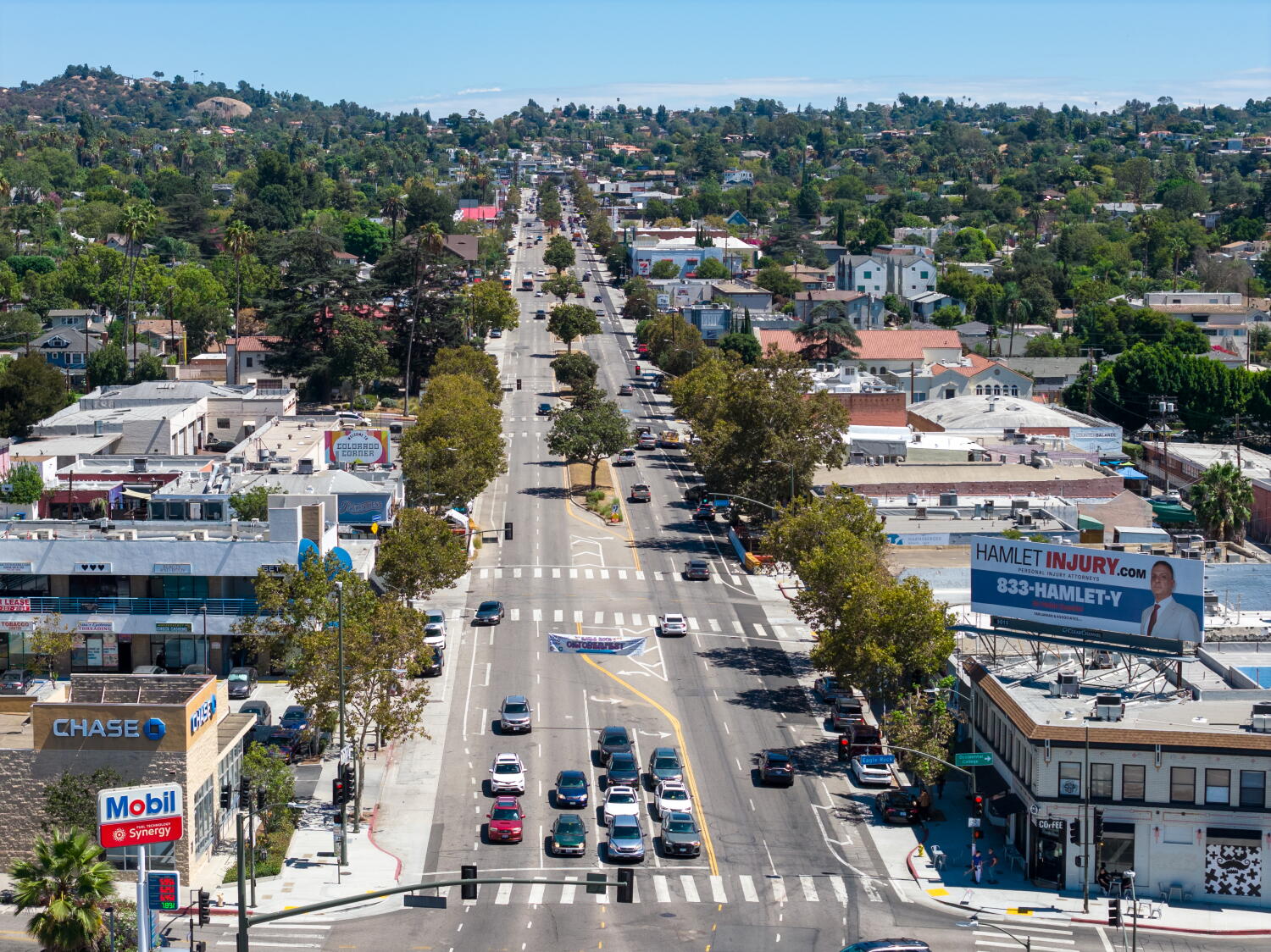
The asphalt on Colorado Boulevard has always carried more than just cars. It carries the friction of a neighborhood trying to decide what it wants to be when it grows up. For decades, the main thoroughfare through Eagle Rock functioned as an asphalt conduit, hauling commuters from Pasadena into downtown Los Angeles while cutting clean through the commercial heart of an old streetcar suburb. When transit planners proposed carving out dedicated bus lanes along this stretch to speed up the Metro Transit Authority lines, they triggered a predictable shockwave. Residents pushed back with petitions, town halls, and impassioned letters to the editor claiming the project would literally split their community in half.
Strip away the rhetoric of impending doom, and you find a classic urban planning collision. On one side stand municipal transit strategists tasked with moving thousands of daily bus riders past crippling traffic bottlenecks. On the other stand merchants and homeowners whose daily logistics depend on unobstructed street parking, easy left turns, and the uninterrupted flow of private vehicles. Urban transformation is rarely polite. When a city retrofits streets built for mid-century suburban expansion to serve a denser, multi-modal future, someone always bears the adjustment cost.
To understand why a few painted lines on pavement can cause such an uproar, you have to look at how Los Angeles neighborhoods were engineered. Eagle Rock developed around streetcar lines that vanished long ago, leaving behind wide commercial corridors dominated by the automobile. Colorado Boulevard became a high-speed raceway during rush hours. Local businesses thrived on visibility and curb parking, while residents treated side streets as escape hatches from boulevard gridlock.
When transit agencies propose priority lanes for buses like the Metro rapid lines, they are attempting to solve a severe math problem. Moving eighty people in a single articulated bus requires a fraction of the road space taken up by eighty single-occupancy SUVs. Yet, the physical reality of the street cannot be easily stretched. Reallocating an existing lane from general traffic to transit use compresses the remaining space. Traffic engineers model the shifts, but neighborhood stakeholders live the friction.
The fear of being split in half is not merely poetic license. It describes a tangible psychological and physical barrier. When a major commercial artery becomes harder to cross on foot or more congested for local vehicle traffic, neighborhood cohesion strains. Shoppers from the north side of the boulevard might think twice about patronizing a bakery on the south side if navigating the corridor becomes an exercise in frustration. Small businesses operate on thin margins; even a slight dip in customer accessibility can tip a boutique or a family-run restaurant toward insolvency.
Yet the status quo is unsustainable. Los Angeles faces a climate mandate, crippling congestion, and a transit-dependent population that relies on buses to reach jobs, schools, and healthcare. If public transit remains stuck in the same general traffic lanes as cars, ridership stagnates. The region pours billions into rail extensions, but rapid bus networks represent the fastest, most cost-effective way to deliver high-capacity transit to corridors that need it immediately.
The tension in Eagle Rock mirrors battles playing out across every major American metropolis. Cities are wrestling with the transition from car-centric dominance to multi-modal networks. Every inch of curb space has become contested territory. Is a parking space more valuable as temporary storage for a single private vehicle, or as a loading zone for delivery vans, or as a passenger boarding platform for a high-frequency bus?
Cities often bungle the execution of these projects. Planners arrive with finalized blueprints, holding community meetings that feel less like genuine consultations and more like ritualistic exercises in public appeasement. When residents feel municipal decisions are being forced upon them from downtown headquarters, opposition hardens into ideological warfare. Trust erodes before the first bucket of red paint ever touches the asphalt.
Mitigation measures matter enormously, though they are rarely enough to placate critics entirely. Successful corridor redesigns require aggressive synchronization of traffic signals, targeted investments in municipal parking lots just off the main drag, bulb-outs to shorten pedestrian crossing distances, and real-time transit tracking that proves the system is actually delivering the promised speed gains. If a bus lane slows down overall traffic without noticeably improving bus speeds, the project is a failure of design, not an inevitable cost of progress.
The debate over Colorado Boulevard is ultimately about the allocation of public space in a crowded city. As urban populations climb and transportation demands shift, the era of free, unlimited road capacity for private vehicles is drawing to a close. Neighborhoods like Eagle Rock are on the front lines of this painful negotiation. The asphalt will keep carrying traffic, but the rules of engagement are changing, and the friction will not disappear just because the paint dries.