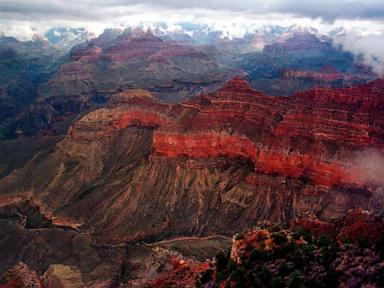
The air at the rim of the Grand Canyon feels like a promise. At 7,000 feet above sea level, shaded by ancient pinyon pines, the breeze carries a crisp, alpine edge even in the dead of summer. You stand on the edge of the South Rim, looking across an impossible gulf of purple and ochre stone, and your chest expands. It feels safe. It feels like an achievement just to look at it.
But the canyon is an upside-down mountain.
When you climb a traditional peak, the challenge is transparent. It stares you in the face from the trailhead. The air thins, the temperature drops, and the physical tax is demanded upfront. If you run out of gas, you simply turn around and let gravity carry you back to safety. The Grand Canyon operates on a cruel inversion of this logic. It lures you in with an effortless descent, tempting you deeper into its depths while hiding its true weapon until you are too far gone to escape.
Three times in recent weeks, that weapon found its mark. Three hikers entered the stone labyrinth with backpacks, water bottles, and dreams of conquering one of the great wonders of the earth. None of them walked out. As a new, punishing heatwave settles over the American Southwest, park rangers are bracing for an enemy that cannot be reasoned with, cordoned off, or easily survived.
The Crucible in the Stone
To understand why people die here, you have to understand the physics of a thermal trap. Imagine a giant stone oven left open under a midday sun. The massive walls of Precambrian rock do not just reflect sunlight; they absorb it, store it, and radiate it back out into the air long after the sun has dipped below the horizon.
As you descend trails like Bright Angel or South Kaibab, you are walking downward into an atmospheric pressure cooker. For every thousand feet of drop, the temperature climbs by up to five degrees Fahrenheit. By the time you reach the canyon floor—nearly a mile below the rim—the thermometer routinely strikes 120°F (49°C) in the shade.
But there is no shade.
Let us look at a hypothetical hiker named Marcus to see exactly how this trap springs. Marcus is thirty-four, runs half-marathons, and packed three liters of water. He feels invincible as he jogs down the switchbacks at 7:00 AM. His boots kick up red dust, and the morning air is a comfortable 75°F.
He reaches Indian Garden, a beautiful oasis a few miles down, and decides he has plenty left in the tank to push to the river. He feels fine because his sweat evaporates instantly in the bone-dry desert air. This is the first delusion. Because his skin feels dry, Marcus believes he is not losing moisture. In reality, his body is leaking water at a rate of over a liter an hour just trying to keep his core temperature from spiking.
By 11:00 AM, Marcus realizes he needs to head back. He turns around.
Suddenly, gravity is no longer his friend. Every step requires lifting his body weight up a steep, unrelenting incline of sun-baked rock. The air around him has warmed to 110°F. The rock under his feet is closer to 140°F, cooking the soles of his boots. He drinks his water, but it is warm now, tasting like plastic. His stomach begins to churn.
When the Mind Evaporates
What happens next is not a clean, predictable slide into exhaustion. It is a violent systemic breakdown.
When your core temperature passes 104°F, your body enters a state of triage. It panics. In a desperate bid to dump heat, your brain orders blood vessels near the skin to dilate completely, diverting blood away from your vital organs and your muscles. Your heart rate skyrockets, pumping furiously to move blood to a surface that is increasingly incapable of cooling down.
Then, the mind begins to fracture.
Hyponatremia—a critical drop in blood sodium levels caused by drinking heavily without replacing lost electrolytes—creeps in alongside heat stroke. Marcus becomes confused. He stops at a switchback, looking at a steep drop-off, unsure of which way is up. His gait becomes clumsy. He feels an overwhelming desire to lie down, just for a moment, in a patch of shade that is only inches wide.
This is the exact sequence that search and rescue teams see time and time again. The tragedy of the three hikers who lost their lives this season is that they were likely competent, enthusiastic outdoorspeople. They were not foolish; they were simply human, operating inside an environment that treats human physiology with utter indifference.
The human body is an exquisite machine, but it has hard thermal limits. When those limits are breached, the organs fail in sequence, like a line of dominoes falling in slow motion.
The Invisible Rescue Line
There is a profound psychological weight carried by the rangers who patrol these inner-canyon trails. They spend their summers walking into the heat while screaming signs tell everyone else to turn back.
Consider what happens when a call for help goes out from Phantom Ranch or Devil’s Corkscrew at 1:00 PM. In standard conditions, an injured traveler expects a helicopter to swoop in and whisk them away to a hospital. But extreme heat rewrites the rules of aviation.
As the air warms, it expands and becomes less dense. This drop in air density deprives helicopter blades of the lift they need to fly safely. When the temperature inside the canyon reaches a certain threshold, the rescue choppers are effectively grounded. They cannot fly into the gorge because the air is too thin to hold them up.
If you collapse at the bottom of the canyon during a heatwave, rescue becomes a grueling, hours-long ground operation. Rangers must hike down through the furnace, carrying heavy medical gear, to reach you. They are risking their own lives to save yours, moving through an environment where even a minor mistake can turn a rescuer into a patient.
The Myth of Preparation
We live in an era obsessed with gear. We believe that if we buy the right technical fabric, carry the most advanced hydration bladder, and download the finest GPS mapping apps, we can buy our way out of risk. The outdoor industry feeds this illusion, marketing an idealized vision of rugged self-reliance.
The Grand Canyon shatters that commercial myth within the first three miles.
The heat inside the canyon does not care about the brand name on your backpack. It does not care that you trained on a stair-climber in an air-conditioned gym for six months. It operates on a scale of deep time and massive geography that reduces human ambition to something small and fragile.
I remember standing near the river a few summers ago, the canyon walls rising like cathedral ceilings above me, feeling the air move past my face. It did not feel like wind. It felt like the breath of a blast furnace. I drank water constantly, yet my mouth remained dry. Every breath felt heavy, as if the air itself was thick with dust and ancient heat. You realize very quickly down there that you are completely on your own, a transient visitor in a place that was never meant to sustain human life for long.
The current warnings issued by the National Park Service are not bureaucratic suggestions. They are pleas for survival. They tell hikers to stay off the trails between 10:00 AM and 4:00 PM—the hours when the sun transforms the inner gorge into a dead zone.
To heed these warnings requires a commodity that is increasingly rare in our modern, achievement-oriented culture: humility. It requires a hiker to look at a trail they have traveled thousands of miles to see, to look at their expensive gear and their carefully planned itinerary, and say, No. The canyon won today.
The stone walls will still be there tomorrow, shifting color from red to gold under a rising sun, indifferent to whether we are there to witness it or buried beneath the dust at its feet.