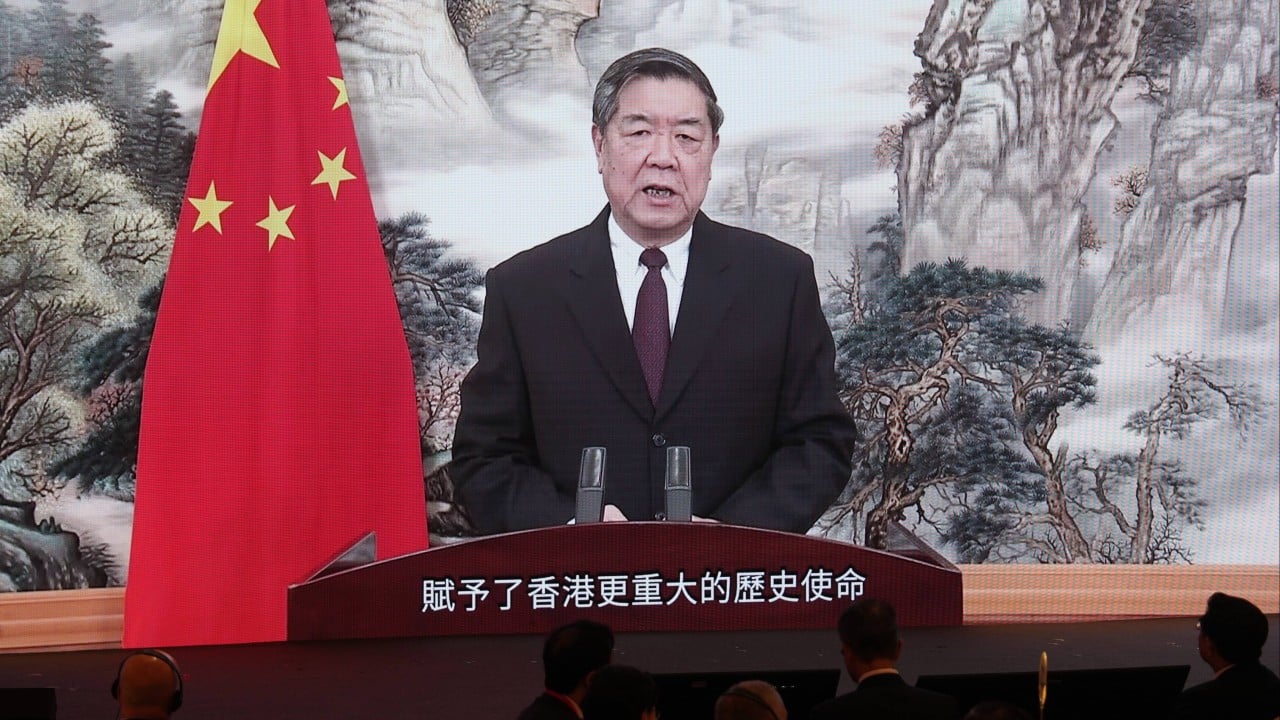
When Chinese Vice-Premier He Lifeng steps up to a podium and pledges unwavering state support for Hong Kong as an international financial centre, global bankers listen closely. They have to. Yet behind the choreographed reassurance of mainland backing lies a complicated reality that Beijing's official readouts rarely acknowledge. Beijing wants Hong Kong to remain a premier capital market, a vital offshore renminbi hub, and a magnet for Western institutional money, even as domestic regulatory crackdowns, geopolitical friction, and capital controls fundamentally alter how that money actually moves.
The pledge itself follows a familiar script. Whenever foreign capital grows skittish over slowing mainland growth or tightening political oversight, senior officials in Beijing dispatch high-level economic policymakers to reaffirm Hong Kong's unique status under the "one country, two systems" framework. He Lifeng, who oversees China's financial sector and serves as director of the Central Financial Commission, carries immense weight in these moments. His words signal that the central government recognizes Hong Kong's irreplaceable role as China's primary financial bridge to the outside world.
Why Beijing Cannot Afford a Weakened Hong Kong
To understand why He Lifeng's assurances matter right now, look at China's balance sheet. Mainland China still operates a largely closed capital account. Beijing restricts how much money can leave the country and tightly manages the onshore renminbi exchange rate to prevent destabilizing capital flight. Because Shanghai and Shenzhen remain insulated from free-flowing global liquidity, China needs an offshore pressure valve.
Hong Kong is that valve. It operates under common law, maintains a currency pegged to the US dollar, and allows unrestricted capital flows. When a mainland tech giant or state-owned enterprise needs US dollars to fund overseas expansion, it lists in Hong Kong. When a pension fund in New York or London wants exposure to Chinese equities without navigating mainland currency controls, it buys shares through the Stock Connect program in Hong Kong.
Without a functioning, credible international financial centre on its southern coast, Beijing loses its most efficient mechanism for raising foreign currency and internationalizing the renminbi. Shanghai cannot simply replace it. Until Beijing is willing to dismantle its capital controls—a move that carries massive systemic risk for domestic banks—Hong Kong remains structurally indispensable to the Chinese economy.
The Structural Friction Behind the Slogans
Promises from Beijing can stabilize market sentiment for a news cycle, but they cannot erase the structural headwinds battering Hong Kong's financial sector. Over the past few years, the city's initial public offering market has suffered a historic slump. Valuation multiples on the Hong Kong Stock Exchange have compressed, making it harder for companies to raise capital at attractive prices.
Several converging forces explain this drought.
- US Interest Rates: High borrowing costs in the United States have pulled global liquidity out of emerging markets and back into US Treasuries. Because the Hong Kong dollar is pegged to the greenback, the Hong Kong Monetary Authority must mirror Federal Reserve rate hikes, tightening local financial conditions even when the local economy needs stimulus.
- Mainland Regulatory Uncertainty: International investors still carry scars from Beijing's sweeping crackdowns on private enterprise, particularly in the technology and education sectors. When policy shifts happen overnight without clear warning, global fund managers demand a higher risk premium to hold Chinese assets.
- Geopolitical Scrutiny: Washington has increasingly scrutinized US investment into Chinese firms, particularly those linked to artificial intelligence, semiconductors, and quantum computing. Compliance departments at major Western banks now spend millions vetting deals that would have sailed through five years ago.
He Lifeng's vocal support addresses none of these external pressures directly. Beijing cannot lower US interest rates, nor can it easily convince risk-averse pension boards in North America to overlook geopolitical tensions.
How Mainland Policy Actually Flows Into the City
When Vice-Premier He speaks of supporting Hong Kong, he is not offering a blank check. Instead, Beijing relies on targeted institutional adjustments designed to channel mainland liquidity southward while encouraging select mainland companies to list in the city.
The primary toolkit revolves around the Connect schemes. Stock Connect links the Hong Kong exchange with Shanghai and Shenzhen, allowing mainland investors to buy Hong Kong-listed shares and foreign investors to trade mainland A-shares. Bond Connect and Swap Connect perform similar functions for fixed income and interest rate derivatives. By expanding the types of securities eligible under these programs—such as including exchange-traded funds and real estate investment trusts—Beijing can artificially boost trading volumes in Hong Kong using domestic Chinese savings.
Consider a hypothetical example of how this works in practice. Suppose a mid-sized mainland logistics company wants to go public, but faces a massive backlog of applicants waiting for approval from regulators in Shanghai. Beijing can instruct the China Securities Regulatory Commission to fast-track that company's application to list in Hong Kong instead. Simultaneously, state-backed institutional funds on the mainland can be encouraged to act as cornerstone investors in the offering. The deal gets done, Hong Kong records an IPO, and headlines proclaim a revival in capital markets.
Yet seasoned market participants see the distinction between organic global demand and state-directed liquidity. If the buyers, sellers, regulators, and underlying assets of a stock exchange are all predominantly from mainland China, the market begins to look less like an international financial centre and more like an offshore branch of the mainland domestic market.
The Quiet Shift in Hong Kong's Client Base
Walk through the banking towers of Central today, and you will notice a subtle transformation in who is doing the deals. For decades, Hong Kong's financial ecosystem was built around Western bulge-bracket investment banks intermediating capital between North American or European institutions and Asian borrowers. That model is shrinking.
Western banks have steadily trimmed their Asia-Pacific headcount, particularly in equity capital markets and mergers and acquisitions. In their place, mainland Chinese securities firms and state-owned banks have expanded aggressively, capturing the lion's share of underwriting fees for mainland corporate bond issuances and secondary listings.
At the same time, Hong Kong's wealth management industry is pivoting. While some Western family offices have moved staff to Singapore to diversify their regional footprint, Hong Kong is aggressively courting ultra-high-net-worth individuals from mainland China and the Middle East. The city's government has rolled out tax concessions for single-family offices and revived an investment migration scheme requiring applicants to invest tens of millions of Hong Kong dollars in local assets.
This pivot keeps capital flowing into the city's private banks, yet it alters the city's character. An international financial centre traditionally thrives on frictionless diversity—a chaotic, competitive mix of global capital competing for returns under transparent rules. As the client base narrows toward mainland wealth and state-aligned capital, Hong Kong risks losing the broad international consensus that once underpinned its market depth.
The National Security Overhang and Market Confidence
Any honest assessment of Hong Kong's financial future must confront the elephant in the boardroom: the intersection of national security legislation and commercial law. Following the introduction of the National Security Law in 2020 and the subsequent passage of domestic security legislation under Article 23, Hong Kong's legal environment underwent a permanent shift.
Government officials and Beijing policymakers insist these laws target only a tiny minority of political actors and have zero impact on legitimate business operations. They point out that Hong Kong retains its independent judiciary for commercial disputes, its low tax regime, and its free port status. For day-to-day corporate transactions, contract enforcement remains reliable.
However, finance relies heavily on the free flow of information. Due diligence requires analysts to dig into corporate ownership structures, interview former employees, assess political risk, and publish unvarnished research reports. When definitions of state secrets and national security expand, financial researchers and corporate investigators inevitably become more cautious. Self-censorship creeps into market commentary. A bank analyst who might once have written a blunt downgrade on a state-linked property developer now softens the language to avoid drawing regulatory attention.
Over time, subtle compromises in information transparency erode market efficiency. Global investors do not need Hong Kong to be a political battleground, nor do they expect it to operate independently of Beijing's sovereignty. What they require is predictability—assurance that commercial data is accurate, that bad news can be reported openly, and that legal disputes involving state-owned entities will be adjudicated strictly on commercial merits.
What Real Support From Beijing Would Look Like
If He Lifeng and the Central Financial Commission genuinely want to cement Hong Kong's status as a top-tier global financial hub, verbal endorsements will not suffice. Real structural support requires policy moves that go beyond simply telling mainland firms to list on the Hong Kong exchange.
First, Beijing would need to establish clearer, more predictable boundaries around regulatory enforcement on the mainland. Global capital can price almost any risk except arbitrary policy shifts. Consistent communication from mainland regulators before major sector overhauls would do far more for Hong Kong stock valuations than any speech in Beijing.
Second, authorities must accelerate the practical usability of the offshore renminbi. Hong Kong holds the world's largest pool of offshore yuan deposits, yet the range of high-yielding, liquid renminbi-denominated investment products remains relatively narrow. Expanding derivatives markets, easing cross-border collateral rules, and allowing global institutions to hedge currency risk more cheaply would give international investors a concrete reason to keep capital parked in Hong Kong rather than Singapore or Tokyo.
Third, Hong Kong's local regulators need the autonomy to maintain rigorous listing standards. During market downturns, there is always political temptation to lower the bar for new listings just to boost headline numbers. Resisting that urge protects the long-term credibility of the exchange, ensuring that companies listed in Hong Kong meet international governance benchmarks rather than using the city as a venue for distressed fundraising.
The High-Wire Act Ahead
Hong Kong has reinvented itself repeatedly over the past century, shifting from an entrepôt trading port to a manufacturing hub, and finally into a financial powerhouse. Resilience is baked into the city's commercial DNA. Its infrastructure remains world-class, its talent pool is deeply experienced, and its geographic position at the doorstep of the world's second-largest economy still offers unmatched proximity to mainland growth.
Yet proximity to Beijing is both Hong Kong's greatest asset and its heaviest burden. Vice-Premier He Lifeng's pledge confirms that the central government will not allow the city's financial markets to wither. State resources will be mobilized, cross-border channels will be widened, and liquidity will be directed southward whenever market conditions deteriorate.
What remains unresolved is whether state support can coexist with genuine internationalism. A financial centre cannot thrive on official decrees alone; it requires the voluntary, enthusiastic participation of global capital that has plenty of other places to go. Until global fund managers see tangible evidence that regulatory risk in China has stabilized and that Hong Kong's market mechanisms operate free from political distortion, Beijing's loudest promises will continue to meet a cautious, skeptical bid.