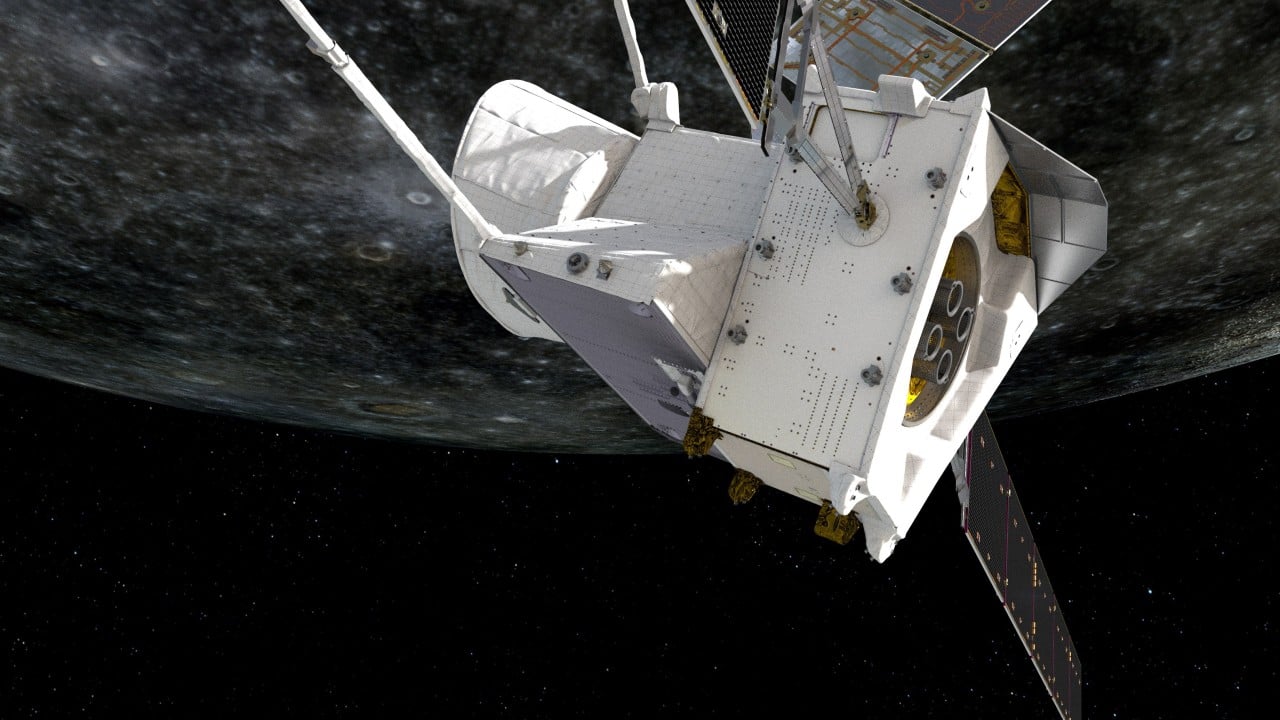
Getting a spacecraft to orbit Mercury is basically an exercise in cosmic parking in a hurricane. You’re flying toward the sun, which means gravity wants to slingshot you past the target at terrifying speeds. You have to brake constantly, loop around planets, and burn through billions of miles of space just to match paces with a scorching, tiny world.
Right now, the joint European and Japanese BepiColombo mission is finally entering its home stretch after nearly a decade of traveling through the inner solar system. Controllers at the European Space Agency watched anxiously as the heavy transfer module separated from the twin science orbiters, marking a brilliant turning point for one of the most punishing engineering challenges humanity has ever attempted.
If you think exploring Mars is tough, Mercury laughs at those operational parameters.
The Brutal Physics of Reaching Mercury
Most space fans track Mars missions because they are straightforward. Mercury is an entirely different beast. Because it sits right next to the sun, any spacecraft approaching it picks up massive amounts of acceleration. To get caught by the planet's weak gravity well instead of flying straight past, BepiColombo has spent eight long years using nine planetary flybys—looping past Earth, Venus, and Mercury itself—to bleed off speed.
Think about the thermal environment for a second. The spacecraft experiences temperatures topping 800 degrees Fahrenheit on one side, while its polar craters sit in permanent, freezing shadow. Mission engineers often compare operating hardware there to standing right next to a high-powered pizza oven. Protecting sensitive instruments under those conditions required obsessive thermal shielding and a roundabout trajectory that clocked over six billion miles.
Now, the heavy cruiser module has dropped away. The conjoined science orbiters—Europe's Mercury Planetary Orbiter and Japan's Mercury Magnetospheric Orbiter—are locked in for their final approach, with orbit insertion scheduled for November and full separation slated for December.
Why Mercury Still Puzzles Scientists
We actually know shockingly little about the inner solar system's smallest planet. Before now, only two spacecraft had ever visited it: NASA's Mariner 10 in the 1970s and the MESSENGER mission, which ended its run a decade ago. MESSENGER did incredible work, but it left massive gaps in our understanding. Its eccentric orbit meant the southern hemisphere remained largely shadowed in mystery, and its instruments could only look at certain phenomena from a single vantage point.
BepiColombo changes the playbook by splitting into two distinct observers. One will map the surface and study the dense interior, while the other loops through the magnetosphere to track how solar winds smash into the planet's magnetic field.
Researchers want answers to a few glaring questions:
- Where did such a dense, oversized metallic core come from?
- Are those weird surface depressions, or hollows, actually being eaten away by vaporizing minerals?
- How do permanently shadowed polar craters manage to pack deposits of water ice despite the searing ambient heat?
What Happens Next on the Timeline
The transition phase happening right now sets the stage for actual science operations to kick off next spring. Once the orbiters separate in December and drift into their targeted mapping trajectories, instruments that have stayed tightly packed for nearly ten years will finally open up and start taking data.
If you are following space exploration, pay attention to the data drops expected late next year. We are about to get our very first high-resolution look at Mercury's southern pole and a synchronized dataset of its magnetic anomalies. Keep an eye on official mission updates from space agencies as these orbiters slip past the threshold and finally start mapping the blanks left behind by past generations.