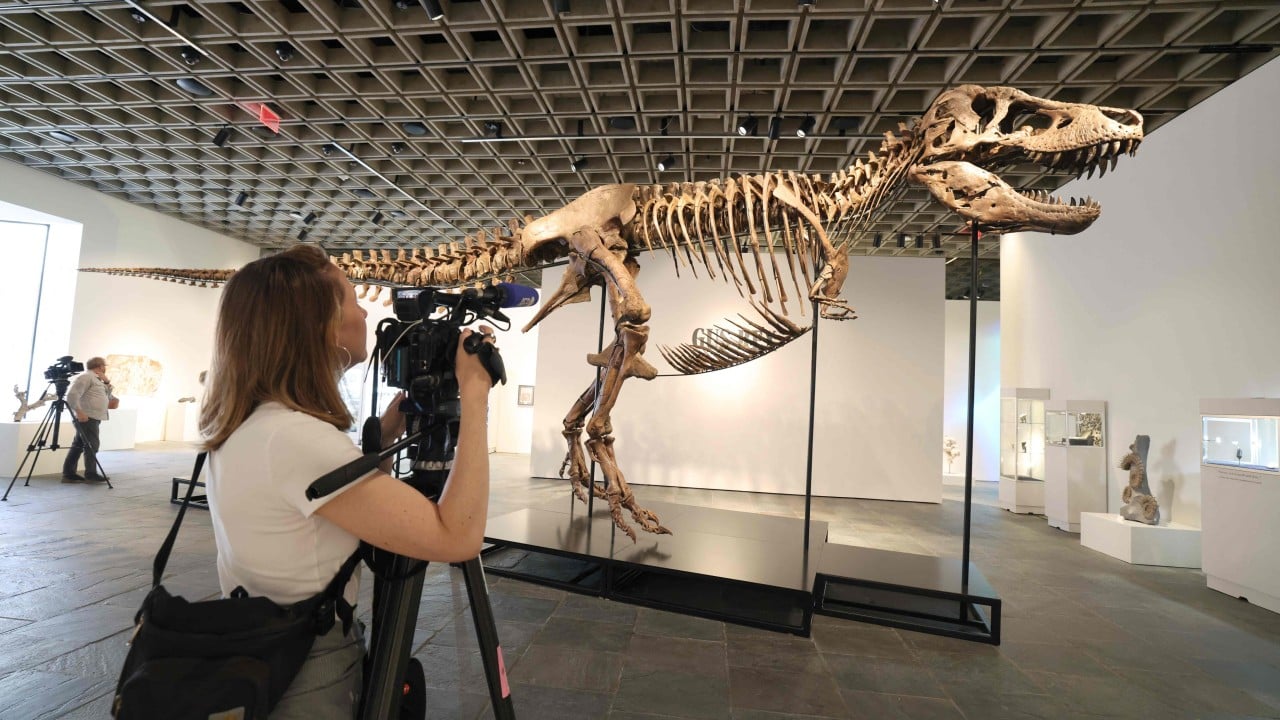
A 10-minute phone call just rewrote the history of paleontology. Under the steady gaze of auctioneer Phyllis Kao at Sotheby’s in New York, a massive, 67-million-year-old Tyrannosaurus rex named "Gus" sold for a mind-boggling $50.1 million.
Let that number sink in. Fifty million dollars.
It completely shattered the previous fossil auction record of $44.6 million, which was set only two years ago in 2024 by a Stegosaurus named Apex. It easily bypassed Gus's own pre-sale estimate of $20 million to $30 million.
To the auction house and the anonymous billionaire buyer, this is a triumphant celebration of rarity and high-end art collecting. To the scientific community, it’s a quiet tragedy.
The Makings of a $50 Million Apex Predator
Gus isn't just another pile of old stones. Digging up a T. rex is hard enough, but finding one this complete is like winning the cosmic lottery.
Discovered in 2021 on a 6,500-acre cattle ranch in Harding County, South Dakota, the fossil lay hidden within the famous Hell Creek Formation. Ranch owner Gary "Gus" Licking had spent years picking up teeth and small bone shards on his property before bringing in Theropoda Expeditions, a commercial excavation outfit, to find what lay beneath. Sadly, Licking passed away in 2022 before the massive scale of the find was fully realized, and the skeleton was named in his honor.
It took three grueling field seasons of digging and years of meticulous laboratory prep to clean, document, and mount the beast.
- The Length: Roughly 38 feet of prehistoric fury.
- The Height: Standing a proud 12.5 feet tall.
- Completeness: Clocking in at 61% complete by bone count, and up to 80% complete by total bone mass.
- The Skull: An exceptionally preserved 54-inch skull showcasing six distinct dentitions and terrifying, dagger-like teeth.
Gus even boasts incredibly rare fossilized elements, like the furcula (the wishbone), a full pelvis, and 30 out of 32 gastralia (the delicate belly ribs that rarely survive fossilization).
But the bones also tell a violent story. If you look closely at Gus’s skull, jaw, and ribs, you can see clear evidence of healed fractures and deep bite marks from ancient battles. It’s a vivid, physical record of Cretaceous life.
Why Billionaires are Treating Fossils Like Picassos
If you have $50 million burning a hole in your pocket, you could buy a superyacht, a private island, or a couple of penthouses. Why buy a dead dinosaur?
Because of the ultimate scarcity.
You can buy a Picasso or a Basquiat if you have the cash; there are hundreds of them circulating the private art market. But there are only so many highly complete T. rex skeletons on Earth, and US law allows landowners to sell whatever they find on their private property.
Because of this, dinosaurs have officially transitioned from scientific specimens to the ultimate billionaire status symbols. They represent a bizarre intersection of extreme wealth, natural history, and interior design. Before the auction, Sotheby's even displayed Gus in the lobby of their Breuer building in Manhattan, treating the predatory skeleton like a massive piece of brutalist sculpture.
The Scientific Cost of Private Ownership
When these auctions happen, academic paleontologists lose sleep.
Organizations like the Society of Vertebrate Paleontology have been vocal about their concerns. When a specimen like Gus goes to a private phone bidder, there is no guarantee that scientists will ever be allowed to study it.
In science, peer review is everything. If a fossil is locked away in a private penthouse, other researchers can't verify discoveries or study the bone structure. In the eyes of academia, a fossil that isn't in a public, accredited museum is essentially lost to science. Museums simply cannot compete with private hedge-fund money when bidding wars start.
Sometimes, there's a silver lining. Billionaire Ken Griffin loaned Apex the Stegosaurus to the American Museum of Natural History. Stan the T. rex, which sold for $31.8 million back in 2020, eventually found a home in the upcoming Abu Dhabi Natural History Museum. But these loans are entirely up to the whims of the ultra-wealthy.
What Happens Next?
If you are a private collector, landowner, or just a dinosaur enthusiast, this record-breaking sale changes the landscape.
If you own land in fossil-rich areas like the Hell Creek Formation, your property value just went up in theory. Expect commercial fossil hunters to knock on doors looking for leases.
If you are looking to get involved in supporting public science, consider donating to or volunteering with local museum excavation programs. They need private funding now more than ever to compete with commercial outfits.
As for Gus, we can only watch and wait. The hope is that this anonymous buyer eventually chooses public education over private vanity, allowing a new generation of kids and researchers to stand beneath those massive jaws and wonder at the Cretaceous king. Until then, Gus remains the most expensive, and perhaps the most isolated, dinosaur on the planet.