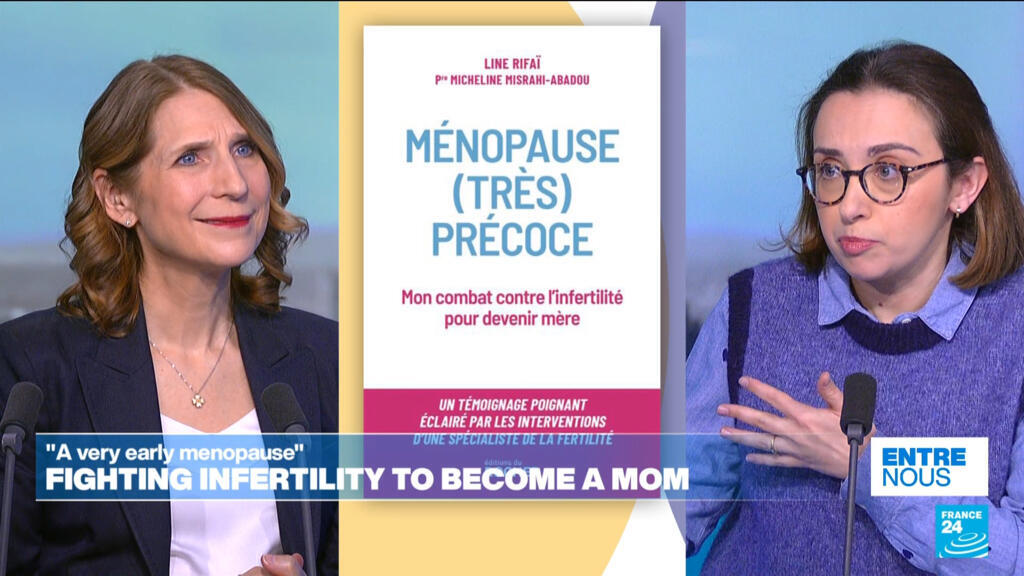
Elena was twenty-eight when she realized her body was keeping a secret from her. It started with a missed period, then another, and then a series of night sweats that soaked through her sheets, leaving her shivering in the dark. She laughed it off at first. Stress, she told her friends. A promotion at the firm. Too much caffeine.
But when the hot flashes began to feel like a physical assault—an internal wildfire that climbed her neck and scorched her cheeks during client meetings—she went to see a specialist. She expected a vitamin prescription or a lecture on work-life balance. Instead, the doctor sat across from her with a look of practiced, heavy-hearted neutrality and used a phrase that sounded like a glitch in the matrix: Premature Ovarian Insufficiency.
Elena wasn’t just late for her period. She was witnessing the sunset of her reproductive life before she had even decided if she wanted a family.
The Arithmetic of Grief
Most women grow up with the vague understanding that fertility is a sliding scale. We are told about the "cliff" at thirty-five, a looming deadline that dictates our dating lives and career trajectories. But for about one percent of women, that cliff isn't a future concern. It is a present reality occurring before the age of forty. For some, like Elena, it happens in their twenties.
Biologically, we are born with every egg we will ever have. It is a finite inheritance. Normally, this treasury is spent slowly over decades. In cases of "very early menopause," the vault is emptied prematurely. This isn't just a "struggle to get pregnant." It is an abrupt, systemic recalibration of what it means to be a young woman.
When the ovaries stop functioning, the body loses more than just the ability to conceive. It loses its primary source of estrogen. Think of estrogen as the oil in a complex engine. Without it, the gears begin to grind. Bone density thins. Cardiovascular risks climb. The brain fog rolls in, thick and suffocating, making simple tasks feel like wading through grey sludge.
The Ghost in the Ultrasound
In the clinical world, they call it POI. In the lived world, it feels like a haunting.
Elena’s journey into the world of infertility was defined by the "ghosts" on the ultrasound screen. To understand the science, you have to look at the Antral Follicle Count. In a typical twenty-something, the screen should show a cluster of dark circles—follicles ready to sprout. On Elena’s screen, there was nothing but static and shadows. Her ovaries had shrunk, becoming quiet and scarred.
"Is there a way to jumpstart them?" she asked.
The doctor shook her head. Unlike the natural menopause that occurs in one’s fifties, POI is often unpredictable. Occasionally, the ovaries might flicker back to life for a month, releasing a rogue egg in a final, desperate gasp. This "intermittent function" creates a cruel form of hope. It keeps women tethered to ovulation kits and pregnancy tests, even when the odds are less than five percent.
The medical community often struggles to explain why this happens. Sometimes it’s genetic—a fragile X chromosome or a family history of early "changes." Sometimes it’s an autoimmune strike, where the body’s defense system mistakes its own eggs for invaders. Often, the answer is simply "idiopathic." A fancy way of saying: we don't know.
The Invisible Stakes of the Waiting Room
There is a specific kind of silence in a fertility clinic. It is heavy, communal, and desperately fragile. Elena sat there among women ten or fifteen years her senior. They looked at her with a mix of pity and confusion, assuming she was a surrogate or perhaps someone freezing her eggs for a high-powered career.
She felt like an impostor in her own youth.
This is the hidden cost of early infertility: the theft of time. When a woman in her forties faces the end of her fertility, she is grieving a closing door. When a woman in her twenties faces it, she is grieving a door that was never fully opened. She is forced to make decisions about egg donation, adoption, or a childless life before she has even found a partner to share that life with.
The psychological toll is a quiet, eroding force. Research suggests that women with POI experience levels of distress, anxiety, and depression comparable to those diagnosed with cancer. Yet, because the condition isn't life-threatening in the immediate sense, it is often dismissed as a "hormonal issue."
The Chemistry of Restoration
Treatment is a double-edged sword. To protect Elena’s heart and bones, she was placed on Hormone Replacement Therapy (HRT).
For many, the word HRT carries the baggage of the early 2000s—fear of breast cancer and strokes. But for a woman whose ovaries have retired early, HRT isn't a luxury; it’s a vital restoration. It replaces what should have been there naturally.
The first time Elena applied the estrogen patch, she felt a strange sense of mourning. She was twenty-eight and using a treatment associated with her grandmother. But within a week, the "fire" in her neck receded. The brain fog lifted. She could think again. She could breathe.
However, the patch couldn't solve the quietness of her ovaries. It could fix the engine, but it couldn't provide the spark.
For those seeking motherhood, the path becomes a series of high-stakes gambles. In vitro fertilization (IVF) rarely works for POI because you cannot stimulate eggs that aren't there. This leaves many women standing at the crossroads of egg donation. It is a beautiful, complex, and sometimes heartbreaking solution. It requires a woman to untether the concept of "mother" from "genetic contributor."
The Redefinition of Self
Elena eventually stopped checking the apps. She stopped peeing on the plastic sticks that promised her a future they couldn't deliver.
She began to realize that her worth wasn't tied to her follicular count. This is perhaps the hardest part of the narrative to rewrite. We live in a culture that equates a woman’s "prime" with her reproductive capacity. When that capacity is stripped away, the identity crisis is profound.
The struggle isn't just about the absence of a child. It’s about the presence of a new, unexpected self. It’s about learning to live in a body that has fast-forwarded through a major biological chapter.
Consider the metaphor of a book. Most people get to read the chapters in order: childhood, adolescence, young adulthood, middle age, and then the quiet resolution. POI is like having a hundred pages ripped out of the middle. You are forced to jump from the rising action straight to the denouement, left to make sense of a plot that no longer follows the rules.
The New Landscape of Hope
We are getting better at spotting the signs. Doctors are beginning to listen when young women complain of "random" night sweats or irregular cycles. The conversation is shifting away from "you’re too young for that" to "let’s check your AMH levels."
Anti-Müllerian Hormone (AMH) testing has become a vital tool. It acts as a fuel gauge for the ovaries. While it can’t predict exactly when the tank will hit empty, it can warn a woman if her levels are lower than they should be for her age. It offers the one thing Elena didn't have: a head start.
With that head start, women can choose to freeze eggs while they still have them. They can plan. They can grieve on their own terms rather than being blindsided in a cold exam room.
The narrative of early menopause is often written as a tragedy. And in many ways, it is. There is no sense in sugarcoating the loss of choice. But there is also a story of resilience here. It is the story of women like Elena who learn to navigate a world that wasn't built for their timeline.
They find community in the shadows. They build families through the grace of donors, the miracle of adoption, or the radical choice to find fulfillment in other ways. They prove that while the biological clock might be broken, the person standing in front of it is not.
Elena still wears the patch. She still feels the occasional pang when a friend announces a pregnancy on social media. But she also feels a strange, hard-won clarity. She no longer takes her health for granted. She no longer waits for "the right time" to travel, to love, or to speak her mind.
She knows, better than anyone, that time is an illusion, and the only season that truly matters is the one you are currently breathing in.
The fire inside her is no longer a hot flash. It is a steady, quiet light.


