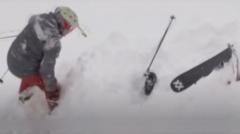
Survival in a deep snow immersion incident—frequently mischaracterized as a simple "rescue"—is governed by a rigid decay function of oxygen availability and mechanical chest compression. When a skier is buried, the transition from an athletic activity to a life-threatening medical emergency occurs in less than sixty seconds. The primary threat is not the cold, but the immediate consolidation of snow crystals into a semi-solid mass that inhibits the expansion of the thoracic cavity. This analysis deconstructs the physiological stressors of burial, the physics of snow compaction during a fall, and the tactical requirements for successful extraction.
The Mechanics of Snow Consolidation
The moment a skier comes to rest beneath the surface, the kinetic energy of the fall is transferred to the surrounding snowpack. This energy, combined with the heat from the victim’s body and the friction of movement, causes a phase change in the snow crystals.
- Sintering: Individual snow grains rapidly bond together, turning a fluid-like powder into a concrete-like casing.
- The Vice Effect: Because snow is compressible, the weight of even two feet of "light" powder exerts significant PSI (pounds per square inch) against the victim's back and chest.
- Air Pocket Volume: The survival timeline is dictated by the initial volume of the air pocket. If the skier cannot create space in front of their face before the snow sets, they face immediate "ice masking," where exhaled breath melts the surrounding snow, which then refreezes into an impermeable ice layer, cutting off all gas exchange.
The Three Pillars of Survival Probability
The success of a rescue is not a matter of luck; it is a calculation of three intersecting variables. If any one of these variables reaches zero, the others become irrelevant.
1. The Respiratory Path
The body’s CO2 clearance is the first system to fail. In a burial, the victim is breathing into a finite space. The concentration of $CO_2$ rises as $O_2$ levels plummet. This creates a state of hypercapnia, which triggers a panic-induced increase in heart rate and respiratory demand, further accelerating the depletion of the limited oxygen supply. A victim without a clear airway or air pocket typically faces brain death within 15 to 35 minutes.
2. The Extraction Velocity
The physics of moving snow is the greatest bottleneck in the rescue process. Wet snow can weigh up to 30 pounds per cubic foot. To reach a skier buried just three feet deep, a rescuer may need to move over a ton of snow. Traditional shoveling methods are inefficient; "strategic shoveling"—utilizing a V-shaped conveyor belt of multiple rescuers—is the only method that maintains the necessary cubic-feet-per-minute (CFM) displacement required to beat the 15-minute asphyxiation threshold.
3. The Signal Integrity
Search time is the only variable the rescue team can control. If the victim is not wearing a transceiver, or if the rescuers are not proficient in "fine search" patterns, the search phase will inevitably exceed the survival window. The transition from the "signal acquisition" phase to the "probing" phase must be seamless. A single error in grid navigation can add 120 seconds to the search—a 10% reduction in the victim’s total survival probability.
The Physiology of the "Tree Well" Trap
While avalanches involve moving snow, "Snow Immersion Suffocation" (SIS) often occurs in stationary snow around the base of trees. This creates a specific mechanical trap known as the "inverse funnel."
- The Void Space: Branches near the ground prevent snow from packing tightly around the trunk, creating a hidden pocket of air and loose needles.
- The Gravity Feed: When a skier falls headfirst into this void, their struggle causes more snow from the surrounding branches to slough off, filling the hole and packing in around them.
- The Positional Obstruction: Because the victim is often inverted, the weight of their own legs and skis further compresses their torso into the narrowest part of the tree well. Gravity works against the diaphragm, making it physically impossible to inhale deeply enough to create a pressure differential.
Tactical Response and the "Reaching" Fallacy
A common misconception in recreational skiing is that a victim can "dig themselves out." This ignores the physics of snow density. Once the snow has settled, the victim is effectively encased in a mold. Movement is restricted to small tremors of the extremities.
The rescue must be approached as a high-stakes engineering problem rather than a frantic scramble. The first responder’s primary objective is not to find the person, but to establish an airway. Every second spent digging toward the feet or skis is wasted. The "strike" of the probe must be followed by a dig path that targets the head and chest directly, using an offset approach to prevent the rescuer's own weight from collapsing the victim's air pocket.
Strategic Imperatives for High-Risk Terrain
To mitigate the risk of fatality in deep snow environments, the following operational frameworks must be implemented:
- Visual Contact Maintenance: The "Buddy System" fails if it is not a "Line-of-Sight System." In deep powder, a skier can disappear in seconds. The trailing skier must maintain a visual fix on the leader’s entry and exit points in every high-risk zone.
- Equipment Redundancy: Transceivers are the baseline, but RECCO reflectors and avalanche airbags serve as critical failsafes. The airbag’s primary function in a burial is "inverse segregation"—large objects tend to rise to the top of a moving granular flow—and creating a larger physical volume of air if buried.
- Proactive Airway Protection: If a fall becomes inevitable and the skier realizes they are going under, they must cross their arms in front of their face. This creates the "breathing room" necessary to survive the first 10 minutes of burial while the search phase begins.
The margin for error in deep snow rescue is non-existent. The data suggests that if a victim is not reached within the first 18 minutes, the survival rate drops from 90% to less than 35%. Efficiency in extraction is not merely a skill; it is the fundamental determinant of life.
The strategic play for any backcountry or deep-powder skier is the mandatory adoption of a "Zero-Search-Time" protocol. This involves skiing in staggered intervals where the "observer" is stationary and ready to deploy before the "active skier" even enters the fall line. If the search phase can be reduced to zero by immediate visual marking of the burial site, the problem shifts entirely from a search-and-rescue operation to a pure mechanical excavation, doubling the statistical likelihood of a successful outcome.