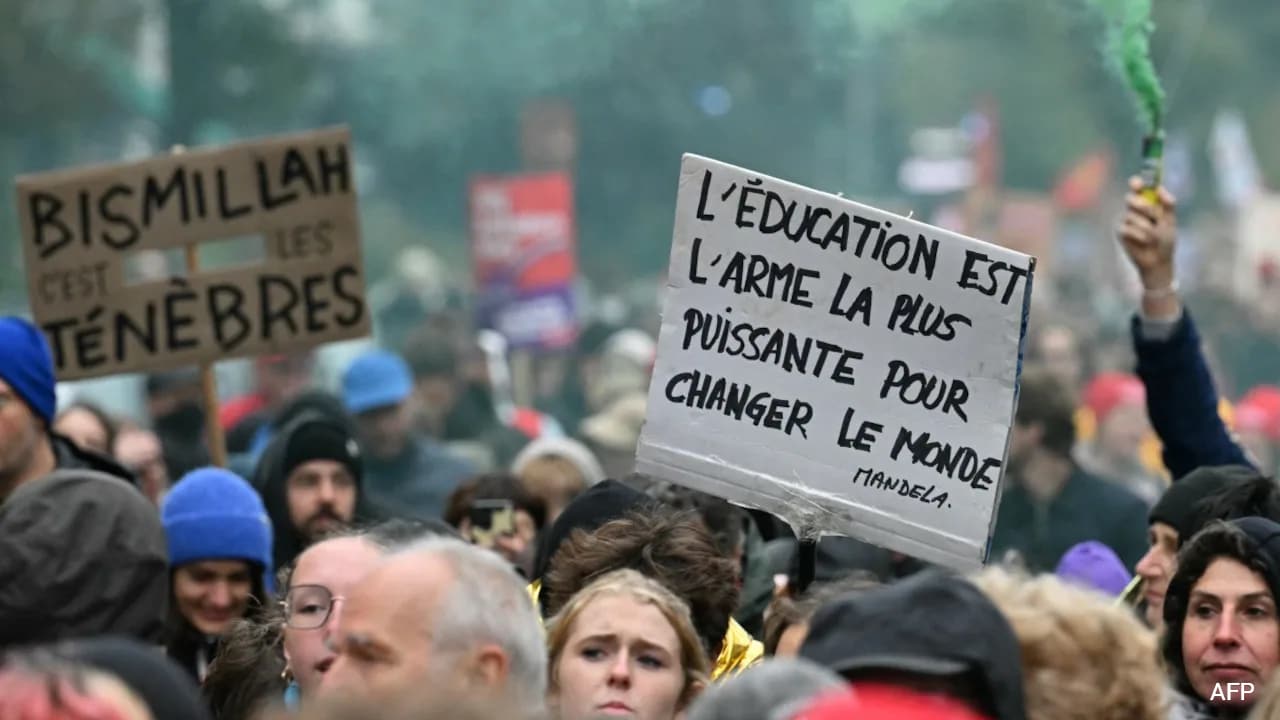
"Bismillah, c'est les ténèbres" sounds like a glitch in a translation app. Put it on a cardboard sign in Paris, though, and suddenly you have the sharpest punchline of France's autumn protests.
Honestly, when I first saw the phrase popping up across feeds in October 2026, I assumed it was just another bizarre TikTok mashup. Turns out it's much sharper—and a lot more uncomfortable for French authorities. High school students and demonstrators turned a clumsy, likely fake-teenager chat message into a rallying cry that mocks alleged police infiltration, calls out lazy stereotyping, and exposes real anger over schools and living costs.
What the Phrase Actually Means in French and Arabic
Taken word for word, the slogan barely makes sense. Bismillah is an Arabic phrase meaning "in the name of God," used by Muslims before starting an action or task. In everyday French youth slang, people often toss it out casually like "let's go".
Then comes the second half. C'est les ténèbres translates literally to "it is the darkness" or "it's the forces of darkness," which young speakers sometimes use loosely to mean a bleak or chaotic situation. Stitch them together and you get "In the name of God, it's darkness"—a clunky mashup that sounds like someone trying way too hard to sound edgy and streetwise.
That awkwardness is the whole point. Students didn't adopt the line because it's poetic. They grabbed it because it reads like a caricature of how an outsider imagines teenagers talk.
How a Clumsy Snapchat Message Became a Street Slogan
The story starts on Snapchat in early October 2026. High schoolers organizing school blockades and protests began sharing screenshots of messages from accounts they suspected belonged to undercover officers or informants trying to slip into private group chats.
One widely circulated message, tied to an account using the name "Mamadou," read something like "Salut ! Bismillah c'est les ténèbres," followed by slangy questions about when the blockade was happening, talk of wrecking things, and a pair of Algerian flag emojis. Other screenshots allegedly showed similar accounts asking where blockades would happen or who had fireworks and flares.
French media outlets including franceinfo, Euronews, and The New York Times covered how quickly those screenshots snowballed. Students spotted what looked like forced slang, mismatched cultural cues, and heavy-handed tropes. Instead of panicking about spies in their chats, they turned the supposed infiltrators into a joke.
Still, let's be clear about what's proven and what isn't. Neither the French police nor the Interior Ministry confirmed that those Snapchat accounts belonged to officers, and independent verification hasn't settled the origin of every screenshot. Some screenshots online could easily be pranks, trolls, or parodies piled onto an already viral meme. In fast-moving protest culture, rumors travel faster than forensics.
Why Bismillah C'est Les Tenebres Hits a Nerve Beyond Memes
Memes usually burn out in a week. This one stuck because it tapped into deeper tensions that were already boiling over in France.
The student mobilization started around September 18 in Créteil, southeast of Paris, over grinding schedules, overcrowded rooms, run-down buildings, and teacher shortages—problems many students and families say hit working-class suburbs and minority youth hardest. Around 400 schools saw closures on October 2 alone, and the student anger merged with broader nationwide cost-of-living protests around October 17, which saw major clashes, property damage, and heavy policing.
For many demonstrators, the phrase became shorthand for racial profiling and stereotyping. Critics pointed out that pairing Arabic expressions, North African references, and talk of "wrecking everything" played into a lazy assumption that Muslim or North African youth are automatically the violent troublemakers at a protest. As semiologist François Jost noted in media coverage of the movement, young people use their own phones, codes, and humor to carve out a human perspective that mainstream framing often misses.
Political groups jumped on it too. The New Anticapitalist Party adapted the slogan on social media alongside reminders not to talk to police without a lawyer. Even satire got tangled up in the wave: on October 9, L'Humanité posted a comedy clip playing on the undercover-cop trope, and far-right MEP Matthieu Valet—a former police officer—criticized it as fake news without catching the joke, earning plenty of online mockery before deleting his post.
It hasn't stayed strictly inside France either. Reporting from outlets like Al Jazeera and French press noted echoes or spin-offs during student and cost-of-living protests in places like Italy, Belgium, Germany, and Canada.
Where Misunderstandings and Pushback Happen
If you look closely at how the slogan spread, you'll notice two distinct kinds of pushback—and both matter if you're trying to understand the moment honestly.
First, there's skepticism from people who say we shouldn't treat unverified social media screenshots as hard proof of state surveillance. That's fair. Online hoaxes happen constantly during big protests, and claiming every weird account is a cop without evidence weakens real accountability arguments. At the same time, watchdog scrutiny and investigations into policing tactics during the fall unrest kept suspicion high among protesters.
Second, not every demonstrator loved seeing the phrase on signs. Some Muslim protesters and online users pushed back against slogans mixing Bismillah with chaotic or violent imagery, viewing it as disrespectful or blasphemous—leading to arguments and even efforts to tear down certain signs. Meanwhile, other protesters playfully twisted the wording into riffs like "Bismillah c'est les Lumières" or local expressions to keep the satire rolling.
That push-and-pull shows why a single catchphrase rarely has one clean meaning in the middle of a messy movement. One person sees anti-surveillance satire. Another sees anti-racist pushback. Someone else sees a joke that crosses a religious line.
How to Read Protest Slogans Without Getting Fooled
Viral protest lines are great entry points into a story, terrible places to stop researching. When a phrase like this takes off on TikTok, Snapchat, or X, a few habits help you separate real context from noise.
- Check the origin story first. Trace whether a slogan came from a real quote, a botched message, or a satirical post before repeating claims about who wrote it.
- Separate the meme from the grievance. A funny sign doesn't explain why schools are understaffed or why rent and groceries squeeze households—always look at the underlying policy demands.
- Watch for multiple counter-readings. Pay attention to who is laughing along, who is offended, and who is using the line for their own political point.
- Cross-check with grounded reporting. Compare social media clips against established outlets and civil-liberties reporting so you don't mistake a parody account for official policy.
Next time a weird slogan takes over your feed during a major demonstration, pause before sharing it as gospel and look up who coined it, who hijacked it, and what real problem made people march in the first place.
France Protests: What Does 'Bismillah, C'est Les Ténèbres' Mean
This video offers a quick visual breakdown of how the viral phrase emerged during France's fall protests and why it resonated with demonstrators.