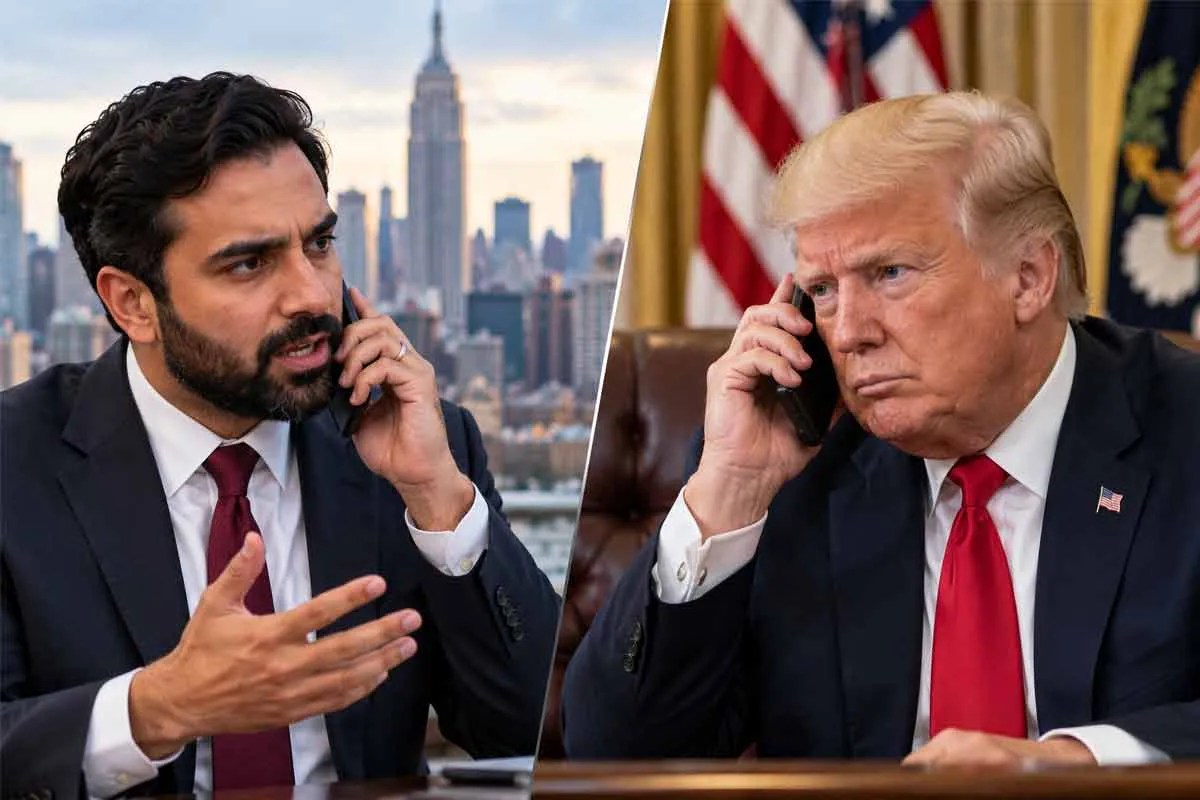
The headlines rolled in with predictable, exhausting fury. An Immigration and Customs Enforcement operation goes sideways in New York City, a civilian takes a bullet, a five-year-old child sits terrified in the back seat, and the local mayor immediately reaches for the phone to call the White House. The public narrative instantly hardens into a familiar, lazy binary. Protesters scream about federal overreach, municipal politicians posture for the cameras demanding accountability, and defenders of the agency point the finger at sanctuary city policies for creating a lawless vacuum.
Everyone is arguing about the symptom while ignoring the chronic, metastasizing disease.
Focusing solely on the political theater between City Hall and Washington misses why these urban confrontations are designed to fail from the ground up. I have watched municipal enforcement architectures and federal operational directives collide for years. The system is not malfunctioning; it is functioning exactly as a fragmented, contradictory bureaucratic machine is built to operate. When armed federal agents execute high-stakes tactical stops in dense metropolitan corridors without synchronized local intelligence sharing, chaos is not a risk factor. It is a mathematical certainty.
The Myth of Local Control in Federal Enforcement
The prevailing consensus suggests that if local police departments and federal immigration authorities simply coordinated better, or if mayors exercised stricter oversight, these violent flashpoints would vanish. This is a comforting illusion pedanted by commentators who have never spent an hour inside an operational command center.
ICE does not answer to the NYPD, and the NYPD does not command federal tactical units. When federal task forces drop into a sanctuary jurisdiction, they operate on federal mandates, federal risk assessments, and federal rules of engagement that treat municipal borders as administrative annoyances rather than complex, densely populated communities.
Blaming the mayor for a shooting during an ICE raid is like blaming the weather forecaster for a hurricane. Local executives possess zero operational veto over federal field operations. They can issue strongly worded press releases, hold emergency town halls, and dial executive extensions until their fingers cramp, but federal immigration enforcement answers up a completely separate chain of command that bypasses local police commissioners entirely.
When you fragment the monopoly on urban violence into competing jurisdictions with conflicting political incentives, tragedies are inevitable. Federal agents operate with a siege mentality in cities that have explicitly signaled non-cooperation. That siege mentality breeds hyper-vigilance, and hyper-vigilance turns routine traffic stops into war zones where children in car seats become collateral damage in a macro-political war.
The Sanctuary City Paradox
Let us address the elephant in the room that both sides of the aisle refuse to touch with a ten-foot pole. The progressive sanctuary model was designed to foster trust between local immigrant communities and municipal police. The logic: if a witness or victim of a crime fears that calling 911 will lead to deportation, public safety collapses for everyone.
Fair enough. But municipal sanctuary laws created an operational void. By cutting off local jails from federal detainer requests, cities forced ICE out of controlled, secure institutional environments—like booking stations and county lockups—and pushed them directly onto the open streets.
Think about the operational reality. In a cooperative environment, federal agents pick up individuals inside a secure facility where doors lock and metal detectors screen visitors. In a non-cooperative jurisdiction, agents are forced to hunt targets on crowded avenues, outside schools, and at traffic lights. They must conduct dynamic vehicle stops in heavy traffic, surrounded by civilian bystanders who have no idea who is drawing a weapon.
The sanctuary policy did not eliminate immigration enforcement; it relocated it from the controlled environment of a jail cell to the chaotic asphalt of a crowded New York street. Every time a politician praises sanctuary protections while simultaneously condemning street-level enforcement tactics, they are engaging in willful intellectual dishonesty. You cannot ban ICE from institutional settings and then act shocked when they operate on the asphalt.
The Tactical Breakdown Inside the Vehicle
When a tactical stop goes wrong, the post-mortem always fixates on split-second human decisions. Did the agent panic? Did the driver accelerate? Did someone reach for a waistband?
These questions are distractions. Look at the equipment, the training pipelines, and the operational tempo. Federal immigration officers undergo a fraction of the rigorous, continuous de-escalation and urban patrol training required of major city tactical units, yet they are routinely deployed into environments far more hostile than anything most suburban patrol officers will ever see.
When you place under-resourced, politically radioactive federal units into a hostile urban theater, every civilian movement looks like a lethal threat. The presence of a five-year-old child in the vehicle should have fundamentally altered the tactical risk matrix of the operation. Standard law enforcement doctrine dictates that high-risk dynamic vehicle interventions are aborted or heavily modified when vulnerable minors are identified.
The fact that the operation proceeded to the point of discharging firearms with a child in the car exposes a catastrophic failure of basic operational field judgment. Yet, the agency's internal accountability mechanisms are notoriously opaque, insulated from local civilian complaint boards or municipal oversight.
What Accountability Actually Looks Like
If we want to stop reading these same terrifying headlines every few months, we have to stop treating them as isolated moral scandals and start treating them as structural engineering flaws.
First, New York needs an independent, permanent municipal oversight panel with subpoena power over all federal law enforcement operations conducted within city limits. Not to micromanage federal policy, but to enforce basic urban safety protocols. If federal agents operate in our neighborhoods, they must coordinate movement patterns and risk thresholds with local emergency dispatchers to prevent blue-on-blue confusion and protect civilian bystanders.
Second, Congress must untangle the jurisdictional spaghetti. Immigration enforcement should either be entirely professionalized with mandatory urban tactical integration, or federal authorities must return to cooperative institutional transfers rather than street-level ambushes.
Until we dismantle the structural friction between local governance and federal mandate, mayors will keep making useless phone calls, politicians will keep grandstanding on television, and innocent people—including children strapped into car seats—will continue paying the price for a broken system designed for confrontation rather than resolution. Stop arguing about who answers the phone. Fix the architecture that makes the call necessary in the first place.