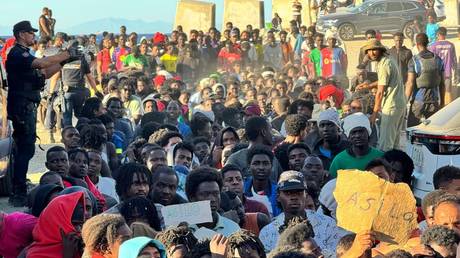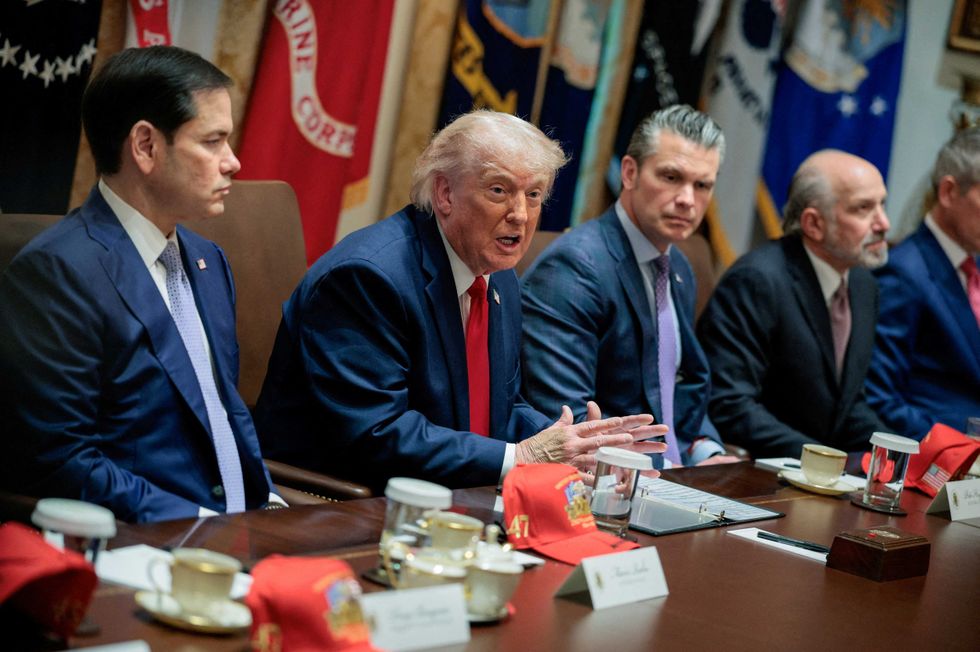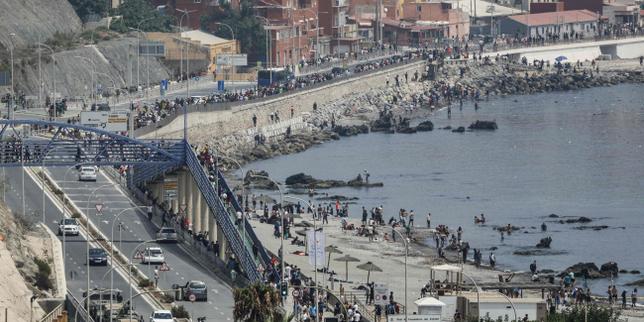
Every single time a crowd surges against a perimeter fence in Ceuta or Melilla, or a political standoff erupts at an internal European border, Brussels rolls out the exact same worn-out script. Interior ministers gather under emergency lights, sip lukewarm coffee, and declare with absolute conviction that the Schengen area is not the problem, but rather the solution.
It is a masterpiece of institutional self-preservation. It is also entirely backwards. For a different perspective, consider: this related article.
Let us be brutally honest about what is happening here. When Laurent Nuñez and his ministerial peers stand behind microphones to defend the sacred cow of a passport-free zone, they are treating a structural design flaw as an ideological virtue. They want us to believe that the friction-free movement of four hundred million people inside a fortified bubble can coexist indefinitely with completely outsourced, brittle external border management.
I have spent years watching bureaucrats manage migration crises from air-conditioned crisis rooms in Brussels and Paris, and the disconnect between theory and street-level reality makes my teeth ache. They treat border integrity as an administrative headache rather than a fundamental exercise of state sovereignty. When pressure spikes at the southern fringe, the reflex is never to fix the operational machinery. The reflex is to double down on political branding. Related coverage on this matter has been shared by The Guardian.
Stop pretending Schengen is working just because traffic flows smoothly between Berlin and Vienna. A security architecture is only as strong as its weakest point of contact with the outside world. And right now, that perimeter is held together by diplomatic duct tape and financial payouts to transit states that change their minds whenever it suits their domestic leverage.
The Mirage of Seamless External Control
The core fallacy underpinning the official narrative is that internal mobility and external security are independent variables. They are not. They are bound by a rigid zero-sum equation.
When you eliminate internal checks across twenty-nine countries, you radically increase the pressure on the absolute perimeter. Every single point of entry becomes a national security concern for every other member state, whether they admit it out loud or not. Yet, responsibility for securing those external gates falls disproportionately on frontline nations like Spain, Italy, and Greece.
Brussels loves to talk about solidarity. They love fancy acronyms for border agencies and billions of euros allocated to technological surveillance grids. But technology does not stop desperation, and Frontex cannot deploy sovereign police powers where local political friction prevents it.
Imagine a scenario where a major corporate supply chain relies on a single, un-reinforced bridge across a raging river. When the bridge starts to crack under heavy loads, the corporate executives do not gather in the boardroom to praise the concept of open trade. They reinforce the foundations or they redesign the logistics. They certainly do not look at the cracking concrete and declare that the bridge is the solution to the flood.
Yet that is precisely what European interior ministers do every time Ceuta makes the evening news. They confuse the ideal with the execution. Schengen as a philosophical concept is brilliant. Schengen as an operational reality is a house built on sand, sustained entirely by the hope that external buffer states will continuously absorb shocks they never voted to invite.
Dismantling the Transit State Ransom Economy
Look closely at how border management actually functions around the Mediterranean basin. Europe has systematically subcontracted its dirty work. We pay third-party capitals to act as human wave-breakers, establishing a bizarre geopolitical protection racket where funding is tied to interception rates.
This is not border policy. This is outsourcing desperation to regimes with entirely different strategic incentives. The moment diplomatic relations sour or local political calculations shift, the tap is opened. Suddenly, thousands of individuals arrive at the border fences of Ceuta, not because Schengen is strong, but because the external firewall is entirely dependent on foreign political whim.
To call Schengen "the solution" in this context is an insult to anyone who understands basic systems engineering. A solution implies closure. It implies a sustainable equilibrium. What we have instead is a recurring cycle of panic, emergency funding, ministerial communiques, and quiet amnesia until the next surge.
I have seen companies blow millions on software architectures that looked pristine on a PowerPoint deck but collapsed under baseline user load because the architects refused to test the edge cases. European migration policy is the ultimate PowerPoint architecture. It looks magnificent in a treaty preamble. In the dusty hills outside Moroccan border posts, it is a catastrophic failure of imagination.
The Uncomfortable Truth About Sovereignty
The political class avoids the real solution because it requires admitting a hard truth. You cannot have complete internal disappearance of borders without a centralized, ruthless, and unified enforcement mechanism at the perimeter. And Europe, for all its federalist ambitions, remains a collection of sovereign states with divergent national interests, competing foreign policies, and zero appetite for truly pooled border enforcement.
When Spain deals with a breach in Ceuta, it is dealing with bilateral relations with Rabat, domestic political fallout in Madrid, and EU-level bureaucratic oversight all at once. France reinstates internal controls at its southern border whenever it suits Paris, exposing the fragile fiction that internal free movement is absolute.
We need to stop accepting the lazy consensus that anyone who questions the current configuration of Schengen is somehow an enemy of European integration. That is a strawman designed to shut down debate.
The fix is not to abandon the freedom to travel. The fix is to stop pretending that open internal borders can survive without a complete overhaul of how external entry is regulated, funded, and enforced. That means moving past the polite fiction of shared responsibility where everyone volunteers for the credit and none of the burden.
Until Brussels stops treating border security as a public relations exercise and starts treating it as a hard engineering problem, every summit will end the same way. The ministers will pose for cameras, praise their own wisdom, and leave the fence vulnerable to the next predictable tide.
Build a real wall of accountability, or stop pretending the door is locked.