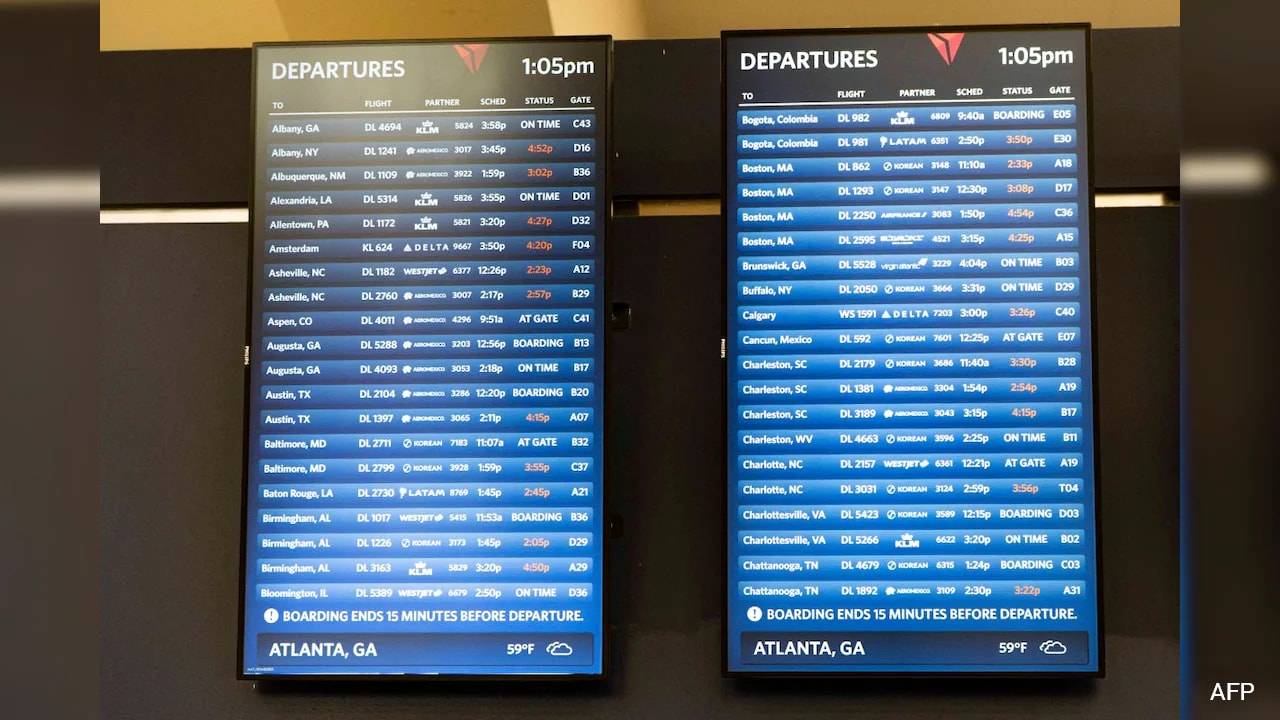
Every time an airline melts down, the press releases read like a sci-fi thriller gone wrong. A rogue server. A botched patch. An automated system failing in the middle of the night, stranding thousands of exhausted passengers on concourse floors from Atlanta to Seattle.
Over 1,000 Delta Air Lines flights delayed across the United States after an automated system fails. That is the headline. That is the clean, sanitized story executives love to feed reporters because it makes a catastrophic operational failure sound like a freak weather event. Meanwhile, you can read related stories here: Inside the Hong Kong Stock Collapse Nobody Saw Coming.
Do not buy it.
Software did not strand those passengers. A deliberate, decades-long business strategy of running complex physical networks with zero operational slack did. When a single database hiccup or automated scheduling glitch can cascade into a four-digit delay count in under six hours, you do not have an IT problem. You have a brittleness problem. To explore the complete picture, check out the excellent analysis by CNBC.
The Lie of the Isolated System Failure
Mainstream coverage of airline disruptions treats aviation technology like a light switch. Either the switch works, or a fuse blows and the room goes dark. Reporters dutifully repeat terms like "automated system failure" or "technical outage" as if an invisible gremlin walked into a data center in Georgia and pulled a plug.
I have spent years watching enterprise operations teams burn tens of millions of dollars on disaster recovery plans that look pristine in boardroom slide decks and shatter the second they hit real-world friction. In commercial aviation, there is no such thing as an isolated technical failure.
When Delta—long lauded as the operational gold standard of the U.S. legacy carriers—suffers a mass delay event tied to an automated system, the failure happens in two distinct phases. First, the primary software trips. Maybe a message queue backs up, maybe a weight-and-balance calculation engine hangs, or maybe a crew-tracking database loses sync. Second, and far more damning, the human and infrastructural fallback mechanisms fail to absorb the shock.
Why? Because those fallback mechanisms were systematically dismantled in the name of quarterly margin expansion.
Think about what an airline actually is. It is not a tech company with wings. It is a hyper-coupled logistical web where federally mandated crew rest rules, FAA maintenance windows, gate availability, and meteorological shifts interact every second. When you automate the dispatch, crew-pairing, and load-planning layers of that web, you gain blistering efficiency on sunny Tuesdays. You pack planes fuller. You turn gates faster. You run crews closer to their legal duty limits.
You also strip away every ounce of buffer that used to keep a minor hiccup from becoming a national travel nightmare.
Tight Coupling and the Illusion of Efficiency
To understand why over 1,000 flights stall out simultaneously, you have to look at Normal Accident Theory, pioneered by Yale sociologist Charles Perrow. Perrow argued that in systems characterized by high interactive complexity and tight coupling, catastrophic cascading failures are not anomalies. They are built into the architecture.
Commercial airlines are the textbook definition of tight coupling:
- Zero Time Slack: An aircraft scheduled for five legs a day has roughly 35 to 45 minutes on the ground between flights. If an automated gate-assignment or flight-plan filing tool freezes for 25 minutes, that aircraft misses its departure window.
- Rigid Sequencing: You cannot fly Leg 3 until Leg 2 lands. You cannot push back from the gate without a signed electronic release. You cannot swap a delayed captain with a reserve pilot if the automated crew-management system cannot verify the reserve pilot's legal rest hours in real time.
- Invariant Resource Allocation: Modern airline hubs operate at near-maximum gate and airspace capacity. When 100 planes sit frozen at the gate because a central dispatch tool went dark, incoming flights have nowhere to park. Tarmacs gridlock. Taxiways clog.
Now compare how an airline operated thirty years ago to how it operates today. Thirty years ago, station managers had paper manifests, local autonomy, and spare aircraft sitting on remote pads for contingencies. If a central mainframe went down, local dispatchers could still calculate weight and balance manually, clear flights via radio, and keep metal moving.
Today, manual fallback is a myth. Modern load-control and flight-dispatch software optimizes fuel burn down to the tenth of a percent based on real-time winds aloft and exact passenger-plus-baggage distributions. The math is too complex and the regulatory compliance checks are too dense for a gate agent with a clipboard and a calculator to replicate at scale. When the automated system drops offline, the entire nervous system of the airline goes into paralysis.
The Technical Debt Nobody Wants to Fund
Why do these automated systems fail in the first place? Industry outsiders assume major carriers run on futuristic, space-age code. Anyone who has actually audited airline infrastructure knows the truth.
Beneath the sleek mobile apps and biometric boarding gates lies a fragile patchwork of legacy mainframes—many running transaction-processing environments designed in the 1970s and 1980s—bolted onto modern cloud middleware via thousands of fragile APIs.
Airline executives love spending capital on customer-facing upgrades. New cabin interiors, faster seatback Wi-Fi, revamped loyalty tiers—these drive immediate brand perception and credit card sign-ups. Spending $400 million to rip out and refactor a core crew-scheduling or flight-operations backend does not win awards in travel magazines. It takes years, carries massive migration risk, and produces zero visible change for the passenger on a good day.
So leadership kicks the can. They wrap old monolithic databases in new automation layers. They add third-party vendor integrations for weather routing, catering, and maintenance tracking. Every new automated dependency increases speed while multiplying the potential points of failure.
Imagine a scenario where a minor certificate expiration or a corrupted data packet in a secondary vendor's feed triggers an infinite retry loop in a core dispatch server. Within twelve minutes, memory buffers overflow. The automated system halts to prevent corrupted flight plans from being issued. Because the airline has eliminated regional operational redundancies to centralize control in a single Operations and Customer Center, every hub in the country loses its brain at the exact same moment.
That is not bad luck. That is deferred maintenance on the invisible infrastructure that holds the business together.
What Passengers Always Ask (And Why the Questions Are Wrong)
Whenever a mass delay event hits the news cycle, search engines flood with the same predictable questions from stranded travelers. Almost every single one of them is framed around the wrong premise.
"Why don't airlines just have a backup system?"
They do. Every Tier-1 carrier runs redundant data centers, failover servers, and disaster recovery protocols. The flaw in the question is assuming a backup system solves logical or software-level failures.
If your primary data center loses power due to a storm, a physical backup server in another state saves you. If a corrupted database state, a bad software update, or an automated logic bug crashes your application layer, your backup server faithfully replicates the exact same crash milliseconds later. Redundancy protects against hardware death. It does nothing against systemic software fragility or bad architecture.
"Is Delta still the most reliable airline after this?"
Reliability in aviation cannot be measured by how an airline performs when everything goes right. On a clear day, every major carrier looks competent. True operational reliability is measured by mean time to recovery when things break.
Delta has spent years cultivating a reputation for operational excellence, backed by impressive on-time arrival metrics and low cancellation rates during normal weeks. Yet this exact operational tightness is a double-edged sword. Because Delta maximizes aircraft utilization and tight hub connections so aggressively, its recovery curve after a systemic shock is often steeper and more painful than that of a carrier with looser scheduling. High efficiency and high resilience pull in opposite directions. You rarely get both at peak levels simultaneously.
"Will automated airline systems eventually eliminate delays?"
No. In fact, deeper automation will make delays rarer on average, yet drastically worse when they happen.
As airlines push toward AI-driven predictive maintenance, automated dynamic pricing, and real-time airspace flow optimization, the system becomes even more finely tuned. You trade frequent, small friction—like a 15-minute delay at a single airport—for rare, massive, system-wide seizures. When you optimize out all the slack, the shock absorbers disappear.
The Cost of the "Zero-Slack" Obsession
Wall Street rewards load factors and cost per available seat mile (CASM). Analysts do not award bonus points to a CFO for keeping five spare widebodies parked idle at hubs or paying extra reserve pilots to sit in airport lounges just in case a server hiccups.
Over the past fifteen years, U.S. airline consolidation turned a chaotic, hyper-competitive market into a disciplined oligopoly. Capacity discipline became gospel. Every seat had to be filled. Every aircraft had to fly maximum block hours. Every ground crew had to be scheduled to the exact minute of projected demand.
This financial engineering worked wonders for balance sheets during boom cycles. It also turned the U.S. aviation network into a glass cannon.
When an automated system fails at Delta—or United, or American, or Southwest—the financial blowback is brutal. Beyond the immediate hit of passenger meal vouchers, hotel rooms, crew overtime pay, and lost ticket revenue, there is the quiet erosion of corporate trust. Business travelers who pay four-figure fares for last-minute domestic flights do not care whether the delay was caused by a thunderstorm or an automated load-planning outage. They care that they missed a client pitch in Chicago.
Yet the incentive structure inside airline C-suites rarely changes after these events. Leadership issues a contrite video statement, blames an unprecedented technical issue, promises a thorough review, and goes right back to squeezing every drop of utilization out of the fleet.
How to Actually Navigate a Fragile Aviation System
If you fly regularly, waiting for airlines to prioritize operational resilience over quarterly margin optimization is a losing bet. You have to build your own shock absorbers into how you book and move through the system.
1. Abandon Tight Connections Through Mega-Hubs
Booking a 42-minute connection in Atlanta, Charlotte, or Dallas-Fort Worth is a gamble against physics and software. When an automated system stalls for even half an hour, short connections are the first casualties. If you have a non-negotiable event—a wedding, a cruise departure, a board meeting—fly nonstop, even if it costs $150 more or requires driving to a secondary airport. If a connection is unavoidable, force a minimum two-hour layover.
2. Fly the First Wave of the Day
Automated system failures and weather disruptions compound chronologically. A glitch at 6:00 AM delays the first departure bank by 45 minutes. By 2:00 PM, that 45-minute ripple has turned into a four-hour backlog as crews time out and inbound aircraft fall out of position. Flights departing before 8:00 AM have the highest statistical probability of operating on time because the aircraft and crew are already sitting at the gate overnight.
3. Bypass the Gate Agent Line Immediately
When 1,000 flights delay simultaneously, airport customer service desks turn into war zones. Standing in a physical line of 200 angry passengers while gate agents wrestle with the exact same sluggish terminal software is a waste of your time. The second a delay hits your phone:
- Open the airline's mobile app and look for self-service rebooking options before inventory vanishes.
- Call the airline's international customer support line (such as the UK, Canadian, or Singapore desk via Wi-Fi calling) where wait times are often fractions of the U.S. domestic queue.
- Check alternative flights on competing carriers immediately if you have status or refundable fare flexibility, before those seats sell out to everyone else on your plane.
4. Know What "Controllable" Actually Means for Compensation
Airlines love categorizing delays ambiguously to limit liability. Under U.S. Department of Transportation rules, weather and Air Traffic Control ground stops are considered outside the airline's control, freeing them from providing hotels or meals. An automated system failure inside the airline's own IT infrastructure is 100% controllable. Document the airline's official statements—screenshot app notifications or news releases attributing the delay to their internal system failure—so gate agents cannot later reclassify your cascading crew-timeout delay as an uncontrollable operational issue.
The Uncomfortable Truth About Modern Travel
There is a massive downside to demanding higher operational resilience from airlines, and travelers hate hearing it: true redundancy is expensive, and you would pay for it.
If airlines maintained 10% spare aircraft capacity, kept large pools of reserve flight crews on standby, and ran parallel manual-capable dispatch systems across every major hub, ticket prices would climb significantly. The cheap basic-economy fares that allow millions of people to fly across the country for less than the cost of a tank of gas exist precisely because airlines run on razor-thin operational margins with almost zero slack.
Consumers want Spirit Airlines prices with private-jet reliability. Airlines deliver that illusion 350 days a year through aggressive automation and hyper-tight scheduling. The other 15 days a year, when a server locks up and 1,000 flights grind to a halt, we get to see the bill come due.
Stop blaming the software when the departure boards turn red. The code did exactly what it was designed to do—push a massive, physical machine to its absolute breaking point until the smallest friction snapped it in half.