Silence.
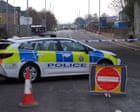
That is what comes after the screech of tires on wet tarmac, after the violent shudder of crumpling steel, and after the sudden, blinding strobe of blue and red lights slicing through the damp Yorkshire night.
We read the headlines over morning coffee, scrolling past them with a thumb that barely slows down. Man charged after two people die in Leeds police pursuit crash. Six words of tragedy, four words of bureaucracy. A standard press release recycled into a three-paragraph wire story. It tells you the what, the where, and the legal aftermath. It tells you nothing about the air leaving the lungs of two families in West Yorkshire, or the split-second calculus that turns an ordinary stretch of asphalt in Leeds into a permanent scar on a community's memory.
Let us look at what actually happens when a routine traffic stop becomes a high-speed chase, and why the charges filed in the aftermath are only the opening chapter of a much darker, more complicated story.
The Anatomy of a Split Second
Consider a hypothetical evening on a familiar arterial road leading out of Leeds city center. Imagine a commuter—let’s call him David—heading home after a late shift, thinking only about reheating dinner and checking his phone before bed. Three hundred yards behind him, a patrol car flicks on its sirens. Ahead of the patrol car, a driver makes a panicked, catastrophic choice: instead of easing onto the shoulder, he buries his right foot into the floorboard.
Physics takes over immediately.
At thirty miles per hour, a family hatchback is a predictable, manageable machine. At eighty or ninety miles per hour on a city street slick with northern drizzle, that same vehicle becomes an unguided missile carrying roughly two tons of kinetic energy. Stopping distances do not double; they quadruple. Reaction times shrink from seconds to milliseconds. Every parked car, every pedestrian stepping off a curb, every driver waiting at a green light—like our hypothetical commuter, David—becomes an unwitting participant in a game of Russian roulette they never agreed to play.
When a fatal collision occurs during a police pursuit, the public reaction is immediate and visceral. People want accountability. They want to know why the driver ran, and they want to know why the police chased.
In the actual Leeds tragedy that prompted the recent criminal charges, the bare bones of the legal reality are stark: two lives were lost, a suspect survived, and prosecutors moved forward with charges—typically encompassing offenses like causing death by dangerous driving, failing to stop, and driving without due care or valid insurance. Under UK law, specifically the Road Traffic Act 1988, causing death by dangerous driving carries a maximum penalty of life imprisonment following sentencing reforms enacted in 2022. The courts treat a vehicle used recklessly not as a mode of transport, but as a lethal weapon.
Yet, standing at the edge of the police cordon the next morning, watching forensic investigators spray-paint yellow markers onto the asphalt, the law feels terribly small. A life sentence cannot wind back the clock by ten seconds.
The Invisible Weight of the Pursuit
I have stood beside enough roadside memorials—bunches of supermarket lilies wrapped in cellophane, soaked by rain, tied to lampposts with zip ties—to know that grief does not follow the tidy timeline of a magistrate's court. When you walk past one of those lampposts weeks later, the flowers are brown and sodden, the ink on the handwritten cards has bled into illegible blue streaks, and the traffic rushes past at forty miles an hour as if nothing ever broke there.
To understand why these crashes keep happening, we have to look past the villainy of a single reckless driver and examine the psychological trap of the pursuit itself.
Think of a police chase like a high-stakes game of chicken played on a crowded tightrope. Law enforcement officers in West Yorkshire and across Britain operate under strict pursuit protocols governed by the College of Policing’s Authorized Professional Practice. Before an officer can even engage in a pursuit, they must be specifically trained and authorized, and they must continuously weigh a brutal equation: Does the immediate risk of letting this suspect escape outweigh the immediate risk of chasing them through populated streets?
It is an impossible tightrope to walk in real time.
If the police back off every time a driver accelerates, word spreads on the street within days that running guarantees freedom. Criminals, intoxicated drivers, and stolen-car rings exploit that restraint, emboldened to drive with total impunity. Conversely, the moment sirens wail and blue lights fill a rearview mirror, adrenaline floods the fleeing driver's bloodstream. Cortisol spikes. Tunnel vision sets in. Psychologists call it perceptual narrowing—the brain literally stops processing peripheral hazards like side streets, red lights, and oncoming headlights because its entire bandwidth is consumed by the flashing lights behind.
The pursuer experiences a milder, trained version of that same adrenaline surge, fighting against human instinct to keep a cool head while navigating intersections at twice the speed limit. One miscalculation by the fleeing driver—a patch of black ice, a blind crest, a misjudged gap—and the energy has nowhere left to go.
What the Headlines Leave Out
When news outlets report that a man has been charged following a fatal crash in Leeds, readers naturally ask a series of urgent, practical questions. Who were the victims? Were they innocent bystanders, or passengers inside the fleeing car? Will the police officers involved face investigation too?
The answers reveal just how tangled the aftermath of a pursuit truly is.
First, whenever a death or serious injury occurs following police contact in England and Wales, the case is automatically referred to the Independent Office for Police Conduct (IOPC). This is not an accusation of wrongdoing; it is a mandatory legal safeguard. Investigators seize dashcam footage, body-worn video, radio transmissions, and GPS telemetry from the patrol vehicles. They measure every second between the activation of the sirens and the moment of impact to determine whether the officers followed pursuit guidelines or whether the chase should have been aborted earlier.
Second, the victims of these crashes often fall into two agonizingly different categories, both of which leave families shattered. Sometimes they are completely unrelated road users—people walking home from a pub, a nurse finishing a night shift, a teenager on a moped—who had zero connection to the crime or the chase. Other times, the victims are passengers inside the fleeing vehicle itself: friends, partners, or young people who got into the wrong car with the wrong person and found themselves trapped in a metal cage hurtling toward disaster, screaming for the driver to slow down while the doors remained locked.
Legally, the driver bears the criminal burden for every life lost in that wreckage, whether the victims were strangers in another car or friends sitting inches away in the passenger seat. Morally and emotionally, the distinction offers zero comfort to the mothers and fathers asked to identify a body at the mortuary.
A Pattern Written in Asphalt
If this Leeds crash felt sickeningly familiar, that is because it sits inside a wider, persistent national pattern. According to annual statistics compiled by the IOPC, dozens of people die every year in England and Wales in road traffic incidents involving police pursuits or emergency responses. Despite stricter pursuit training, tactical vehicle containment strategies, and the deployment of police helicopters to track suspects from the air without ground pressure, the numbers stubbornly refuse to hit zero.
Look at the geography of a city like Leeds. It is a sprawling, post-industrial metropolis where wide dual carriageways abruptly narrow into Victorian terraces, blind bends, and dense residential neighborhoods. A driver can leave a motorway slip road and within ninety seconds be threading through streets lined with parked cars and corner shops. There is no margin for error.
And yet, human nature remains stubbornly resistant to statistics. When someone is driving a stolen car, carrying illicit goods, or terrified of losing their license over a drink-driving offense, their brain does not consult Department for Transport braking tables. They operate on pure, primitive panic. They believe—falsely, catastrophically—that five more seconds of speed will buy them an escape.
I still remember the first time I saw the aftermath of a high-speed urban crash up close, years ago, before the recovery trucks had even arrived. What struck me wasn't the twisted metal, though the engine block had been pushed clean into the footwell. It was a single white sneaker lying fifteen feet away from the passenger door, completely untouched, laces still neatly double-knotted. That small, ordinary detail—someone sitting on the edge of their bed hours earlier, tying their shoes before stepping out the front door—hits harder than any courtroom verdict ever could.
The Long Road Through the Courts
When a suspect is formally charged in connection with a fatal pursuit crash, the public often breathes a sigh of relief, mistaking a charge for closure.
It is anything but.
From the moment charges are read at Leeds Magistrates' Court, the case typically moves upward to the Crown Court, launching a legal process that can stretch across twelve to eighteen months. Defense teams scrutinize toxicology reports, mechanical inspections of the vehicles, road surface friction coefficients, and the exact distance maintained by the pursuing patrol car. Meanwhile, the families of the two people who died are suspended in amber. They cannot fully grieve because they must prepare victim personal statements; they cannot move forward because every hearing forces them to relive the mechanics of how their loved ones died.
Even when a conviction is secured and the judge hands down a substantial custodial sentence, there is no triumph in the courtroom. There is only the quiet, heavy realization that three lives have been destroyed instead of two—one behind bars, two beneath the ground—all for the sake of avoiding a traffic stop that might have resulted in a fine, a driving ban, or a routine arrest.
What Really Changes Behavior
We like to believe that harsher laws and tougher sentencing guidelines will deter the next driver from flooring the accelerator when blue lights appear behind them. If life sentences are on the table, surely people will think twice.
Except panic does not read statute books.
True prevention happens long before a patrol car switches on its sirens. It happens in the cultural shift around how we treat driving itself—recognizing that getting behind the wheel impaired, unlicensed, or agitated is not a minor gamble, but a decision with lethal reach. It happens through smarter policing technology: wider use of automatic number plate recognition (ANPR) networks, drone and helicopter tracking that allows ground units to drop back and lower the psychological temperature of a chase, and tire-deflation devices deployed proactively rather than reactively.
Most of all, it happens when we refuse to let these stories dissolve into routine newsprint.
Every time a brief headline announces another fatal pursuit crash in Leeds or anywhere else, it is tempting to shrug, mutter something about reckless drivers, and move on to the sports scores. Doing so turns real human beings into background noise. Two people woke up on the morning of that crash with plans, unread text messages, half-finished errands, and people waiting for them to come home.
By nightfall, all that remained were blue lights reflecting off wet brick walls, yellow chalk marks on the tarmac, and two empty chairs at dinner tables that will never be filled again.