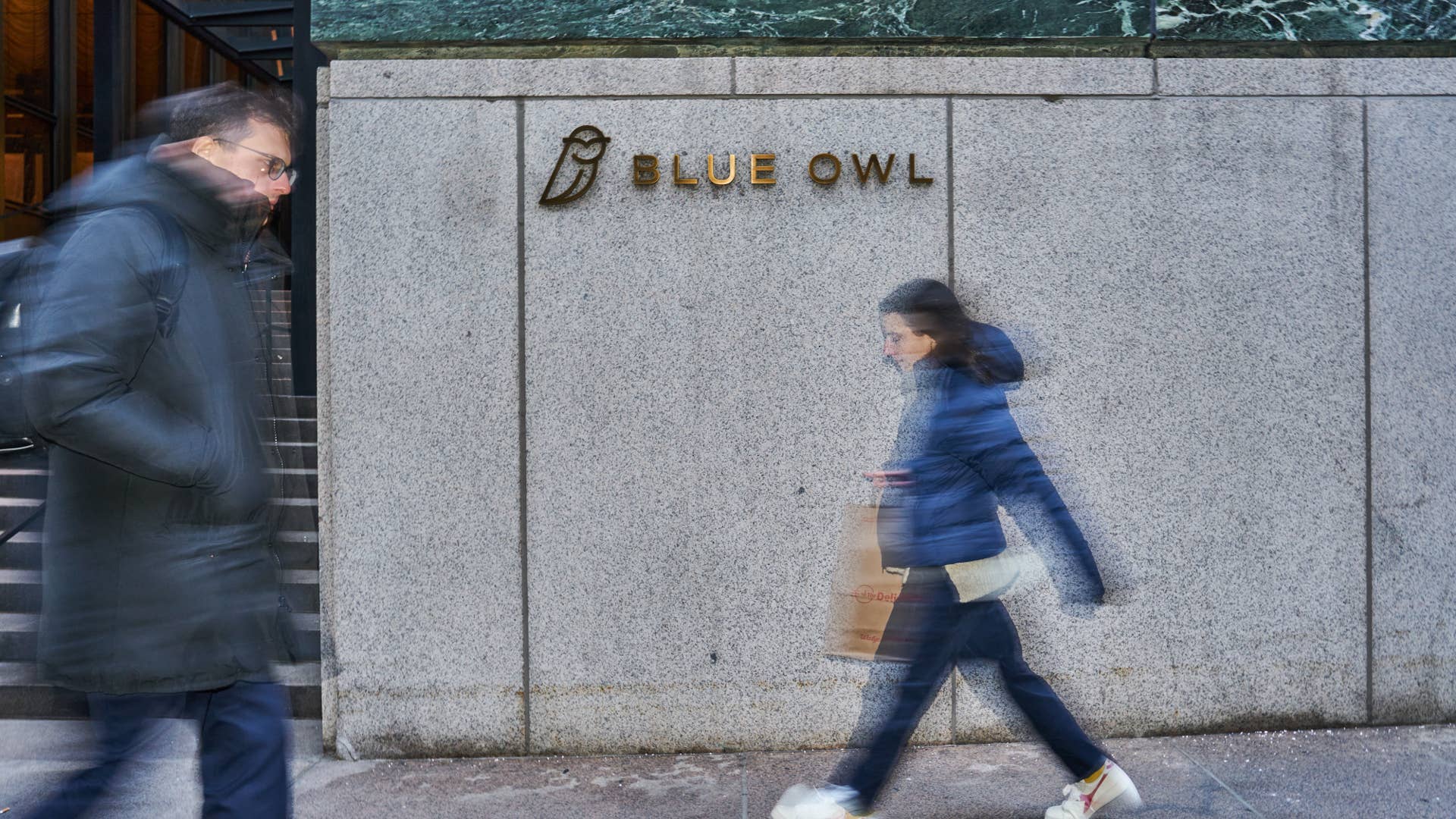
The era of easy money in retail private credit has hit a structural wall. For three years, Blue Owl Capital and its peers sold a seductive narrative to individual investors: institutional-grade yields with a safety valve of quarterly liquidity. But by early 2026, that safety valve began to hiss. Blue Owl Credit Income Corp (OCIC), the firm’s flagship retail vehicle, saw redemption requests skyrocket to 21.9% of shares outstanding in the first quarter of 2026. This is not a rounding error; it is a full-blown liquidity event that forced the manager to "gate" the fund, capping repurchases at the standard 5% limit and leaving the vast majority of exiting investors stranded.
The premise was always fragile. Private credit involves lending to mid-sized companies—businesses that do not have daily ticker symbols or liquid secondary markets for their debt. When thousands of retail investors at once decide they want their cash back, the math simply fails to compute. You cannot sell a portion of a private software loan on 48 hours' notice to satisfy a panicked retiree in Florida.
The Illusion of Semi-Liquid Stability
Blue Owl's meteoric rise was built on the "evergreen" fund model. Unlike traditional private equity, which locks capital away for a decade, these vehicles offer a 5% quarterly repurchase window. It worked perfectly while interest rates were rising and the economy was stable. In 2025, Blue Owl was still reporting record inflows, crossing the $300 billion assets under management (AUM) milestone.
But the tide turned as the credit cycle matured. By late 2025, concerns over borrower quality—specifically in the software and AI sectors where Blue Owl is heavily concentrated—began to leak into the wealth management channel. Financial advisors, once the biggest cheerleaders for "yield at any cost," started hitting the exits. When OCIC faced requests for nearly a quarter of its entire value in a single quarter, it exposed the fundamental mismatch between the assets (illiquid loans) and the liabilities (retail expectations).
The Software Debt Overhang
While Blue Owl highlights its low non-accrual rate—sitting at a pristine 0.4% at fair value as of year-end 2025—the headline number masks a deeper anxiety. The portfolio is weighted toward software-as-a-service (SaaS) companies. These are businesses valued on recurring revenue, not hard assets. In a high-interest-rate environment that persists into 2026, the interest coverage ratios for these companies are thinning.
Fitch Ratings recently shifted its BDC sector outlook to "deteriorating," noting that while defaults are currently low, the pressure on asset quality is rising. Blue Owl’s heavy exposure to large-cap software debt means it is competing directly with the broadly syndicated loan (BSL) market. When public markets rally, these borrowers can refinance away from Blue Owl at cheaper rates. When public markets wobble, the lack of transparency in the private book makes retail investors nervous. It is a "heads they win, tails you lose" scenario for the fund’s yield profile.
The Cost of Growth
Blue Owl’s aggressive expansion has not been cheap. Total expenses grew at a compound annual rate of 8.4% between 2021 and 2025. To keep the machine running, the firm must keep raising capital. This creates a dangerous circularity: if fundraising "evaporates" due to redemption gates, the firm’s ability to generate fee-related earnings (FRE) stalls.
Management has pointed to $28.4 billion in "embedded" fee-paying assets—capital committed but not yet deployed. However, deployment requires a healthy deal environment. If Blue Owl is forced to use its available cash and credit lines—nearly $7.5 billion—just to manage redemption requests and pay out dividends, it cannot put that money to work in new, high-yielding loans.
A Structural Crisis in the Wealth Channel
The broader issue isn't just Blue Owl; it is the "retailization" of the entire private credit asset class. Retail investors, unlike institutional pension funds, are prone to herd behavior. They treat BDCs like high-yield savings accounts until they realize the door only stays open for 5% of the crowd at a time.
For some managers, the solution has been to step in with corporate cash. Blackstone and Brookfield have previously used affiliate capital to satisfy oversubscribed redemptions. Blue Owl has shown some flexibility, fulfilling 5.2% in late 2024, but the 21.9% demand in 2026 was too large to ignore. By sticking to the 5% cap, Blue Owl is doing exactly what the prospectus says it should, but it is also shattering the "liquidity" illusion that sold these products to the masses in the first place.
This is the reality of the private credit plateau. The easy gains from the post-pandemic rate hikes have been harvested. What remains is a slog through a mature credit cycle where liquidity is a luxury that retail investors can no longer afford to take for granted. Investors aren't just leaving because of bad performance; they are leaving because they finally realized they were holding a product that promised a liquidity exit that doesn't exist when everyone needs it most.
The industry is now watching to see if the "waitlist" for redemptions clears or if it becomes a permanent feature of the retail private credit world. For Blue Owl, the challenge is no longer about reaching $400 billion in AUM; it is about proving that their model can survive the very retail audience that made them a giant.