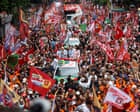
Political survival in Brasilia has always required a rare mix of Machiavellian calculation and sheer stamina. Luiz Inácio Lula da Silva possesses both in abundance. As the veteran leader positions himself as the ultimate bulwark against an emergent right-wing dynasty anchored by Jair Bolsonaro’s sons, the stakes for the world's fourth-largest democracy have reached a boiling point. This is not merely a clash of personalities. It is a structural war over the future of Latin America's geopolitical anchor, pitting a resilient trade unionist against a modernized populist machine that refuses to fade into history.
For decades, the Brazilian political spectrum swung between traditional elite governance and Lula's center-left coalitions. The emergence of the Bolsonaro movement fractured that dynamic. When the former military captain captured the presidency in 2018, he did not just win an election; he unlocked a dormant cultural conservatism fueled by evangelical expansion, deep-seated corruption fatigue, and ferocious anti-communism. Even after the courts barred Jair Bolsonaro from holding public office until 2030, the apparatus did not collapse. Instead, the mantle passed downward.
The sons, particularly federal deputy Eduardo Bolsonaro and senator Flávio Bolsonaro, inherited a mobilized street movement and a digital warfare apparatus built during the height of the Trump-era playbook. They learned the lessons of 2022 well. While their father remains a potent symbol, the younger generation represents an institutionalized ideological front. They have weaponized congressional committees, decentralized media networks, and international conservative alliances to keep the pressure on Lula's administration from day one.
Lula's strategy relies on a singular premise: that he remains the only figure capable of holding together the fragile, ideologically diverse coalition that defeated Bolsonaro at the ballot box. This argument carries weight, yet it exposes a glaring vulnerability. By framing the national democratic project around his own indispensable presence, the ruling Workers' Party risks repeating a historical error. Personalist politics often leaves a vacuum when the central figure departs. The opposition understands this calculus perfectly. They are banking on the reality that biological clocks tick for everyone, while political resentment endures.
Economic reality complicates the political theater further. Inflationary pressures, sluggish growth forecasts, and fiscal constraints limit how much social spending the administration can deploy to secure its working-class base. The traditional battlegrounds of São Paulo and Rio de Janeiro remain fiercely contested territories where municipal elections serve as grueling testing grounds for national dominance. The right has mastered the art of grievance politics, tying national economic anxieties directly to corruption scandals that have historically plagued the left.
Behind closed doors, foreign diplomats and domestic investors watch the succession drama with acute nervousness. Markets crave predictability, yet Brazilian politics offers permanent turbulence. The Supreme Court has emerged as an aggressive arbiter of democratic norms, prosecuting actors involved in institutional subversion and digital disinformation campaigns. This judicial activism has shielded the republic from immediate collapse, but it has also drawn furious accusations of judicial overreach from the right, further polarizing an already fractured electorate.
When Lula claims that only his distinct political gravity can prevent a return to the turbulence of the previous administration, he is speaking to a genuine fear among democratic loyalists. Yet the institutional health of a nation cannot depend on a single mortal. The upcoming electoral cycles will test whether Brazilian democracy has matured into a system of checks and balances robust enough to withstand dynastic populism, or if it remains trapped in the gravitational pull of charismatic strongmen. The outcome will reverberate far beyond the borders of South America, setting a crucial precedent for democratic resilience in the twenty-first century.