The water off the coast of Porto Seguro is the kind of blue that tricks you into believing nothing could ever go wrong. It is a warm, forgiving Atlantic embrace, thick with the scent of salt and the distant promise of fried fish served on paper plates under thatched roofs. For generations, the rhythm of this historic Brazilian coastline was dictated by the tides and the patient wisdom of men who knew every coral outcrop by heart. They knew where the snapper hid. They knew the gentle pulse of the parrotfish keeping the algae in check.
Then came the invaders.
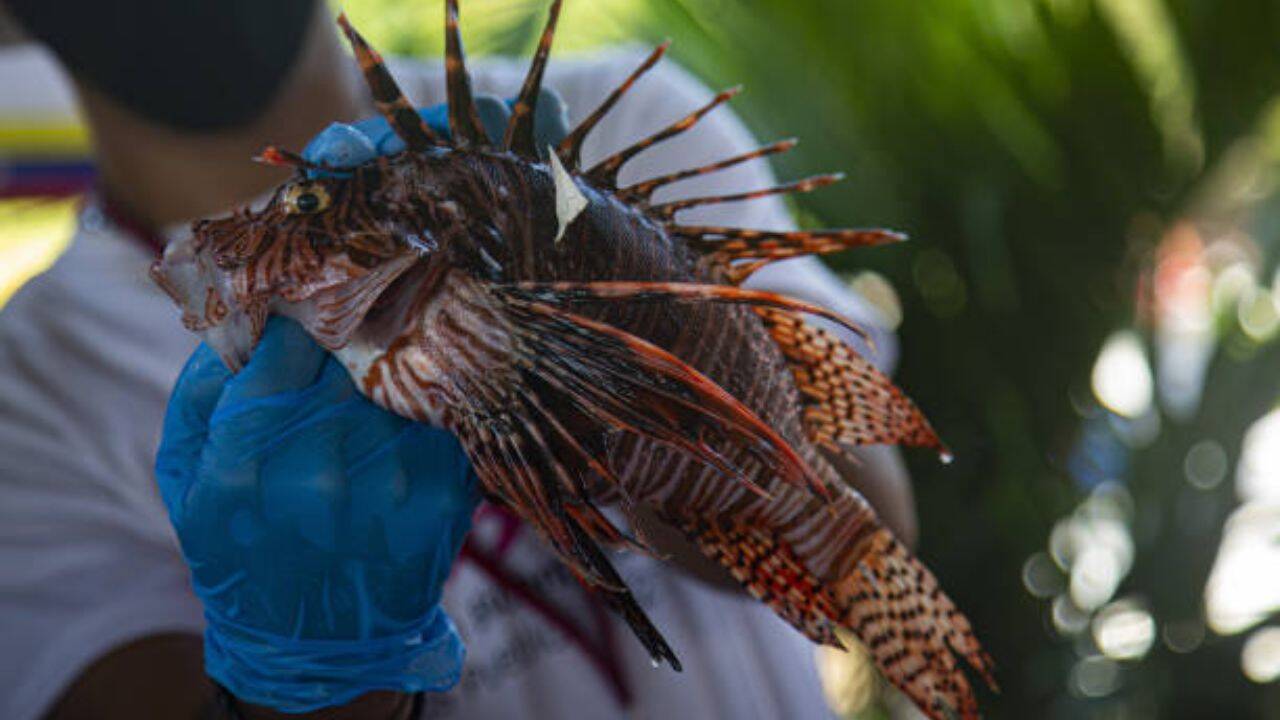
They did not arrive with an army's roar. They slipped in through the ballast water of cargo ships or escaped from backyard aquariums in North America, drifting south on ocean currents like shimmering, poisonous ghosts. Red and white stripes. Venomous spines. An arrogant, fan-like posture that practically screams that nothing in these waters belongs here.
The lionfish.
Imagine standing on the deck of a small wooden skiff at dawn, watching an artisanal fisherman pull up a net that feels inexplicably heavy. You expect a writhing mass of silver sardines, or perhaps a heavy grouper that will feed a family for a week. Instead, you find a creature that looks like an exotic houseplant possessed by a demon. That is the reality facing Porto Seguro today. An alien species has decided to make itself entirely too comfortable in the Atlantic, and the local ecosystem is paying the price in blood.
To understand why a ten-dollar bounty on a fish matters, you have to understand the math of catastrophe. A single female lionfish can release up to two million eggs a year. They spawn every few days, month after month, across every marine environment they touch. They have no natural predators in these waters. Grouper and sharks look at those venomous spines and turn away, seeking easier meals. Meanwhile, the lionfish eats everything in sight. It swallows juvenile reef fish whole, inhaling up to eighty percent of a reef's resident biomass in just a few short weeks.
Local fishermen watch their livelihoods evaporate before their eyes. João, a weathered diver who has spent forty years harvesting the reefs of Bahia, describes the change with a quiet sort of grief.
"The reefs are going silent," he says, adjusting his cracked dive mask. "You go down there now, and it is just empty space. The small fish that used to dart around the coral are gone. There is only the red stripe. Everywhere you look, just red stripes staring back at you."
Silence underwater is terrifying. It means the grazing species have been wiped out, leaving the coral to choke and die under blankets of unchecked green algae. When the coral dies, the habitat disappears. When the habitat disappears, the fisheries collapse. When the fisheries collapse, towns like Porto Seguro lose their soul.
So, what do you do when an unstoppable force meets a coastal community whose very survival depends on the ocean? You change the rules of the game.
Porto Seguro decided to turn prey into prize. The local administration, alongside marine conservationists, launched a direct financial incentive: ten dollars for every captured lionfish.
Ten dollars might not sound like much in downtown Manhattan. In coastal Brazil, where an artisanal fisherman might struggle to clear a modest daily wage, ten dollars per fish is a radical intervention. It transforms a ecological nightmare into an economic opportunity. Suddenly, every local diver, spearfisherman, and boat captain is armed with a new purpose. The ocean floor is no longer just a workplace; it is a hunting ground.
Consider what happens next on a typical Tuesday afternoon.
Boats that used to target commercial species now cruise the shallows with specialized acrylic collection tubes and Hawaiian slings. Divers descend into the murky depths, scanning the ledges where the invaders lurk in the shadows. When a lionfish is spotted, the hunter moves with surgical precision, avoiding the venomous dorsal spines that can deliver a sting severe enough to cause temporary paralysis, extreme nausea, and agonizing pain. One swift strike. The fish is pinned, secured, and brought to the surface.
At the dock, the transaction is startlingly simple. The fish are counted, verified, and logged. The bounty is paid out in cash.
Critics might scoff at the notion of a bounty. They will point out that eradication is mathematically impossible at this stage. The lionfish has established a permanent foothold from the Caribbean down to the southern shores of Brazil. You cannot vacuum millions of venomous fish out of the vast, complex labyrinth of the Atlantic coral reefs.
Those critics miss the point entirely.
The bounty is not about absolute eradication. It is about population control and community mobilization. It is about shifting the ecological pressure away from the native species and putting it squarely onto the invaders. More importantly, it weaponizes human appetite and economic self-interest against an ecological threat.
There is an unexpected culinary twist to this tragedy, too. Lionfish flesh is pristine, white, buttery, and completely delicious. Once the venomous spines are safely snipped off with kitchen shears, the fish poses zero threat to the palate. In fact, conservation groups across the Americas have championed a simple slogan: eat them to beat them.
Walk into a beachside restaurant in Porto Seguro today, and you might find lionfish ceviche on the menu, marinated in fresh lime juice, cilantro, and red onion. It is a strange form of poetic justice. The invader becomes the appetizer. By creating a commercial market for the meat alongside the governmental bounty, the town has built a two-pronged defense system. Fishermen get paid to catch them, and restaurants get paid to serve them.
Yet, as the sun dips below the horizon, painting the Bahian sky in streaks of bruised purple and gold, the scale of the challenge remains sobering.
The ocean is vast. The currents are endless. Every time a diver surfaces with a tube full of captured lionfish, a hundred more are likely hatching in the deep dark where no human eye can see them. The war for the reefs is not a battle that will be won with a single decisive victory. It is a grueling, daily war of attrition.
João sits on an upturned plastic crate by the water's edge, counting his catch for the day. His hands are calloused, scarred by decades of honest work, and marked by the occasional white blur of an old spine prick. He looks out over the dark, restless expanse of the Atlantic, listening to the rhythmic wash of the waves against the hull. He knows the odds. He knows tomorrow he will have to go back down into the blue, searching for red stripes in the shadows. He smiles anyway, picks up his spear, and checks the rubber bands.