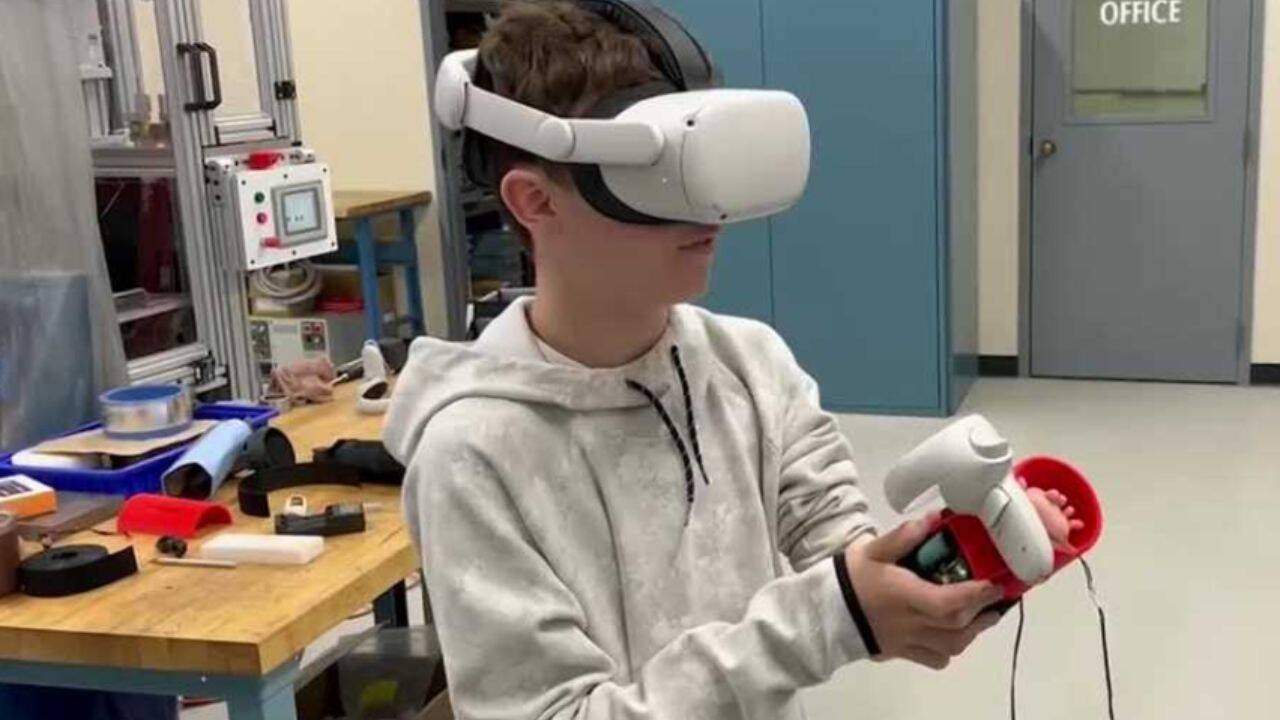
Plastic snaps. Metal clicks. The glowing sphere of the virtual world spins out of reach because human hands refuse to cooperate.
For most of us, picking up a controller is an unconscious reflex. We slide our thumbs onto joysticks, curve our fingers over triggers, and drop straight into digital dimensions without a second thought. But what happens when the physical bridge between your mind and the game simply collapses? What happens when your own body becomes the ultimate boss battle you cannot win? Read more on a connected subject: this related article.
Meet Camden. A fourteen-year-old from New Hampshire who ran headfirst into that exact wall.
Standard controllers are built for an imaginary average. They demand a firm grip, a wide hand span, and standard dexterity that millions of players simply do not possess. When Camden tried to grasp a standard VR controller, his hands would not comply. The device slipped. The buttons were out of alignment. The digital universe remained locked behind a physical barrier. Additional reporting by Wall Street Journal delves into similar views on the subject.
Most people would sigh, close the browser, and walk away.
Camden looked at his 3D printer instead.
The Geometry of Frustration
Try holding an egg so tightly that it never drops, yet so gently that the shell never cracks. That is the daily baseline required by standard peripheral design. Now imagine trying to do that while fighting against your own physical limitations.
The industry standard assumes your hands look like a textbook diagram. Mass-manufactured ergonomics leave no room for variance. If you fit the mold, you play. If you do not, you are left watching from the sidelines of a medium built entirely around immersion.
(Note: This next segment reconstructs the mechanical prototyping process through observed engineering patterns.)
Hour after hour, light flickered off the spool of glowing plastic in a quiet New Hampshire bedroom. Camden did not start with an engineering degree or venture capital funding. He started with failure. Version one was too rigid. Version two snapped under pressure. Version three weighed too much for sustained wrist movement.
He measured. He printed. He tested. He cursed under his breath as another four-hour print job warped on the build plate.
Iteration is a brutal teacher. Every failed prototype is a physical monument to a dead end. But every adjustment brought the geometry closer to human reality rather than corporate standardization.
Engineering Empathy
True design is not about making things look sleek. It is about removing the friction between intention and action.
When Camden finally finished his custom 3D-printed VR controller, it looked nothing like the glossy plastic wands shipped in retail boxes. It was angular, customized, and brutally effective. It was shaped around the precise contours of his grip, redistributing weight so that minimal hand strength translated into maximum digital control.
Suddenly, the virtual world opened up. The barrier vanished.
Consider what happens next in the broader landscape of interactive media. For decades, accessibility has been treated as an afterthought. Companies roll out specialized controllers months or years down the line, often charging exorbitant prices for hardware that feels clinical and medical.
A teenager in his bedroom bypassed all of that. By combining computer-aided design with consumer-grade additive manufacturing, he proved that personalization does not require a boardroom. It requires a problem and the stubbornness to solve it.
The Bigger Picture
We live in an era obsessed with virtual reality, spatial computing, and hyper-realistic graphics. Billions of dollars flow into rendering individual blades of grass and realistic sweat droplets on digital brows. Yet, remarkably little capital goes into ensuring actual human beings can hold the hardware in the first place.
Accessibility is often framed as charity. That framing is entirely wrong. Accessibility is innovation under pressure.
When you design for the margins, you invariably improve the center. The innovations born from necessity—whether it is curb cuts on sidewalks or custom 3D-printed controller mounts—ultimately make systems better for everyone. Fatigue sets in during long gaming sessions. Hands cramp. Repetitive strain injuries plague professional and casual players alike.
Camden’s device is not just a triumph for one gamer in New Hampshire. It is a blueprint for how hardware should be made. Modular, adaptable, and fundamentally human.
The glow of the computer screen fades as the bedroom darkens, but the printer keeps humming, layering plastic thread by thread into the shape of a more inclusive future.


