The air inside the grotto smells of damp moss, melting wax, and the quiet desperation of a thousand prayers whispered into the dark.
For generations, humanity has dragged its broken pieces to the feet of the Pyrenees. We bring failing hearts, withered limbs, and minds frayed by the unrelenting weight of suffering. We come to Lourdes because the maps of our modern lives run out at the edge of physical decay. Science maps the genome, engineers artificial joints, and yet, an unyielding fraction of human pain remains stubbornly beyond our reach. So we board the trains. We wheel the beds. We stand in the mist.
And then, the quiet voice speaks.
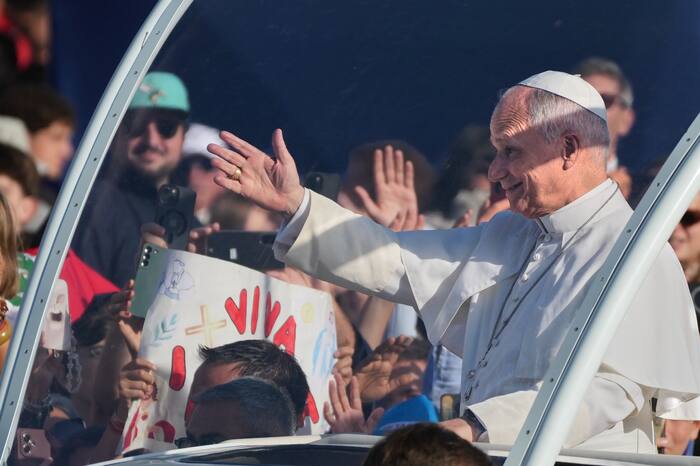
Pope Francis recently turned his gaze toward this sanctuary, not merely to celebrate the miraculous cures etched into the history books of the Catholic Church, but to issue a sharp, unyielding reminder about the people who never walk out of the water.
Protection. Not for the strong. Not for the influential. But for the weakest.
Consider what happens when the cameras pack up and leave Lourdes. The headlines celebrate the official miracles—the handful of documented healings that rigorous medical committees spend decades vetting. Statistics show that out of the millions who visit seeking physical restoration, only seventy cases have been formally recognized by the Church as miraculous. A microscopic fraction. A statistical whisper.
What about the rest?
What about the millions who leave in the exact same wheelchair they arrived in?
I remember watching a woman named Claire outside the baths years ago. Her hands were curled like dry autumn leaves from rheumatoid arthritis. She had saved for three years to make the pilgrimage from Lyon. She immersed herself in the ice-cold spring water, her eyes squeezed shut in a mix of hope and terror. When she emerged, shivering and exhausted, her fingers remained curled. The disease had not retreated by a single millimeter.
That is where the real story begins.
Most people misunderstand what Lourdes is actually selling. It is not a cosmic lottery where the lucky win a new pancreas and the rest go home empty-handed. If that were the case, it would be a cruel monument to false hope. Instead, the true architecture of the shrine lies in its reversal of worldly power.
In ordinary life, weakness is a liability. It is an administrative burden, a cost inefficiency, a quiet inconvenience hidden away in sterile nursing homes and back bedrooms. We build our societies around the productive, the fast, and the invulnerable. We worship autonomy.
Lourdes does the exact opposite.
At the sanctuary, the person in the wheelchair takes precedence over the able-bodied volunteer pushing them. The sick are treated not as patients to be managed, but as royalty to be served. It is a radical inversion of human hierarchy that leaves first-time visitors profoundly disoriented.
When the Pope urges the protection of the weakest at shrines like this, he is not just talking about physical safety or charitable handouts. He is diagnosing a profound spiritual sickness in our broader culture. We have built an economic and social engine that quietly discards anyone who cannot keep up. We measure human worth by output, by speed, by net utility.
We are terrified of our own fragility.
Think about how we react to aging, to disability, to terminal illness. We sanitize it. We medicate it out of sight. We treat vulnerability as a design flaw rather than an inevitable chapter of the human condition.
The water at Lourdes flows whether you are cured or not. That is the haunting beauty of it. The spring does not discriminate based on your prognosis. It pours over the faithful and the skeptical, the healed and the suffering alike.
History shows us that sanctuaries of healing have always served as mirrors for the societies that built them. In medieval Europe, leper colonies on the outskirts of towns forced communities to confront the physical reality of decay. Today, we hide our decay behind hospital curtains and institutional walls, pretending that science will soon eradicate death entirely.
It will not.
No matter how advanced our biotechnology becomes, entropy remains undefeated. We will all, eventually, break down. We will all need someone to push our wheelchairs, wipe our brows, and look us in the eye when our bodies fail us.
This is why the Pope’s message carries such urgent weight. Protecting the weakest is not an optional act of charity reserved for saints and do-gooders. It is the baseline test of our humanity. If a civilization’s worth is measured by how it treats its most vulnerable members, then our modern obsession with self-sufficiency and hyper-performance looks increasingly hollow.
We have optimized everything except our capacity for tenderness.
Walk through the torchlight procession at Lourdes after dusk. Thousands of flickering candles cut through the mountain night. You see bankers marching alongside laborers, intellectuals holding hands with individuals suffering from severe developmental disabilities. In that shared light, the artificial divisions of status, wealth, and capability dissolve.
There is a profound liberation in dropping the armor of perfection.
We spend so much of our lives pretending we have it all together. We curate our LinkedIn profiles, our social feeds, our polished professional personas, terrified that someone might spot a crack in the facade. But at the foot of the shrine, perfection is entirely irrelevant. The only ticket of entry is your need.
And everyone qualifies.
The challenge of the modern era is to translate the radical hospitality of the grotto into the cold concrete of our cities. How do we build hospitals that feel like sanctuaries rather than processing plants? How do we design workplaces that accommodate human limitation rather than burning people out by age forty? How do we look at an elderly neighbor or a chronically ill friend without feeling the subtle, selfish urge to look away?
It starts by admitting a terrifying truth: we are all the weak ones, waiting our turn.
The miraculous cures make the evening news. They provide the dramatic hook, the splash of the extraordinary into the mundane. But the real miracle of Lourdes isn't the sudden mending of bone or the retreat of a tumor.
The real miracle is that for a few days, in a damp valley in the south of France, we remember how to look at each other with love instead of fear.
The candles burn low. The mountain air grows crisp against the skin. The wheelchair remains parked by the basin, waiting for the morning light, holding a universe of quiet dignity that no statistics can ever capture.