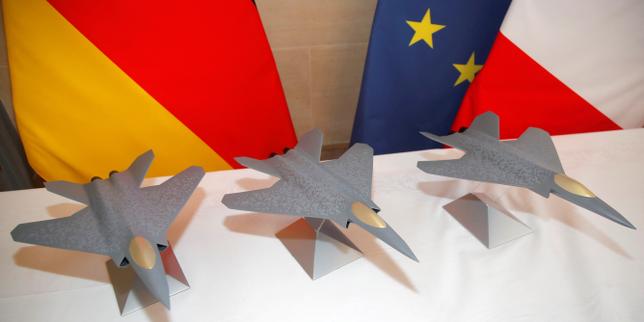
The coffee in the glass-walled conference rooms of Paris and Berlin always tastes like ink and adrenaline. For years, engineers, generals, and politicians sat across from one another, staring at blueprints for a machine that was supposed to secure the continent’s sky for the next half-century. They called it SCAF—the Système de Combat Aérien du Futur. It wasn’t just an airplane. It was a promise.
By 2040, this interconnected web of stealth jets, swarming drones, and ultra-fast combat clouds was meant to replace the aging Rafale and Eurofighter fleets. It was designed to prove that Europe could defend itself without constantly looking to Washington for permission or parts.
Instead, it became a masterclass in how pride destroys progress.
Walk into any aerospace hangar and you will hear a distinct mechanical hum. It is the sound of precision. But when the French defense giant Dassault Aviation and Germany’s Airbus tried to merge their cultures, that hum turned into a screaming metal grind. The project didn't stall because the technology was too complex. It fractured because humans are stubborn, history is long, and trust is the hardest thing on earth to engineer.
The Ghost in the Cockpit
To understand why a multi-billion-euro defense initiative stumbles, you have to look at the people holding the pencils.
Hypothetically, let us call him Jean-Pierre. He is a senior design engineer in Saint-Cloud, just outside Paris. For three generations, his family has built fighter jets that possess a distinct French philosophy: light, agile, and single-seat. French jets must be capable of landing on aircraft carriers because France maintains global power projection. More importantly, they must be able to carry nuclear deterrents. For Jean-Pierre, the blueprint isn't just math. It is national sovereignty.
Now, look across the Rhine. Let us imagine Anja, an operations manager in Munich. Her reality is entirely different. Germany’s military posture is strictly defensive, collaborative, and grounded in NATO integration. Anja’s bosses do not care about carrier landings. They care about heavy, twin-engine reliability, industrial workshare, and keeping German factories humming.
When Jean-Pierre and Anja sit down at the same table, they aren't just arguing about the wing sweep or the thrust-to-weight ratio of a engine. They are arguing about their respective identities.
France brought the supreme technical know-how of building a complete carrier-capable fighter from scratch. Naturally, Paris demanded the driver's seat. Germany, footing a massive portion of the bill, flatly refused to be a junior partner. They wanted the intellectual property. They wanted the source codes.
The result? Years of bitter, public deadlocks over who got to lead the "Next Generation Fighter" pillar of the project. While engineers waited for political clearance, the world kept turning. Silicon Valley accelerated its autonomous AI. Beijing rolled out advanced stealth variants. Europe sat in committee meetings, debating copyrights.
The Illusion of a Shared Sky
We often treat international defense procurement like a giant, cooperative puzzle. We assume that because two nations share a border and a currency, they must share a vision of the future.
They don't.
Consider the fundamental divergence in how these two economic powerhouses view industrial secrets. France treats its defense sector like a crown jewel, protected by the state and insulated from outside eyes. Germany views defense spending through the lens of industrial policy—a way to inject high-tech engineering jobs into Bavaria and Lower Saxony.
When the French refused to share the flight control software, fearing their proprietary brilliance would be absorbed by a competitor, the Germans felt cheated. When the Germans demanded equal industrial leadership on the jet's core systems, the French saw an amateur trying to commandeer the cockpit.
It is an agonizingly familiar pattern. Anyone who remembers the tortuous development of the Eurofighter Typhoon in the 1980s and 90s—which France famously walked away from to build the Rafale solo—can see history repeating itself. We are trapped in a loop of regional ego.
The defense analysts call it "industrial duplication."
The politicians call it "strategic autonomy."
The soldiers just call it a mess.
The Cost of Waiting
While Europe bickered over who got to write the software for a plane that hadn't been built yet, the reality on the ground shifted violently. The invasion of Ukraine shattered any lingering illusions about the luxury of time. Suddenly, abstract debates about 2040 capabilities collided with the immediate, terrifying need for air defense today.
Germany made a choice that sent shockwaves through the SCAF partnership. They bought American F-35s.
It was a pragmatic, urgent decision to fulfill a NATO nuclear-sharing requirement. But to Paris, it felt like a betrayal. It was an admission that when the pressure rises, European solidarity is secondary to American hardware. It proved that the immediate umbrella of Washington's protection is sweeter than the distant promise of a homegrown miracle.
The numbers tell a brutal story. Every euro spent acquiring foreign platforms is a euro pulled away from domestic research and development. The European defense market remains fragmented, inefficient, and painfully slow. We are spending more money to get less done, distracted by internal turf wars while the geopolitical climate grows steadily colder.
A Tale of Two Projects
The ultimate tragedy of the SCAF dispute is that it did not happen in a vacuum. Right across the English Channel, another group of nations watched the Franco-German gridlock and chose a different path.
The Global Combat Air Programme (GCAP), led by the United Kingdom, Italy, and Japan, moved with a terrifyingly quiet efficiency. They did not get bogged down in decades of historical baggage regarding carrier operations or nuclear delivery. They focused on rapid prototyping, digital design, and a clear division of labor.
Rhythm is everything in aerospace. GCAP found its beat. SCAF lost its tempo.
When you lose momentum in tech, you lose everything. Engineers get bored and retire. Bright graduates choose startups over stagnant defense conglomerates. The cutting-edge concepts drawn on napkins in 2018 begin to look obsolete by 2026. You find yourself building yesterday's future.
The Empty Hangar
Go to the great airshows—Le Bourget, Berlin, Farnborough. The pavilions are filled with sleek, full-scale fiberglass mockups of the Next Generation Fighter. They look magnificent under the stadium lights. They look fast. They look invincible.
But if you knock on the fuselage, it sounds hollow.
Because right now, it is. It is a shell of painted plastic covering an empty space where a unified European foreign policy ought to be. Until Berlin and Paris can agree on who they are fighting for, how they intend to fight, and who owns the right to sell the weapons afterward, that mockup will remain an expensive piece of corporate art.
The true failure of the future combat aircraft isn't a failure of aerodynamics. The wings would have generated lift. The engines would have broken the sound barrier. The radar would have tracked targets across horizons.
The failure belongs to the ground. It belongs to a continent that wants the status of a superpower but refuses to pay the price of true integration. We are left watching the skies, waiting for a savior that we were supposed to build ourselves.