The North Sea is a shallow, treacherous graveyard for giants not built for its sandy shelves. When a juvenile humpback whale, nicknamed "Timmy" by local onlookers, became a fixture of the German coast near the island of Sylt, the narrative written by the public was one of a heartwarming rescue. On the surface, the story ended with a successful release into deeper waters. Underneath, the incident exposes a disturbing lack of preparation for the shifting migration patterns of marine megafauna and the staggering logistical failures of European maritime coordination.
Timmy’s survival was an anomaly. Most large cetaceans that enter the Wadden Sea—a region defined by massive tidal shifts and complex sandbars—do not leave alive. This whale was not just "lost." He was a symptom of a larger, more volatile change in how the Atlantic’s apex species are navigating a warming ocean. While the media celebrated the final push that sent him back to the blue, the actual operation was a chaotic, high-stakes gamble that nearly ended in a public relations disaster and a slow, agonizing death for the animal.
The Sand Trap of the Wadden Sea
The geography of the German Bight is fundamentally hostile to a creature that relies on deep-water acoustics to navigate. Humpbacks are designed for the verticality of the open ocean. When they enter the North Sea through the English Channel or the northern gap, they find themselves in a basin that rarely exceeds 30 to 50 meters in depth. Near the coast of Schleswig-Holstein, that depth drops to nothing twice a day.
Timmy spent weeks circling the shallow waters, his sonar likely bouncing off a confusing, flat seafloor that offered no clear exit. Biologists on the scene noted that the whale began to show signs of "logging," a state of lethargy where the animal floats at the surface because it lacks the energy to dive or travel. This isn't resting. It is a slow-motion shutdown. The skin begins to slough off due to the lower salinity of coastal waters, and the internal organs start to compress under the animal's own weight if it touches the bottom during low tide.
The decision to intervene is never simple. Under international conservation guidelines, "letting nature take its course" is the default setting. However, when a whale becomes a tourist attraction, the political pressure to act overrides biological caution. The rescue of Timmy was as much about managing the optics of a dying whale on a popular beach as it was about conservation.
Logistics of a Seven Ton Extraction
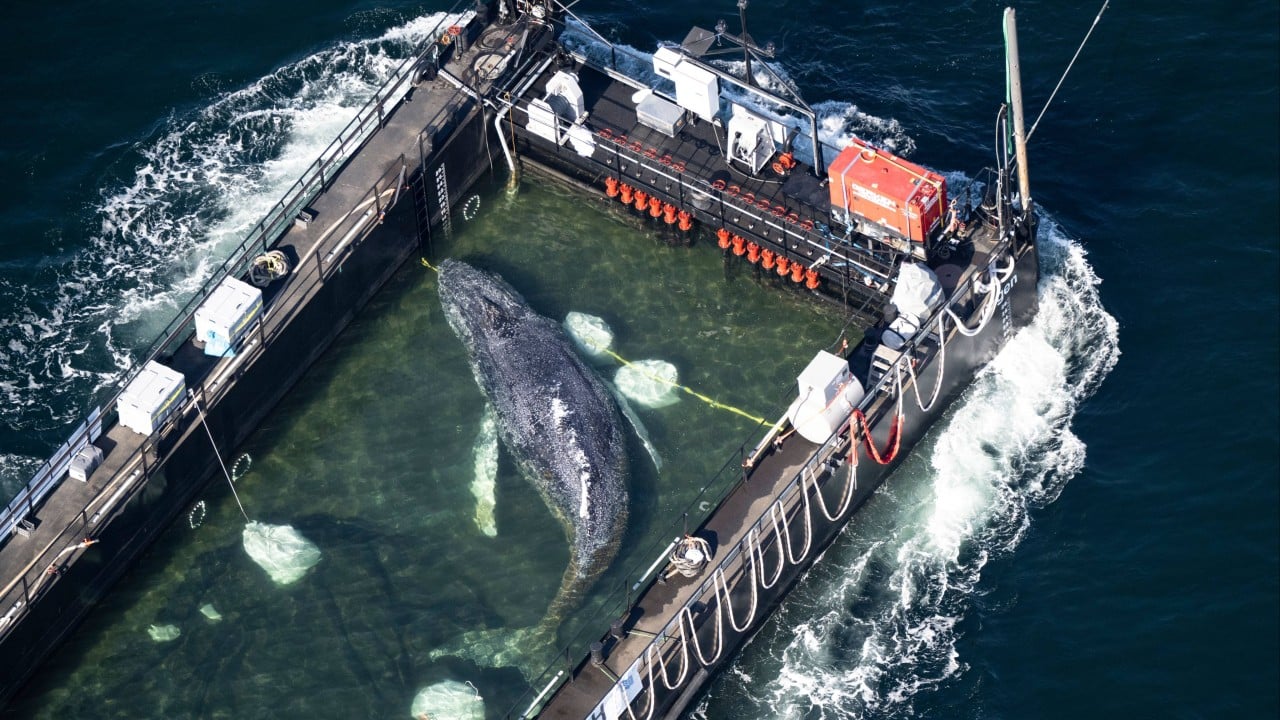
Moving a living humpback is a feat of engineering that most coast guards are entirely unequipped to handle. You cannot simply tow a whale by the tail; doing so dislocates the spine and kills the animal within minutes. To move Timmy, rescuers had to coordinate between the Federal Agency for Nature Conservation (BfN), local fisheries, and specialized divers.
The operation required a custom-built sling—a harness that supports the belly and keeps the blowhole clear of the water. Even with the harness, the stresses on the animal are immense. A humpback’s heart is the size of a small car, and under the stress of a relocation, that heart can fail from a massive release of catecholamines—essentially, the whale is scared to death.
The Problem of Human Interference
Throughout the weeks leading up to the release, the rescue effort was hampered by the very people who claimed to love the whale. Private boaters and drone pilots swarmed the area. Every engine noise is a cacophony to a humpback, adding layers of acoustic stress to an already disoriented animal. The German maritime authorities had to establish a restricted zone, but enforcement was spotty at best.
This interference isn't just a nuisance; it's a death sentence. When a whale is trying to find the "acoustic opening" to deeper water, the drone of a dozen outboard motors creates a wall of sound. Timmy wasn't just stuck in the sand; he was trapped in a cage of human noise.
Why the North Sea is Becoming a Dead End
We are seeing more humpbacks in the North Sea than at any point in the last century. This isn't necessarily a sign of a booming population. Instead, it indicates a shift in prey distribution. Sand eels and herring, the primary food sources for these whales, are moving into colder, shallower pockets as the Atlantic currents shift.
Humpbacks are following the food into a labyrinth. In the deep Atlantic, a mistake in navigation is easily corrected. In the North Sea, a ten-mile error in judgment puts a whale in a depth of five meters. The "Timmy" incident is a preview of a new normal where these encounters will become frequent, and our current "ad-hoc" rescue style will be insufficient.
The cost of this single operation ran into the hundreds of thousands of euros. It involved specialized vessels, weeks of monitoring, and the labor of dozens of experts. If this becomes a monthly occurrence, the appetite for these rescues will vanish. We are currently operating on a "heroics" model rather than a "management" model.
The Myth of the Happy Ending
The news reports ended with footage of Timmy swimming toward the horizon. But in the world of marine biology, the "release" is just the beginning of a different kind of danger. A whale that has been stranded or near-stranded for weeks is physically depleted. Its blubber layer is thinned, its immune system is compromised by stress, and it has likely gone weeks without significant caloric intake.
Without a satellite tag—which was not mentioned in the primary success stories—there is no way to know if Timmy survived the following week. He was released into a sea still crowded with shipping lanes. The North Sea is one of the busiest maritime corridors on Earth. A weakened whale, swimming low in the water, is the prime candidate for a ship strike.
We treat these events as isolated miracles. We prefer the story of the plucky whale that made it out over the reality of an ecosystem in flux that is luring these animals to their deaths. The success of the Sylt release was a triumph of luck and local persistence, but it masked a total lack of a unified European response strategy for large-scale strandings.
A Failed Infrastructure for Marine Life
The European Union has strict mandates for protecting marine mammals, yet the actual hardware for a whale rescue is scattered and disorganized. There is no central "heavy lift" marine rescue team for the North Sea. Every time a whale gets stuck, local officials have to reinvent the wheel, borrowing equipment from construction firms or the military.
If we are serious about the welfare of these animals as they migrate through human-dominated waters, we need more than just good intentions and some rope. We need dedicated rapid-response barges equipped with hydro-acoustic deterrents to keep whales away from shallow zones before they strand. We need a coordinated acoustic monitoring network that can "hear" a humpback entering the English Channel and trigger alerts to shipping traffic.
The rescue of Timmy was a tactical success but a strategic warning. The whale may have reached deep water, but he left behind a record of human coastal management that is reactive, underfunded, and dangerously sentimental. We are cheering for the survivor of a system that we haven't even begun to fix.
The next whale to wander into the Wadden Sea will likely not be so lucky. The tides don't care about headlines, and the sand doesn't give back what it takes unless you have the massive, coordinated force of an industrial-scale rescue ready to move within hours, not weeks. We have the technology to track these animals and the wealth to protect them, yet we continue to rely on the hope that they will simply find their own way out of the traps we've made of the oceans.
Stop calling it a rescue. Call it a temporary reprieve.