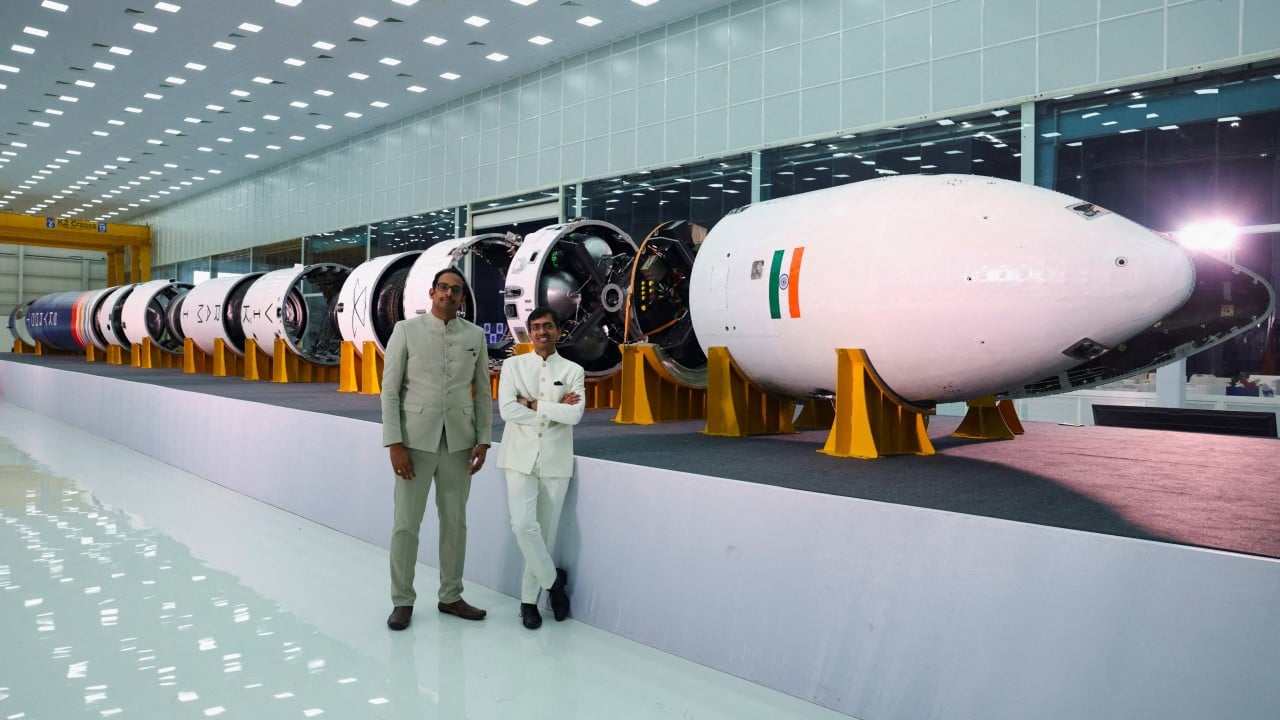
In late 2022, a single-stage suborbital rocket lifted off from India’s state-run spaceport at Sriharikota. The mission, dubbed Prarambh, marked the first time a privately developed Indian rocket reached space. Mainstream headlines celebrated the event as a textbook triumph of liberalization, framing it as the birth of a commercial force ready to challenge global dominant players like SpaceX. It was an inspiring narrative. It was also highly misleading.
The launch proved that Indian startups could build functional hardware under intense regulatory and financial constraints. What it did not prove was whether these companies could survive the brutal macroeconomic reality of the modern launch market. As the initial euphoria fades, India's private space sector faces a systemic crisis that patriotism and venture capital cannot solve. The global market is drowning in small-satellite launch capacity, margins are razor-thin, and the state-backed behemoth that birthed these startups remains their most dangerous competitor.
The Suborbital Illusion
To understand why the private space rush is stalling, look at the technical classification of the hardware. The early successes achieved by private players were suborbital flights. Reaching an altitude of 89.5 kilometers is a notable engineering milestone for a young company. Yet, it is structurally distinct from orbital insertion.
Getting an object into space requires speed. Keeping it there requires energy. To achieve orbit, a vehicle must accelerate to roughly 7.8 kilometers per second, fighting through atmospheric drag while executing precise multi-stage separations. This transition demands a massive increase in thermal protection, guidance accuracy, and engine efficiency. The engineering complexity does not scale linearly; it scales exponentially.
Building a suborbital sounding rocket is essentially building a sophisticated firework. Converting that architecture into a reliable orbital launch vehicle requires capital that domestic venture funds are rarely willing to risk. The capital expenditure for orbital infrastructure is immense, and the return on investment is deferred by years of testing, failures, and regulatory hurdles.
The Micro-Launcher Trap
Most Indian private aerospace startups are targeting the small-satellite market with micro-launchers designed to carry payloads under 500 kilograms. The business thesis seemed sound five years ago. Thousands of small internet-of-things and Earth-observation satellites needed rides to low-Earth orbit. Startups promised bespoke, on-demand targeting for these constellations, bypassing the long wait times associated with ridesharing on larger rockets.
The thesis broke. SpaceX altered the economics of space by introducing its Transporter rideshare missions. By stacking dozens of small satellites onto a single Falcon 9 rocket, the company drove the price of orbital transport down to roughly $5,500 per kilogram.
No small-satellite launcher can compete with those economics. The structural overhead of a rocket—the avionics, the guidance systems, the launch pad rental, and the telemetry tracking—remains largely static whether the vehicle carries 300 kilograms or 22,000 kilograms. When that fixed cost is divided by a tiny payload capacity, the price per kilogram skyrockets. Private micro-launchers often need to charge upwards of $15,000 to $20,000 per kilogram just to break even.
Satellites are becoming more integrated. Operators are realizing that waiting six months for a cheap rideshare slot on a massive rocket is vastly more economical than paying a massive premium for an immediate, dedicated flight on a micro-launcher. The addressable market for private Indian rockets is shrinking before the rockets are even fully operational.
The State Giant in the Room
The most glaring obstacle to the private sector is the Indian Space Research Organisation. For decades, the state agency operated as a closed ecosystem, designing, building, and launching everything internally. Under recent mandates, the government created IN-SPACE, a regulatory body designed to open state infrastructure to private players.
This relationship is fundamentally conflicted. The state agency is not just a facilitator; it is an active competitor in the small-satellite market. The state-developed Small Satellite Launch Vehicle was engineered specifically to capture the commercial micro-launcher market. The state vehicle is backed by decades of institutional knowledge, fully amortized manufacturing facilities, and a government safety net.
Private startups must pay the state for access to launch pads, tracking stations, and testing facilities. They are effectively funding their primary competitor. When a foreign satellite operator looks to launch from India, they face a choice between an unproven private startup and a state-backed program with a legacy of reliable flights. The choice is clear.
The Capital Chasm
Global space investments have dried up significantly from their pandemic-era peaks. High interest rates have forced venture capital firms to abandon speculative, deep-tech bets in favor of companies with immediate cash flows.
Indian space startups operate in an ecosystem that is structurally averse to long-term hardware risks. Domestic venture capital is overwhelmingly calibrated for software-as-a-service enterprises and consumer technology platforms. These businesses offer quick exits and predictable scaling metrics. A rocket company requires hundreds of millions of dollars before its first commercial payload. If a prototype explodes on the pad, the investment evaporates.
Typical Deep-Tech Venture Lifecycle vs. Indian Space Startup Reality:

Capital Required to Achieve Stable Orbit: $150M - $250M
Average Seed/Series A Round for Indian Space Startups: $10M - $25M
The Valuation Gap: 10x shortfall in mid-stage capital
This funding structure leaves local players stranded in a mid-stage capital chasm. They raise enough money to build a prototype engine or a suborbital test vehicle, but they lack the financial runway to survive the multi-year testing phase required to stabilize an orbital platform.
The Geopolitical Bottle
The assumption that India can easily absorb international launch demand ignores rigid geopolitical realities. The United States controls the vast majority of the global commercial satellite market. Under International Traffic in Arms Regulations, any satellite containing American components faces severe restrictions regarding how and where it can be launched.
Unless India secures specific, high-level bilateral agreements with Washington regarding tech transfers and security protocols, American satellite manufacturers cannot legally launch on private Indian vehicles. This restricts Indian startups to a much smaller pool of domestic, European, and regional payloads. Within that smaller pool, they must fight for market share against established low-cost players in Europe, Japan, and Rocket Lab in New Zealand.
The Alternative Path to Survival
The survival of India’s private space industry depends on companies abandoning the romantic, high-risk pursuit of building entire orbital launch vehicles. The real value lies further down the supply chain.
India possesses a massive, highly skilled precision manufacturing sector that operates at a fraction of Western labor costs. Private companies that pivot away from launch services toward component manufacturing, specialized software, propulsion subsystems, and satellite bus development are quietly finding profitability. Building valves, tanks, and telemetry software for global prime contractors is less glamorous than launching a rocket under a company banner, but it generates predictable, sustainable revenue.
The companies that insist on building rockets to chase the ghost of SpaceX will likely face bankruptcy or state absorption within the decade. The math is unyielding. Space may be infinite, but the capital funding the journey is tightly constrained. Private launch providers must adapt to the economics of transport, or they will remain expensive footnotes in aerospace history.