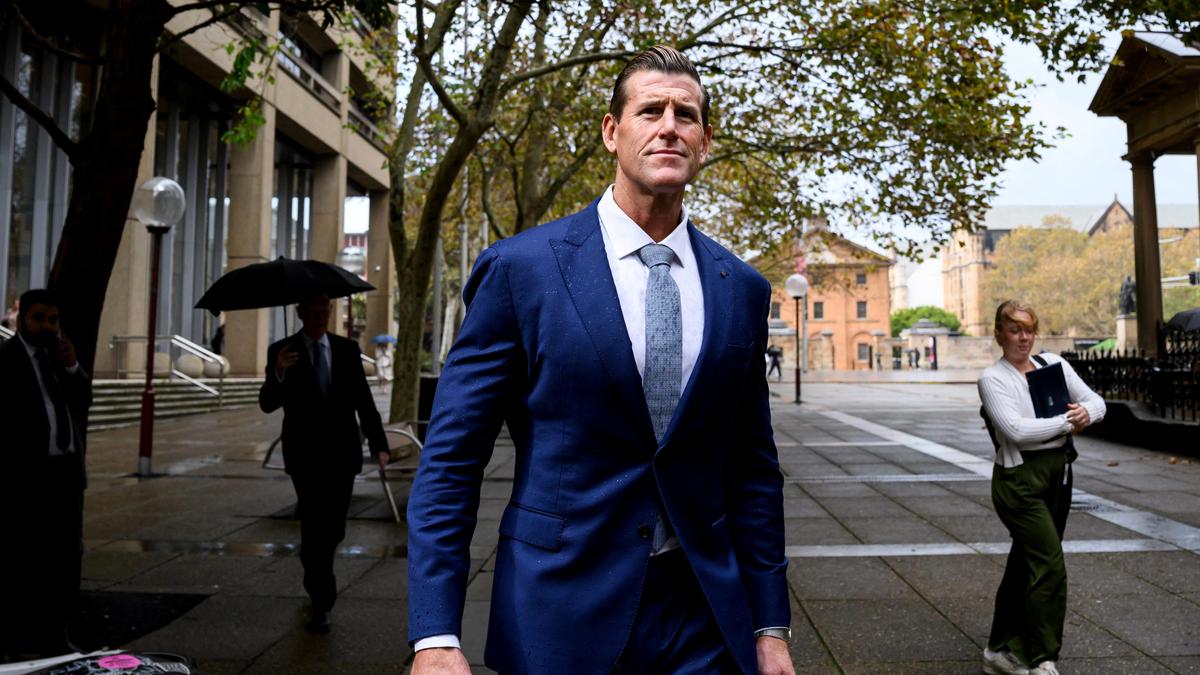
The release of a former Australian Special Air Service Regiment soldier on bail marks a significant shift in one of the most complex legal battles in the nation's history. This individual, the first Australian serviceman charged with the war crime of murder under domestic law, now walks free under strict conditions while the judicial system grapples with events that took place in Uruzgan Province over a decade ago. The case centers on the death of an Afghan man during a 2012 field operation, an incident captured on helmet-camera footage that has since become a focal point for national debate regarding military accountability and the fog of war.
For the Australian Defense Force (ADF), this is not merely a single criminal trial. It is the physical manifestation of the Brereton Report, a multi-year inquiry that uncovered "credible information" regarding unlawful killings in Afghanistan. The granting of bail suggests the road to a final verdict will be long, arduous, and fraught with evidentiary hurdles that test the limits of international humanitarian law when applied in a local courtroom.
The High Bar of Extraordinary Circumstances
Securing bail on a charge of murder is a rare feat in the Australian legal system. In the context of war crimes, the threshold is even higher. The magistrate’s decision to allow the former soldier to return to his community pending trial indicates that the defense successfully argued the existence of "special" or "extraordinary" circumstances.
These circumstances often involve the projected length of the trial and the complexities of gathering evidence from a foreign conflict zone. In this specific instance, the defense highlighted the significant delays inherent in a case where much of the testimony must come from overseas witnesses and classified military records. The prosecution’s case relies heavily on video evidence and the testimony of former comrades, some of whom may be shielded by various levels of anonymity or legal immunity.
The court had to balance the gravity of the allegation against the fundamental right to the presumption of innocence. By imposing strict conditions—including the surrender of travel documents and bans on contacting specific witnesses—the court is attempting to ring-fence the integrity of the upcoming trial while acknowledging that keeping a defendant in custody for years before a verdict is reached can constitute an injustice in itself.
Sifting Through the Fog of Uruzgan
To understand why this case is so divisive, one must look at the specific nature of the 2012 operation. Unlike traditional warfare where front lines are clearly defined, the conflict in Afghanistan was characterized by asymmetric engagements. Soldiers were often tasked with identifying threats within civilian populations, a reality that created immense psychological pressure.
The prosecution alleges that the killing of the Afghan man was not a heat-of-the-moment decision or a response to an immediate threat, but a deliberate act that violated the laws of armed conflict. The defense, conversely, will likely focus on the operational environment. They will point to the split-second nature of combat decisions and the intelligence available to the patrol at the time.
The central challenge for the jury will be to strip away the years of political discourse and media speculation to focus on the moments captured on that grainy helmet-cam footage. Video evidence is often treated as an objective truth, but in a military context, it lacks the 360-degree sensory input of the soldier on the ground. A shadow, a muffled sound, or a piece of intelligence whispered over a radio link can change the entire justification for a kinetic action.
The Weight of the Brereton Inquiry
This prosecution did not happen in a vacuum. It is the direct result of the Inspector-General of the Australian Defence Force’s Afghanistan Inquiry, led by Justice Paul Brereton. That report was a searing indictment of a "warrior culture" that had allegedly curdled into something unrecognizable to the ADF’s core values.
The report identified a small number of elite soldiers who were accused of "blood painting"—forcing junior soldiers to kill prisoners to achieve their first kill. While the current case before the courts is distinct from those specific allegations, it carries the weight of a military establishment trying to purge itself of systemic failure.
The analytical truth is that the ADF is on trial alongside the individual. If the prosecution fails, it raises questions about the viability of the Brereton Report’s findings and the ability of the civilian justice system to adjudicate military actions. If it succeeds, it sets a precedent that will echo through every special forces unit in the Western world.
Evidence and the Tyranny of Distance
The logistical nightmare of a war crimes trial cannot be overstated. We are looking at events that occurred in a remote village in a country now governed by the Taliban. Traditional forensic investigation is impossible. There is no crime scene to return to, no ballistics to re-examine in situ, and no local police force to assist with civilian statements.
The Office of the Special Investigator (OSI), the body tasked with following up on the Brereton findings, has had to build this case using historical records and the memories of men who have spent the last decade trying to forget. The reliability of witness testimony is a major battleground. Memory degrades, and in high-stress environments, "tactical recall" can be influenced by trauma or a misplaced sense of loyalty to one's unit.
Furthermore, the prosecution must navigate the "mosaic of information" problem. Much of the evidence is classified. Redacting documents to protect national security while ensuring the defendant receives a fair trial is a delicate dance. If the defense can show that they were denied access to crucial context because of government secrecy, the entire case could collapse.
Cultural Rupture and Veteran Mental Health
Outside the courtroom, the impact of this case on the veteran community is profound. For many who served in Afghanistan, the prosecution of a decorated soldier feels like a betrayal by a command structure that sent them into an unwinnable war with ambiguous rules of engagement. They see a double standard where those on the ground face life sentences while the high-ranking officers who designed the missions remain unscathed.
The mental health implications are significant. The "moral injury" associated with these trials affects not just those accused, but thousands of veterans who now feel their service is viewed through a lens of suspicion. The legal process must move forward, but it does so at the cost of a deepening rift between the military and the society it serves.
The conditions of bail reflect this sensitivity. By allowing the former soldier to remain with his family, the court acknowledges the psychological toll of a high-profile prosecution. However, this does little to quiet the noise from political factions who have turned the trial into a culture war. On one side are those demanding absolute accountability to maintain Australia’s international standing; on the other are those who believe combat should never be judged by people who have never worn a uniform.
The Global Precedent
Australia is the first nation to actively prosecute its own special forces for war crimes committed during the conflict in Afghanistan based on its own internal investigations. Other members of the coalition, including the United States and the United Kingdom, are watching closely. The International Criminal Court (ICC) generally operates on the principle of complementarity, meaning it only steps in when a national government is unable or unwilling to prosecute its own.
By bringing this case to a domestic court, Australia is asserting its judicial sovereignty. It is a signal to the international community that the nation is capable of self-correction. Yet, the stakes are incredibly high. A failed prosecution would not only be a blow to the OSI but could potentially invite international bodies to take a closer look at Australian operations.
The legal mechanisms being used—specifically the Commonwealth Criminal Code—were designed for traditional crimes. Adapting them to the nuances of the Geneva Conventions and the realities of modern counter-insurgency is a live experiment in jurisprudence.
The Road Ahead for the Defense
The defense team has already signaled their strategy: they will challenge the narrative of the video footage and emphasize the "lawful command" aspect of military operations. They will likely argue that the soldier acted within the scope of his training and the information available at the time.
A key factor will be the "standard of proof." In a criminal court, the prosecution must prove guilt beyond a reasonable doubt. In the chaotic environment of a night raid in Uruzgan, "doubt" is the primary export. If the defense can introduce enough uncertainty about the status of the deceased—whether he was a non-combatant or a legitimate threat—the case for murder becomes difficult to sustain.
The bail hearing was just the opening salvo. The coming months will involve a grueling series of pre-trial motions, arguments over the admissibility of evidence, and debates regarding the protection of witness identities. The former soldier’s freedom, however restricted, is a tactical victory for his legal team, but it does nothing to diminish the gravity of the looming trial.
The Australian public is now forced to confront a reality that is far removed from the polished imagery of commemorative services. The trial will demand an honest reckoning with what happened in those valleys and how the nation chooses to hold its most elite warriors to account. It is a test of whether a democracy can truly judge its defenders without breaking the shield they provide.
The case moves forward not just as a search for a specific truth about a single afternoon in 2012, but as a defining moment for the ethical future of the Australian Defense Force. Every piece of evidence presented and every witness called will be a brick in the wall of a new legal standard for how modern nations handle the fallout of their longest wars.