Berlin is suffocating under the weight of its own ghosts. Beneath the glass-and-steel optimism of the modern German capital lies a subterranean network of reinforced concrete that refuses to decay. Now, a fierce battle has erupted over a massive subterranean air-raid shelter in the heart of the city. Developers want to tear it down to build luxury apartments. Historians and local activists want it preserved as a grim reminder of totalitarian terror. The resulting bureaucratic stalemate highlights a deeper crisis gripping Germany, which is an agonizing struggle between the desperate need for urban housing and the moral obligation to remember the horrors of the twentieth century.
This is not a simple dispute over real estate. It is an ideological war.
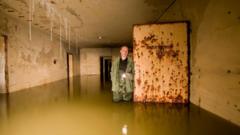
The structure at the center of the storm is a sprawling, multi-level fortress built under the direction of Albert Speer, Adolf Hitler’s chief architect. Designed to protect thousands of civilians—and elite party members—from Allied bombing raids, its walls are several meters thick. It was engineered to survive an apocalypse. It succeeded. Decades after the fall of the Third Reich, the bunker remains entirely intact, an awkward monolithic block sitting on prime real estate that is currently valued at tens of millions of euros.
The Cost of Erasing Concrete
Demolishing a Nazi bunker is a logistical nightmare. These structures were built with dense, steel-reinforced concrete meant to withstand direct hits from heavy artillery. Conventional wrecking balls do not work here. Dynamic blasting is out of the question because the shockwaves would shatter the foundations of surrounding residential blocks and historic buildings.
To remove even a fraction of this concrete requires specialized diamond-tipped saws, hydro-demolition robots, and months of continuous, deafening labor. The financial cost of demolition often exceeds the value of the land itself. For private developers, this is a calculated gamble. They wager that the premium prices commanded by high-end Berlin real estate will eventually offset the astronomical cost of clearing the site.
Yet, the financial math ignores the cultural deficit. Activists argue that removing these physical scars makes it easier for society to forget how quickly democracy crumbled in the 1930s. If you flatten the bunker, you flatten the memory.
The Ethics of Adaptive Reuse
Some urban planners suggest a middle ground known as adaptive reuse. Instead of deploying heavy machinery to pulverize the concrete, why not convert the space into something useful? Berlin has a track record with this approach. The Boros Collection, a world-renowned contemporary art gallery, is housed inside a towering wartime bunker in the Mitte district. Another bunker in the city was converted into a multi-story nightclub, while others serve as secure data storage facilities.
But conversion is fraught with its own ethical traps. Transforming a site where fanatical Nazi ideology was reinforced into a luxury penthouse or a trendy gallery risks trivializing the past. There is a fine line between reclaiming a space and commercializing atrocities.
Opponents of the current demolition plan point out that the city is rapidly running out of authentic, unaltered historical sites. Museum exhibits with polished plaques cannot replicate the claustrophobic terror of standing inside an original windowless concrete vault.
Bureaucracy as a Weapon
The current gridlock is playing out in local zoning offices and regional courts. Heritage protection laws in Germany are strict, but they contain loopholes regarding economic viability. If a property owner can prove that preserving a historic structure is financially ruinous, courts sometimes grant demolition permits.
Developers are exploiting these legal gray areas. They file endless engineering reports demonstrating the structural decay or toxic mold present inside the sealed underground chambers. They claim the building is a public safety hazard. On the other side, preservationists use delaying tactics, filing injunctions based on the potential presence of rare bat colonies nesting in the damp concrete fissures, or demanding further archaeological surveys to ensure no wartime remains are buried beneath the floorboards.
It is a war of attrition waged with paperwork.
The Real Housing Crisis
The debate exposes a glaring hypocrisy in Berlin’s municipal governance. The city is facing a severe housing shortage, with tens of thousands of working-class residents priced out of the market. Politicians often use the housing crisis to justify greenlighting controversial development projects on historic land.
The irony is sharp. The apartments slated to replace the Nazi bunker are not affordable social housing units for struggling Berlin families. They are high-concept, luxury flats designed for international investors and wealthy executives. The "public good" argument used to override heritage preservation is a smoke screen for private profit.
Preserving the bunker does not rob regular Berliners of a place to live; it robs developers of a massive payday.
Memories Can Not Be Sanitized
Germany’s culture of remembrance is praised worldwide, but it faces a generational shift. As the last survivors of the war pass away, the physical landscape must do the heavy lifting of education. Airbrushing the cityscape to create pristine, unblemished neighborhoods creates a dangerous collective amnesia.
The concrete monster beneath Berlin is ugly, inconvenient, and expensive to maintain. That is exactly why it needs to stay. It serves as a permanent architectural warning sign, an immovable obstacle that forces a modern, progressive city to confront its darkest historical roots every single day.