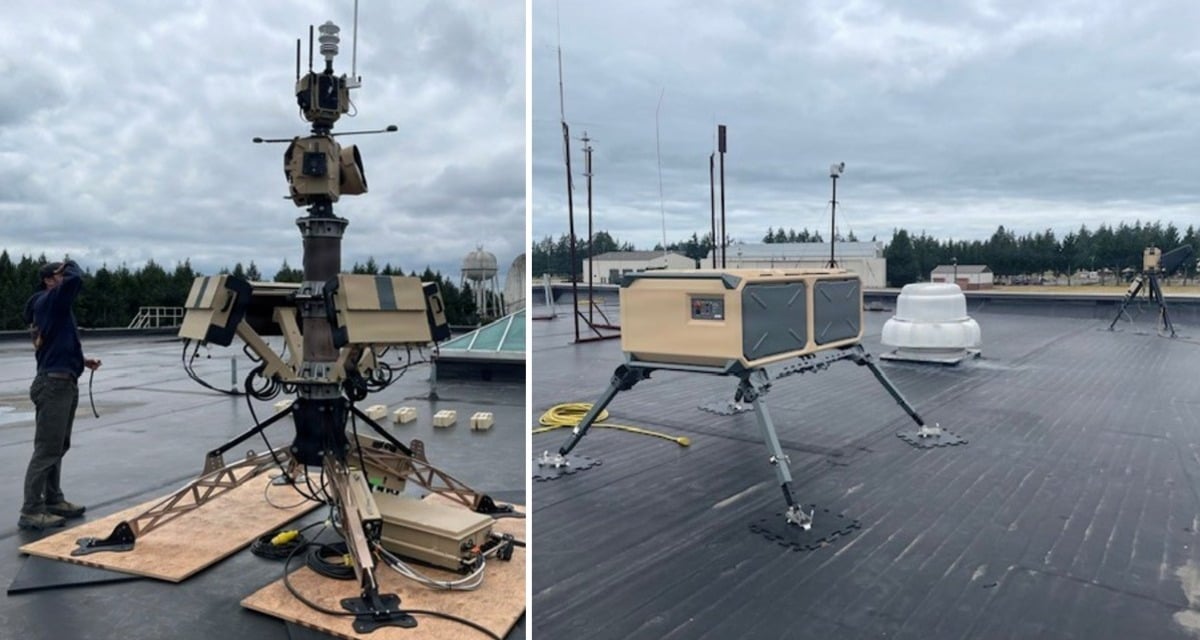
Commercial uncrewed aircraft are buzzing American military installations with impunity, exposing a gaping vulnerability in domestic homeland security that the Pentagon is scrambling to fix. For years, bureaucratic red tape and outdated rules of engagement left base commanders powerless to stop low-cost quadcopters from mapping classified facilities. Now, the military is deploying a new kinetic interceptor system to a key West Coast hub in Washington state to finally shoot these intruders down. But while a fresh batch of hardware looks good on paper, it reveals a deeper crisis regarding how slow the nation has been to adapt to small-scale aerial threats on its own soil.
The deployment of these defense systems to the Pacific Northwest represents a frantic shift in strategy. For over a decade, defense planners treated small drones as an overseas nuisance, something confined to the battlefields of the Middle East or eastern Europe. That illusion shattered when fleets of unidentified aircraft began lingering over sensitive domestic installations, including nuclear storage sites and major shipping ports.
The Shifting Threat Over Domestic Airspace
The United States northern command recently disclosed that domestic military bases recorded roughly 230 unauthorized drone incursions within a single twelve-month period. These were not casual hobbyists losing control of their backyard toys. The aircraft exhibited coordinated flight patterns, prolonged loitering times, and advanced electronic resistance. They appeared over Langley Air Force Base in Virginia, hovered near Wright-Patterson Air Force Base in Ohio, and penetrated the restricted airspace around the Picatinny Arsenal in New Jersey.
The West Coast has become a particularly high-stakes theater for these encounters. The Pacific coastline hosts some of the most critical logistical infrastructure in the global defense network. Massive shipping complexes, naval shipyards, and strategic transport hubs handle the bulk of the material destined for the Indo-Pacific theater. If an adversary wants to disrupt American power projection, they do not need to launch a intercontinental ballistic missile. They simply need to disrupt the flow of cargo containers at the water's edge.
This reality prompted the military to conduct a series of urgent maritime technology demonstrations along the West Coast. Organizations like the 834th Transportation Battalion have been testing autonomous surface vessels and advanced sensors to monitor the restricted waters surrounding strategic ports. The goal is to detect threats well before they reach the shore. However, knowing a threat is present solves only half the problem. Taking it out safely in a crowded domestic environment is where the system frequently breaks down.
The Flaw in Electronic Warfare
Until recently, the military relied almost exclusively on non-kinetic methods to handle rogue aircraft. Electronic warfare systems designed to jam radio frequencies or spoof global positioning signals were the preferred tools. The logic seemed sound. Jamming stops the drone without scattering shrapnel over a civilian neighborhood or an active runway.
In practice, electronic jamming has massive limitations. Modern commercial drones are increasingly autonomous. They no longer rely on a continuous radio link to a pilot on the ground. Many are programmed to navigate using optical recognition or inertial guidance systems that are entirely immune to standard radio-frequency jamming. When a drone does not care about GPS signals, a traditional jamming gun becomes nothing more than an expensive piece of plastic.
Furthermore, blasting powerful electromagnetic signals inside the United States creates immediate regulatory and operational headaches. A jammer strong enough to bring down a hostile drone can easily disrupt local emergency services, commercial air traffic control, or civilian cell towers. In a domestic setting, base commanders found themselves hamstrung by Federal Communications Commission regulations and Federal Aviation Administration flight safety rules. They had the technology to jam the signal, but using it risked knocking out the communications of the surrounding city.
Going Kinetic with Fly-Away Kits
Recognizing the limits of electronic warfare, northern command initiated a program to field rapidly deployable counter-drone teams. These teams use specialized transportable packages designed to be loaded onto C-130 cargo planes and rushed to any base experiencing an active wave of incursions. The West Coast is slated to host one of these primary quick reaction forces.
The core of this new capability is a shift toward low-collateral kinetic defeat. Instead of trying to scramble the brain of an incoming aircraft, the new system physically destroys it. The package uses a hit-to-kill interceptor drone that acts as a guided missile against small aerial targets.
When passive tracking sensors detect an intruder, the interceptor launches from a localized pad. It climbs to a loitering altitude, acquires the target using internal tracking systems, and rams into the hostile craft at high speed. This physical impact neutralizes the target immediately, forcing it out of the sky without relying on explosive warheads that could cause widespread secondary damage on the ground.
This mechanical approach solves the autonomy problem. It does not matter how advanced the intruder's programming is if its propellers are snapped in half by a high-impact collision. By avoiding explosives, the system minimizes the risk to nearby civilian infrastructure, making it a far more viable option for bases nestled right next to major urban centers.
The Friction of Command and Authority
Deploying hardware is simple compared to resolving the legal gray areas that govern domestic military action. The true bottleneck in American drone defense is not a lack of interceptors. It is a lack of clear authority.
Under historical legal frameworks, an installation commander's power stops abruptly at the base fence line. If a hostile drone is sitting fifty yards outside the perimeter, filming a sensitive hangar or tracking the movement of a troop transport, the base commander technically has no legal right to destroy it. That jurisdiction belongs to local law enforcement or federal agencies like the Federal Bureau of Investigation.
This jurisdictional split creates an absurd operational lag. A small commercial drone can cross a perimeter wall in three seconds. If a military operator must verify authorities, consult with legal teams, and coordinate with local police departments before pressing a launch button, the target has already completed its mission and flown away. The adversary exploits this bureaucratic gap with perfect precision.
The Department of War recently issued updated guidance to address this specific vulnerability. The new rules give base commanders expanded flexibility to track, assess, and mitigate aerial threats well before they cross the physical boundaries of the installation. Commanders are now required to draft comprehensive protective plans that outline exactly how they will engage targets that linger near their borders.
The Logistics of Unlimited Magazine Depth
Any long-term defense strategy must reckon with basic economics. The current conflict trends in Europe and the Middle East demonstrate that adversaries will gladly trade hundreds of cheap, mass-produced drones to deplete an opponent's supply of expensive defense munitions.
Using a multi-million-dollar air defense missile to knock down a thousand-dollar quadcopter is a losing equation. The military cannot afford to run out of ammunition during a sustained harassment campaign. This reality is driving the push toward software-defined systems and reusable or low-cost interceptors.
The ideal defense system requires an effectively unlimited magazine depth. A hit-to-kill interceptor that can be recovered, repaired, and refitted after a successful engagement changes the financial calculus completely. Similarly, the integration of automated tracking software allows a minimal number of human operators to manage complex multi-drone scenarios without becoming overwhelmed by the sheer volume of data.
The Unseen Intelligence Gathering Mission
Rogue drone flights are rarely just about simple harassment. They are sophisticated data-collection operations. A quadcopter equipped with high-definition optical cameras, thermal imagers, or radio-frequency sniffers can gather an immense amount of actionable intelligence simply by hovering near a base gate for ten minutes.
They map out the exact shift changes of security personnel. They record the specific structural vulnerabilities of buildings. They track the response times of emergency vehicles when a false alarm is triggered. Over months of repeated incursions, an adversary can build a highly detailed, real-time map of a base's operational habits.
This makes physical capture or recovery of the downed drones a vital priority for military intelligence. When a kinetic interceptor knocks a rogue drone out of the sky, the wreckage becomes a goldmine of information. Technicians can pull the storage drives to analyze the flight logs, pinpointing the exact location where the pilot launched the aircraft. They can examine the serial numbers of the components to trace the supply chains used by foreign intelligence services to bypass trade restrictions.
The Road Ahead for West Coast Security
The arrival of advanced interceptor systems at a key Washington state installation is an admission that the homeland is no longer a safe sanctuary. The oceans that historically protected the United States from foreign interference offer no protection against an off-the-shelf drone launched from the back of a rental truck parked a mile outside a base gate.
Relying on a few specialized quick reaction teams is a temporary fix for a permanent problem. The military cannot rely entirely on flying response kits around the country every time a rogue quadcopter appears on a radar screen. True security will require a permanent, layered defense architecture installed at every single major facility across the nation. This means permanent radar arrays, integrated optical tracking cameras, and localized kinetic options ready to fire at a second's notice.
The transition from a reactive posture to a proactive defense is bound to cause friction with local communities. Civilian populations living near major military bases will have to grow accustomed to the sight of defensive aircraft operating overhead. They will have to accept that the airspace above their neighborhoods is being actively monitored by military sensors. The alternative is to leave the nation's most vital logistical hubs wide open to surveillance and disruption by anyone with a few hundred dollars and an internet connection.


