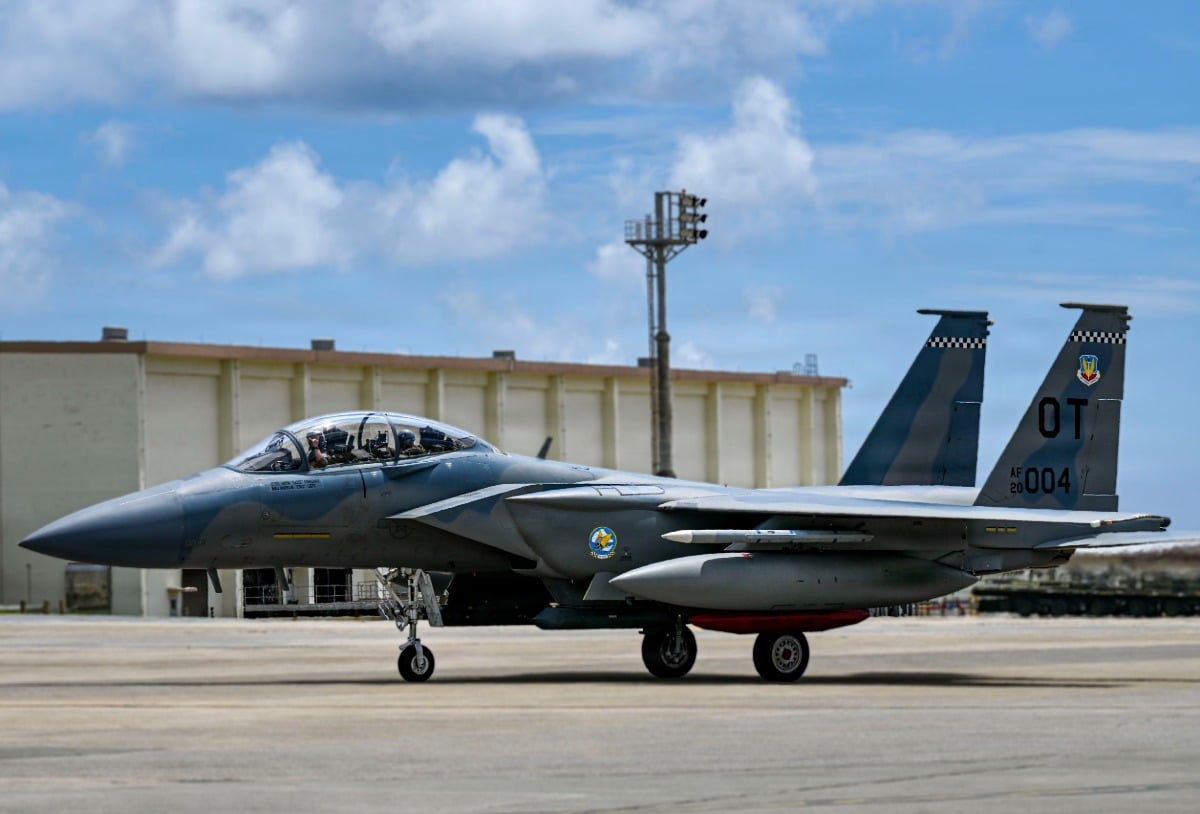
The return of the F-15EX Eagle II to Kadena Air Base in Okinawa, Japan, was greeted with the usual fanfare of military public relations. Press releases from the 18th Wing heralded the arrival of the test aircraft as a major step toward deploying next-generation airpower in the Indo-Pacific. But beneath the polished imagery of the June 29, 2026 landing lies a far more troubling reality of industrial bottlenecks, missed timelines, and a high-stakes shell game that the U.S. Air Force has been forced to play on the doorstep of the Taiwan Strait.
The fundamental issue is that the F-15EX was not supposed to be just visiting.
Under the original Pentagon roadmap, permanent deployment of the service’s newest heavy fighter to Okinawa was slated to begin in the spring of 2026. Instead, the Air Force is executing temporary "familiarization deployments" using test aircraft from the 85th Test and Evaluation Squadron based out of Eglin Air Force Base, Florida. Ground crews and maintainers are using these short stints to train on the fighter's digital architecture because the actual operational squadrons are nowhere to be found. They are stuck in a production pipeline that has been repeatedly choked by manufacturing delays, design revisions, and a crippling monthslong labor strike at Boeing's St. Louis facility last year.
Air Force Secretary Troy Meink recently admitted to lawmakers that the first permanent F-15EX units will not arrive at Kadena until 2027, with the full complement of 36 fighters delayed until at least 2028. For a base situated just 460 miles from Taiwan and 400 miles from the Chinese mainland, a year-long gap in permanent frontline airpower is a structural vulnerability the U.S. can ill afford.
The Empty Nest in Okinawa
For more than four decades, Kadena Air Base was anchored by two permanent squadrons of F-15C/D Eagles. These aircraft formed the backbone of American air superiority in the Western Pacific. However, by late 2022, those airframes were dangerously obsolete, suffering from structural fatigue that risked catastrophic failure during high-G maneuvers. The active-duty Air Force flew its final ceremonial F-15C flight out of Kadena in January 2025, effectively ending a 45-year permanent fighter presence on the island.
To mask the vacuum left by the retiring Eagles, the Pentagon resorted to a rotational strategy.
The Air Force began shuffling a rotating cast of F-22 Raptors, F-35A Lightning IIs, and advanced F-16s through Okinawa on grueling six-month deployments. While this approach keeps hulls on the tarmac, it extracts a massive toll on operational readiness. Moving entire squadrons across the Pacific disrupts pilot training cycles and strains logistics networks. More importantly, rotational forces lack the deep, institutional knowledge of the local theater that only comes with a permanently stationed wing. A pilot rotating in from Alaska or Virginia simply does not possess the same day-to-day familiarity with regional airspace, local weather anomalies, and joint coordination procedures as a crew that calls Okinawa home.
The F-15EX was explicitly purchased to solve this exact crisis. By utilizing an upgraded version of a legacy airframe, the Air Force believed it could rapidly swap out the aging C/D models without completely overhauling the existing maintenance facilities and supply lines at Kadena. It was billed as a plug-and-play solution.
Industrial reality shattered that expectation.
The Missile Truck Doctrine
Defenders of the program often point out that the F-15EX is the most heavily armed fighter in the Western inventory. It features an advanced AN/APG-82(V)1 Active Electronically Scanned Array radar, the EPAWSS electronic warfare suite, and digital fly-by-wire controls. Most crucially, it can carry twelve AMRAAMs simultaneously, far exceeding the internal weapon bays of the F-22 or F-35.
In a hypothetical conflict over the Taiwan Strait, the F-15EX is designed to function as a flying magazine.
[ F-35 Stealth Fighter ] ---> Spots targets via low-observable sensors
                                    |
                                    v (Secure Data Link)
                                    |
[ F-15EX Eagle II ]      ---> Fires long-range hypersonic or cruise missiles
Stealth fighters would slip through enemy radar networks undetected, acting as forward scouts to identify targets. They would then transmit targeting data back to the F-15EX, which would sit safely outside the immediate threat envelope and launch heavy stand-off ordnance or large salvos of air-to-air missiles. This division of labor is mathematically sound on paper. The F-35 has superior survivability but lacks payload volume; the F-15EX has immense payload volume but lacks stealth.
Yet this doctrine hinges entirely on numbers. The Air Force initially downsized its planned purchase of the F-15EX, only to reverse course in the fiscal 2027 budget projections by boosting planned procurement back up to 267 aircraft. Lawmakers are even pushing for authorization to buy up to 329. The sudden urgency stems from the realization that fifth-generation stealth fleets are too expensive to sustain and too limited in ammunition capacity to win a war of attrition against a peer adversary.
The Growing Capability Gap
While Washington wrestles with factory floors and budget lines, Beijing is moving at an alarming pace. The People’s Liberation Army Air Force has rapidly expanded its fleet of J-20 fifth-generation stealth fighters. These aircraft are large, fast, and heavily armed with long-range PL-15 missiles designed specifically to target American tankers and airborne early-warning planes.
By the time the last permanent F-15EX arrives at Kadena in 2028, China will be on the cusp of introducing its first sixth-generation fighter platforms. This creates an awkward tactical paradox. The U.S. Air Force is spending billions of dollars to permanently station a heavily modified 1970s airframe at its most critical Pacific hub, precisely as the adversary transitions to advanced low-observable platforms that can detect and engage non-stealth targets from extreme ranges.
The advanced avionics on the Eagle II are impressive, but they cannot rewrite the laws of physics. A non-stealthy aircraft presents a massive radar cross-section that allows Chinese ground-based air defense systems and naval vessels to track it the moment it leaves the runway at Kadena.
The delay in deploying the F-15EX means that for the next two years, the defense of Okinawa relies entirely on a patchwork of temporary deployments. This stopgap measure keeps the deterrence equation barely balanced, but it leaves no margin for error. If another manufacturing bottleneck hits the aerospace supply chain, or if the regional geopolitical climate deteriorates before 2027, the Air Force will find itself fighting tomorrow's war with yesterday's logistics. Deterrence is not built on temporary visits or test aircraft; it is built on permanent, credible mass. Until those 36 operational airframes are bolted to the flight line at Kadena, the American posture in the Western Pacific remains dangerously fragile.