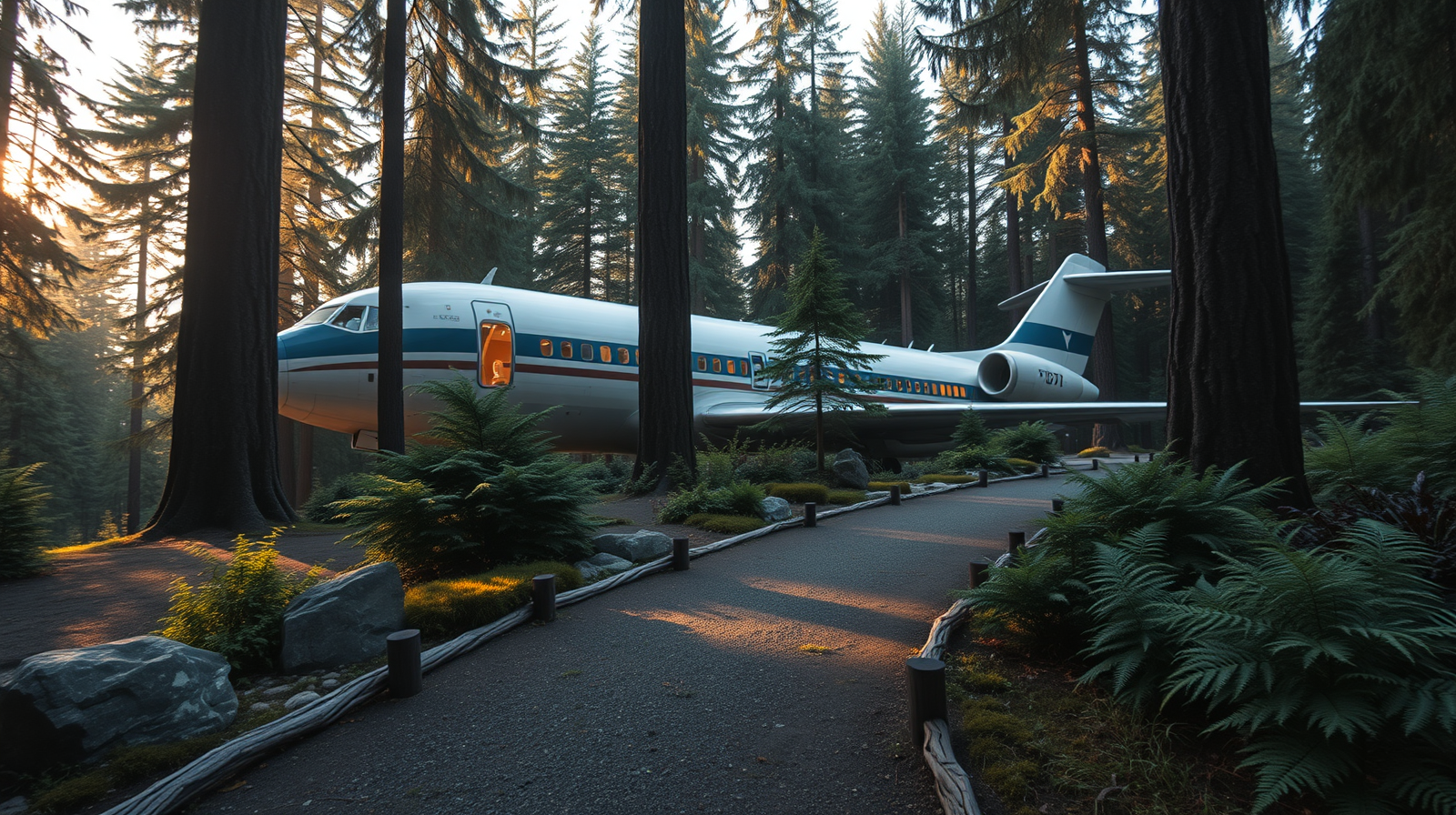
When retired electrical engineer Bruce Campbell wired roughly one hundred thousand dollars to secure a decommissioned Boeing 727-200 in 1999, he was not chasing a quirky internet trend. He was executing a calculated architectural thesis. The aircraft, which once carried passengers for Olympic Airways in Greece, now rests permanently on a wooded plot in Hillsboro, Oregon. It spans over a thousand square feet of pressurized cabin space, operating as a fully functional, debt-free residence. Yet, the viral fascination surrounding this forest jetliner often obscures the grueling physical reality, the staggering logistical hurdles, and the regulatory nightmares required to turn a commercial fuselage into a homestead.
People love the headline. They share the photos of the preserved cockpit and the improvised interior layout. Beneath the novelty lies an uncompromising engineering challenge that most prospective alternative housing enthusiasts completely underestimate. Commercial jetliners are marvels of aerospace design, but they are fundamentally hostile environments for domestic habitation without intense, prolonged intervention.
The Financial Illusion of Cheap Aircraft
Acquiring a commercial airframe often sounds deceptively affordable on paper. Airplanes sitting in desert boneyards or foreign tarmac placeholders can occasionally command surprisingly low purchase prices relative to their immense physical scale. A hull might cost the same as a modest family car.
That initial price tag represents a fraction of the true capital outlay. Transporting a retired Boeing 727 from Athens to an Oregon airfield, tearing down its massive wings, stripping its heavy interior components, and hauling the fuselage section by section through rural roadways required an additional layout that exceeded one hundred thousand dollars. Cranes, specialized flatbed transport, municipal permits, and structural reassembly crews do not offer charity rates.
Furthermore, a bare aluminum tube is not a house. It lacks thermal insulation suited for damp forest winters, domestic plumbing fixtures, standard electrical grid hookups, and wastewater management systems. Converting high-tensile alloy framing into a comfortable living space demands specialized fabrication skills. If you cannot do the welding, wiring, and structural modifications yourself, labor costs will rapidly eclipse the price of traditional residential construction.
Material Science Versus Conventional Framing
Standard residential houses are built with wood studs and drywall, materials that degrade, rot, and succumb to moisture and pests over decades. Commercial aircraft are engineered from high-grade aluminum and titanium alloys meant to withstand massive pressurization cycles, extreme shear forces, and high-altitude temperature swings.
In terms of structural integrity, a decommissioned jetliner outlasts conventional stick-built homes by orders of magnitude. The hull acts as an extraordinary pressure vessel, impervious to windstorms that would rip roofs off standard suburban properties.
Living inside a metal tube introduces unique thermal physics. Aluminum is an exceptional thermal conductor. Without aggressive retrofitting, an aircraft hull acts like an oven in summer and a refrigerator in winter. Condensation becomes an immediate adversary. Human breath, cooking vapor, and ambient humidity inside a sealed metal cylinder generate moisture that has nowhere to escape. Without meticulously engineered vapor barriers and ventilation networks, the interior will corrode from the inside out, turning the dream home into a rusting shell.
Regulatory Labyrinth and Zoning Realities
Try calling your local county planning department and asking for a permit to anchor a commercial jetliner in your backyard. The response will range from stunned silence to an immediate code violation notice.
Most municipal zoning boards operate with rigid rulebooks designed for traditional foundations, standard roof pitches, and conventional setbacks. An airplane does not fit standard zoning definitions. Is it a structure? Is it a vehicle? Is it a temporary storage container?
Navigating this bureaucratic gray area requires immense patience and legal maneuvering. Setback requirements, environmental impact assessments regarding fuel residue or hydraulic fluid runoff, and structural safety sign-offs can stall a project for years. Many jurisdictions outright ban unconventional structures due to aesthetic covenants or outdated building codes. Buying land in an unzoned or loosely regulated rural area is usually the only viable path, which introduces secondary complications regarding access to utilities, emergency services, and winter road maintenance.
The Maintenance Burden of a Flying Museum
Owning a retired airliner means committing to lifelong maintenance. Aluminum requires protection from oxidation. Exterior surfaces must be regularly washed and inspected. The thousands of original fasteners, seals, and windows demand continuous monitoring to prevent water intrusion.
Inside, maintaining vintage avionics and complex legacy electrical systems turns the homeowner into a full-time curator. Systems designed for flight crews and commercial passengers do not naturally integrate with residential appliances like refrigerators, dishwashers, and HVAC units. Every modern convenience must be custom-fitted into curved bulkheads and tight wiring channels.
The lifestyle demands a distinct psychological profile. Privacy is difficult to maintain when your home resembles a roadside tourist attraction. Curious onlookers frequently wander onto private property hoping to catch a glimpse of the cockpit or snap a photograph of the wingtips extending into the tree line.
Upcycling a commercial airliner into a home remains a breathtaking exercise in radical engineering independence. It proves that rigid infrastructure conventions can be challenged. It demonstrates that durable materials can be rescued from premature destruction in industrial boneyards.
The path requires deep technical competence, substantial capital beyond the initial hull purchase, and a willingness to wage war against condensation, bureaucracy, and public curiosity. For the vast majority of people, the fantasy of living in the clouds is far more comfortable than battling the cold, curved reality of an aluminum tube on the forest floor.