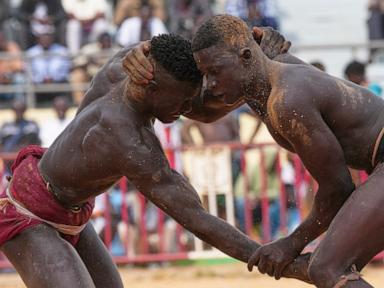
The flashing cameras of foreign photojournalists love the mysticism of la lutte sénégalaise. They capture the glint of sweat on a heavyweight’s bicep, the pouring of translucent herbal liquids over broad shoulders, and the intricate leather gris-gris amulets tied around thick waists. This romantic view frames Senegalese wrestling, known locally as làmb, as an unbroken line to an ancient African past, a communal celebration where rituals eclipse the raw violence of bare-knuckle combat.
That narrative is dangerously incomplete. The reality inside the arenas of Dakar is not a pastoral poem; it is a cutthroat marketplace born out of economic desperation, political maneuvering, and high-stakes corporate betting. While Western galleries applaud the aesthetics of the pre-fight rituals, the fighters themselves are operating within a brutal economic machine where mysticism is leveraged as a business asset, and where a deep domestic financial crisis threatens to break the entire sport.
Senegal is grappling with its worst fiscal crisis in decades, characterized by a massive sovereign debt strain that surged past 130% of GDP following the uncovering of billions in unrecorded spending from previous administrations. In this environment of hyper-precarity, where formal employment is a luxury and traditional sectors like local fishing are collapsing under the weight of foreign industrial trawling, làmb has evolved from a village harvest ritual into the primary engine of social mobility for thousands of young men. It is an industry built on the premise that a man can pull his entire family out of poverty using nothing but his fists and his faith. Yet behind the multi-million CFA franc contracts of a dozen elite champions lies a vast, unregulated underclass of thousands of fighters earning less than $2,000 a year, risking permanent neurological damage in a country with virtually no sports medicine infrastructure.
The Neoliberal Evolution of the Sandbox
To understand how a rural pastime became a corporate behemoth, one must look back to the mid-1990s. Before that era, traditional wrestling was largely an amateur affair organized by the Serer and Lebou ethnic groups. Fights were held to mark the end of the harvest or to celebrate local heroism. The rewards were symbolic: a sack of rice, a head of cattle, or a few bills tossed by village elders.
That changed with the arrival of promoters like Gaston Mbengue and the rise of a legendary wrestler who called himself Tyson, named deliberately after the American heavyweight boxer Mike Tyson. Tyson revolutionized the sport by treating it strictly as a commercial venture. He entered the arena wrapped not just in traditional fabrics, but in the American flag, demanding unprecedented payouts.
This shift transformed làmb into a highly commercialized, televised spectacle that allows bare-knuckle punching (lutte avec frappe). The introduction of striking, heavily influenced by French colonial-era boxing exhibitions, turned a grappling art into a bloody, high-value television product. Suddenly, major telecommunications firms, mobile money platforms, and domestic breweries realized that wrestling arenas could draw 60,000-seat crowds and capture millions of viewers across West Africa. Top-tier tickets in Dakar now fetch up to $85, an astronomical sum in a country where the average annual per capita income hovers around $2,000.
For the modern wrestler, the trajectory from a neighborhood training camp (écurie) to the national stadium is a calculated business strategy. The training camps that dot the beaches of Dakar’s suburbs, such as Pikine and Guédiawaye, function like corporate incubators. Dozens of young men wake up at dawn to run through the Atlantic surf and lift makeshift weights made of concrete blocks and iron car axles. They are not doing this to preserve heritage; they are doing it because the formal economy has shut them out.
The Economics of Mysticism and the Marabout’s Fee
The elaborate rituals that tourists find so captivating are, in truth, the most expensive line items on a fight promoter’s balance sheet. The spiritual preparation for a major bout is not a casual prayer; it is an organized, competitive industry run by marabouts—Sufi spiritual guides who wield immense social and political power in Senegal.
A champion wrestler does not step into the sand alone. He is backed by a corporate-style syndicate of trainers, managers, griots (traditional praise singers and drummers), and a dedicated team of marabouts. The spiritual defense strategy is treated with the same confidentiality as a corporate merger. Weeks before a fight, a wrestler’s team will spend thousands of dollars sourcing specific ingredients for protective potions: sacred water from remote villages, rare roots, and verses of the Koran written on tiny slips of paper dissolved into liquid.
"To win in the arena, your spiritual armor must be heavier than your opponent's," explains a veteran trainer based in Dakar. "If a wrestler loses, the public rarely blames his physical conditioning. They blame his marabout for failing to block the mystical attacks of the rival camp."
This creates a hidden economy within the sport. A top-tier fighter like Balla Gaye 2 or Eumeu Sène can command upward of $200,000 for a single match. However, a massive percentage of that purse is immediately liquidated to pay the spiritual retinue. The marabouts demand flat fees and performance bonuses that can swallow up to 30% of a fighter’s earnings.
Furthermore, the ritual acts themselves are deeply competitive. When a wrestler enters the arena covered in gris-gris and begins dousing himself in oils, he is engaging in a psychological warfare campaign designed to break his opponent's resolve before the first blow is landed. The drumming of the griots and the synchronized chanting of women in the stands are carefully timed performances paid for by the promoters to maximize television ratings. It is an intricate synthesis of ancient belief and modern showbiz.
The Sovereign Debt Crisis Meets the Arena
The entire economic architecture of Senegalese wrestling is now facing a severe structural threat. The structural adjustment pressures and political friction between President Bassirou Diomaye Faye and Prime Minister Ousmane Sonko have sent shockwaves through the domestic private sector. The government’s aggressive tax audits and the imposition of new levies on mobile money transfers have squeezed the very corporate sponsors that keep làmb alive.
Historically, the sport relied on massive cash injections from major telecom brands and state-linked enterprises. With international capital markets tightening and external grants dropping significantly, those marketing budgets are evaporating. Promoters are finding it increasingly difficult to secure the bank guarantees required by the National Wrestling Management Committee Committee (CNG) to sanction high-profile matches.
| Tier of Wrestler | Average Payout per Fight (USD) | Number of Fights per Year | Primary Revenue Source |
|---|---|---|---|
| Elite Champions (Top 10) | $100,000 – $250,000 | 1 — 2 | Corporate Sponsors, TV Rights |
| Mid-Card Contenders | $5,000 – $15,000 | 2 — 3 | Local Promoters, Neighborhood Patrons |
| Preliminary Fighters | $500 – $2,000 | Variable | Informal Community Pools, Small Endorsements |
As the table demonstrates, the wealth disparity within the sport mirrors the broader socioeconomic fragmentation of the country. For every superstar who signs an endorsement deal with a mobile network, there are hundreds of preliminary fighters who suffer broken jaws and concussions for a few hundred dollars. Because the sport operates largely in the informal sector, these athletes have no health insurance, no pension plans, and no legal recourse if a promoter defaults on a payment.
The Dark Side of the Stadium Gates
The commercialization of làmb has also brought a darker element to Senegal's urban centers: rampant sports betting and stadium violence. In a society where youth unemployment is high, the matches have become a lightning rod for broader social frustrations.
When a major neighborhood champion loses, the fallout is rarely confined to the sand. The youth of the losing district, many of whom have wagered their daily survival money on mobile betting apps, frequently clash with police outside the stadiums. Concrete blocks are hurled, cars are burned, and tear gas routinely drifts over the arenas. The CNG has attempted to curb this by issuing heavy fines to wrestlers whose fans cause disruptions, but these measures fail to address the underlying issue. The arena is one of the few places where the marginalized youth of Dakar feel they have a stake in something tangible, and when that stake vanishes, the reaction is volatile.
To view Senegalese wrestling merely through the lens of cultural preservation is to miss the point entirely. It is a highly sophisticated, high-risk economic coping mechanism disguised as heritage. The rituals, the leather amulets, and the sacred chants are entirely real to the participants, but they are operating within a modern capitalistic frame that demands spectacle, blood, and profit. As the country navigates its deep financial restructuring, the sand of the arena will remain a stark mirror of Senegal's broader struggle for economic survival.