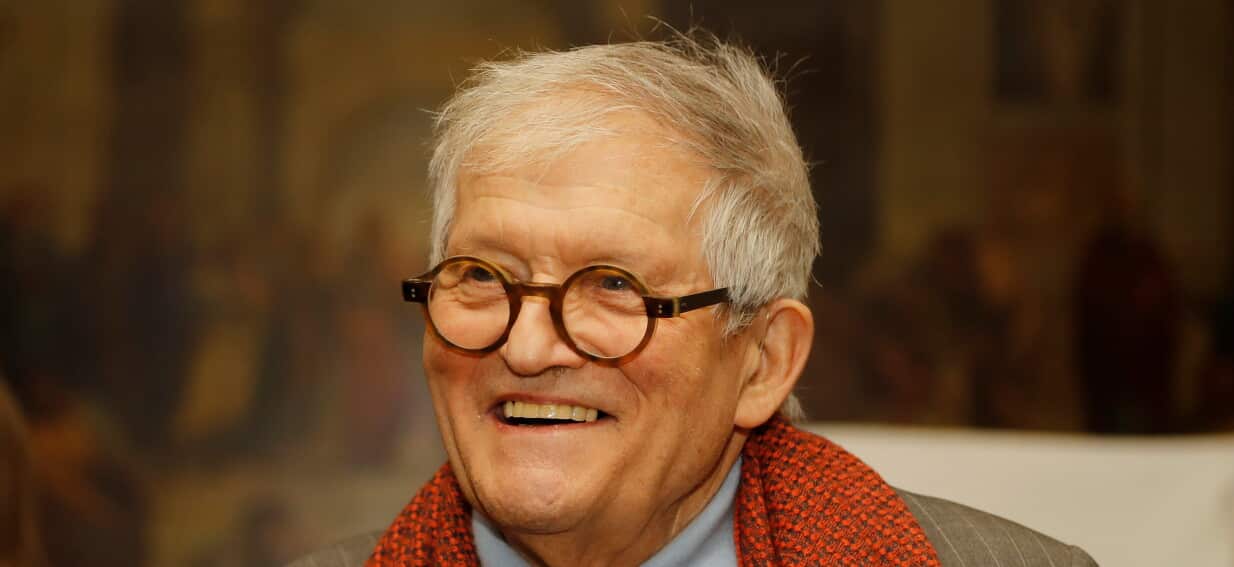
The art world lost its most persistent disruptor when David Hockney passed away at age 88. For more than six decades, Hockney refused to play by the established rules of contemporary art, consistently defying critics who dismissed his work as overly accessible or merely decorative. His death marks the end of an era, leaving a void that cannot be easily filled by today’s conceptually heavy, market-driven artists. While early obituaries fixate on the record-breaking auction prices of his swimming pool paintings, the true weight of his legacy lies in his relentless, technophilic interrogation of how human beings actually see the world.
Hockney was a populist who possessed a formidable, calculating intellect. His career was a lifelong rebellion against the tyranny of abstract expressionism and the rigid dictates of art world gatekeepers. He insisted on representation, on color, and on the validity of pleasure when the cultural elite demanded austerity.
The Myth of the Easy Masterpiece
The art market loves a simple narrative. It prefers to package Hockney as the quintessential California dreamer, the man who captured the sun-drenched, hedonistic leisure of Los Angeles in the 1960s. This view is incomplete. It reduces a complex, technically rigorous painter to a lifestyle brand.
His famous swimming pool series was not born from a desire to paint wealthy backyards. It was a brutal technical challenge.
"Water in a swimming pool changes its look from minute to minute," Hockney once observed. "To capture that fluidity with a medium as static as acrylic paint is an exercise in profound frustration."
The squiggly lines, the flat planes of color, and the sharp lines of architectures were deliberate architectural choices. He was dismantling perspective. He sought to replace the single, static viewpoint of the camera with the shifting, dynamic experience of a living eye.
This fixation on human vision drove his later, often controversial experiments. In the 1980s, Hockney turned his attention to photocollages, which he called "joiners." By assembling dozens of Polaroid or 35mm photographs of a single scene taken from slightly different angles and moments, he constructed a cubist reality. He proved that a single photograph is inherently a lie because humans do not see the world in a single, frozen frame. We look, we look away, our eyes dart, and we construct an image over time.
The art establishment balked at these experiments, viewing them as gimmicky. They missed the point. Hockney was weaponizing consumer technology to expose the limitations of the camera, an instrument he believed had corrupted Western painting since the Renaissance.
The Secret Knowledge Controversy
In 2001, Hockney published a thesis that sent shockwaves through the academic world. He claimed that Western masters, including Caravaggio, Vermeer, and Ingres, had used optical devices like the camera obscura and camera lucida to achieve their uncanny realism.
The reaction from art historians was swift and defensive. They accused Hockney of reducing genius to a series of mechanical parlor tricks. They argued that he was projecting his own obsession with technology backward into history, tarnishing the sacred reputation of the Old Masters.
The Mechanics of the Lens
Hockney stood his ground, backed by the physicist Charles Falco. Together, they demonstrated specific visual anomalies in paintings from the 15th century onward that could only be explained by the use of lenses. They identified mismatched perspectives, sudden shifts in focus, and complex patterns that were mathematically consistent with optical projection.
[Historical Painting Analysis]
  │
  ├── Mismatched perspectives (Multiple vanishing points)
  ├── Sudden shifts in focus (Depth of field limitations)
  └── Distorted patterns on curved surfaces (Lens aberrations)
This was not an attempt to diminish the achievements of these artists. Hockney argued that using a tool did not lessen the skill required to create a masterpiece. It required an immense amount of artistry to translate a projected, upside-down image onto canvas with paint.
The controversy revealed a deep cultural divide. On one side stood the academics, protecting a romantic ideal of untainted, mystical genius. On the other stood Hockney, a working craftsman who understood that artists have always used every available tool to solve the problem of representation.
Shifting Focus to the iPad
While his contemporaries settled into comfortable, predictable late-career styles, Hockney pivoted to digital mediums. When the iPhone and iPad launched, he did not see them as toys or business tools. He saw them as a brand-new way to paint.
He began drawing with his thumbs, and later with a stylus, producing hundreds of vibrant landscapes, portraits, and still lifes. Critics were skeptical, often treating these digital works as the eccentric hobbies of an aging man.
They failed to see the logistical liberation the medium offered. The iPad removed the physical friction of painting. There was no waiting for paint to dry, no brushes to clean, and no canvas to prep. An artist could capture the fleeting light of dawn in real-time, working with a palette of pure, luminous light rather than ground pigments.
Furthermore, the digital files recorded the exact stroke-by-stroke sequence of their creation. Viewers could watch a painting build itself from the first line to the final wash of color. Hockney had dematerialized the art object, turning the process of painting into a performative event.
The Financial Spectacle and the True Value
In 2018, Hockney’s Portrait of an Artist (Pool with Two Figures) sold at Christie's for $90.3 million. At the time, it was the highest price ever paid at auction for a work by a living artist.
The media frenzy focused entirely on the numbers, treating the sale as the ultimate validation of his career. It was a distraction.
Auction Price: $90.3 Million (Market Value)
vs.
Artistic Legacy: Dismantling perspective, optical research, digital pioneering (True Value)
The hyper-financialization of the art world treats masterpieces as alternative asset classes, high-yield commodities for billionaires to trade or store in tax-free airport warehouses. Hockney himself was largely indifferent to this speculation. He had already moved on, living quietly in Normandy, painting the changing seasons on his iPad, entirely consumed by his work.
The inflation of his market value obscures the democratic nature of his art. Hockney made art that people enjoyed looking at. He did not require the viewer to read a multi-page curatorial essay to understand the meaning of a line. This accessibility was viewed with suspicion by an elite that often equates obscurity with depth.
The Final Shift
In his final years in northern France, Hockney returned to the landscape, creating massive, multi-canvas works that captured the arrival of spring. These paintings were an explosion of color, defiance in the face of mortality. They were immense, engulfing the viewer, forcing them to experience the scale and vitality of nature.
He was still fighting the camera. He argued that wide-angle lenses distort the edges of a frame, flattening the world into a sterile box. By combining multiple canvases, each painted from a slightly different perspective, he recreated the expansive, enveloping feeling of actually standing in a forest.
His late work was a triumphant assertion that painting is far from dead. In an era dominated by screens, algorithms, and conceptual installations, Hockney proved that the ancient act of applying color to a surface remains an unrivaled method for exploring human consciousness.
He did not fade away. He worked until the very end, his fingers stained with nicotine and ink, his eyes always looking forward. His true legacy is not a record-breaking auction price or a collection of iconic images of Southern California. It is a lifelong lesson in how to see. He challenged us to reject the passive, mediated images handed down by technology and instead look at the world with our own, flawed, magnificent eyes.