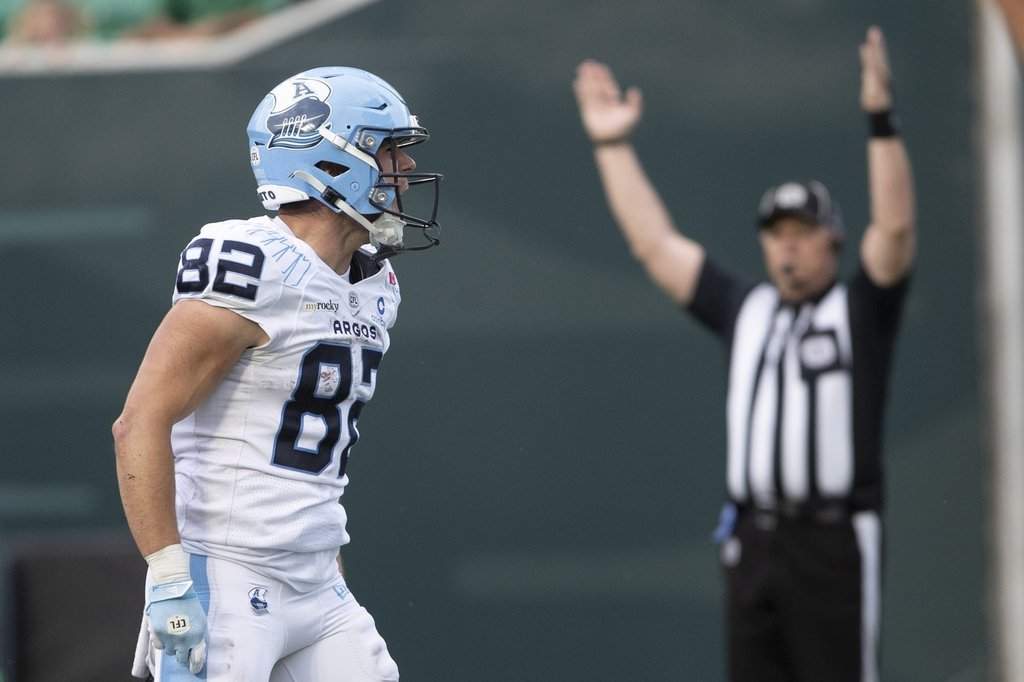
"Solid rookie season." That is the most polite, lazy way to bury the story of Tyler Kahmann's 2026 run with the Toronto Argonauts.
Seventy-seven catches. One thousand ninety-two yards. Eight touchdowns. The CFL's Most Outstanding Rookie trophy. You do not file a 1,000-yard rookie campaign and a league-wide award under "solid" unless you are reading off a press-release script written before the season started.
Standard Canadian Press coverage treats Kahmann's rise like a warm human-interest postcard. Small-town kid from Haysville, Kansas, population around 11,400. Rides public transit for the first time in Toronto. Watches film with quarterback Chad Kelly. Loves the wide Canadian field.
Cute story. Wrong question.
The lazy consensus asks how a former Division II Emporia State standout adjusted to big-city transit and three-down spacing. The real question is far uglier for talent evaluators across North American football: why did the NFL pass on him, why did Toronto waive him in October 2025 before bringing him back in January 2026, and what does his instant dominance expose about how front offices misprice volume receivers?
The "Solid Rookie" Myth and What the Numbers Hide
Traditional football coverage loves tidy narratives. A player struggles at first, figures out the playbook, and enjoys a "solid" year. Calling Kahmann's 2026 output merely solid flattens a season that separated him from every other first-year player in the league, finishing with 186 voting points to outpace British Columbia linebacker Parker McKenna (106) and Winnipeg defensive back Major Williams (63).
Look at his June 11, 2026 CFL debut against the Montreal Alouettes: six catches, 106 yards, and a touchdown right out of the gate after elevation from the practice roster. That is not a slow burn. That is immediate production on a 110-yard field with a 65-yard width and a one-yard neutral zone.
At the same time, raw counting stats in the CFL never tell the whole truth by themselves. A wide Canadian field and pre-snap waggle motion inflate yardage totals compared to the 100-by-53.3-yard American gridiron. Context matters. Defenses have 12 players on the field, which crowds intermediate windows even as horizontal space stretches coverage. You still have to win leverage, read zone drops, and catch contested balls through contact—just as Kahmann did in Regina against the Saskatchewan Roughriders while absorbing hits from multiple defensive backs.
Why Scouts Miss Players Like Kahmann
I have watched front offices spend real money chasing combine testing numbers while ignoring four years of relentless college tape because the logo on the helmet wasn't from a major conference. Kahmann posted 282 receptions, 3,686 yards, and 54 touchdowns across 47 games at Emporia State, earning two First-Team All-MIAA selections and First-Team All-American honors in 2024. Yet his pro day numbers—a 4.51-second 40-yard dash, a 30.125-inch vertical jump, and nine bench press reps—looked ordinary on a spreadsheet.
When an undrafted free agent gets cut by the Indianapolis Colts in August 2025, briefly lands on a practice squad, gets waived the next day, and then gets released by Toronto in October 2025, most observers stamp him "camp body." They confuse early roster churn with lack of ability.
In football evaluation, timing and spatial processing often matter more than a 0.08-second gap in straight-line sprint speed. Zone-beating receivers win by settling in soft spots, throttling down at the right depth, and giving the quarterback a clear throwing window on time. Kahmann himself pointed straight to that trait when talking about working middle-of-the-field zones and being "friendly with the quarterback".
Imagine a scenario where a scouting department grades receivers strictly on raw athletic thresholds and power-conference competition. Every small-school route technician with average burst gets filtered out before training camp even starts. The club saves time on the front end, then wonders why a low-cost import lights up another league a year later.
The Uncomfortable Truth About CFL "Adjustment"
People Also Ask whether adapting to Canadian football is harder for an American receiver than adapting to life in a major city. That framing gets the difficulty backward.
Learning which bus or subway line beats rush-hour traffic in Toronto is a logistics annoyance. Surviving 12-man defensive rotations, deeper end zones, and one-down-to-get-it urgency on second-and-long is a tactical problem. Most imports wash out because they run American routes—drifting vertically instead of finding open grass in deep zones—and force timing throws into tight coverage.
Kahmann bypassed much of that friction because he spent time in the building late in 2025, started watching film with Chad Kelly in training camp, and understood how Kelly delivers timing routes right out of a receiver's break. When injury forced him to shift positions and play more on the boundary midseason, he held up because he knew the structure of the offense, not just a single spot.
What Coaches and Front Offices Should Actually Do Next
If you run a CFL personnel department or coach wide receivers, stop treating small-college All-Americans as lottery tickets to stash and forget. Change how you evaluate them:
- Grade separation by timing, not just speed. Track how often a prospect wins at the top of the stem against off-zone and match coverage rather than relying on 40-yard dash times.
- Test mental retention early. Put rookies on film study with the starting quarterback immediately so route adjustments become automatic before live bullets fly.
- Cross-train perimeter and slot/wide spots. Versatility protects the offense when injuries hit key starters like Makai Polk.
There is a real catch to leaning too hard into small-school volume scorers. Lower-tier college corners sometimes give wide receivers cushions they will never see against veteran defensive backs in professional football, and a big rookie year creates a new problem: once league film piles up, defenses adjust, bracket your best routes, and test whether your second-year efficiency holds when the surprise element is gone.
Even with that caveat, calling Tyler Kahmann's rookie season merely solid misses the point. He proved that a patient, film-sharp receiver can walk into a wide-open game and take over. Everyone else was busy checking his hometown population; he was busy taking the league.