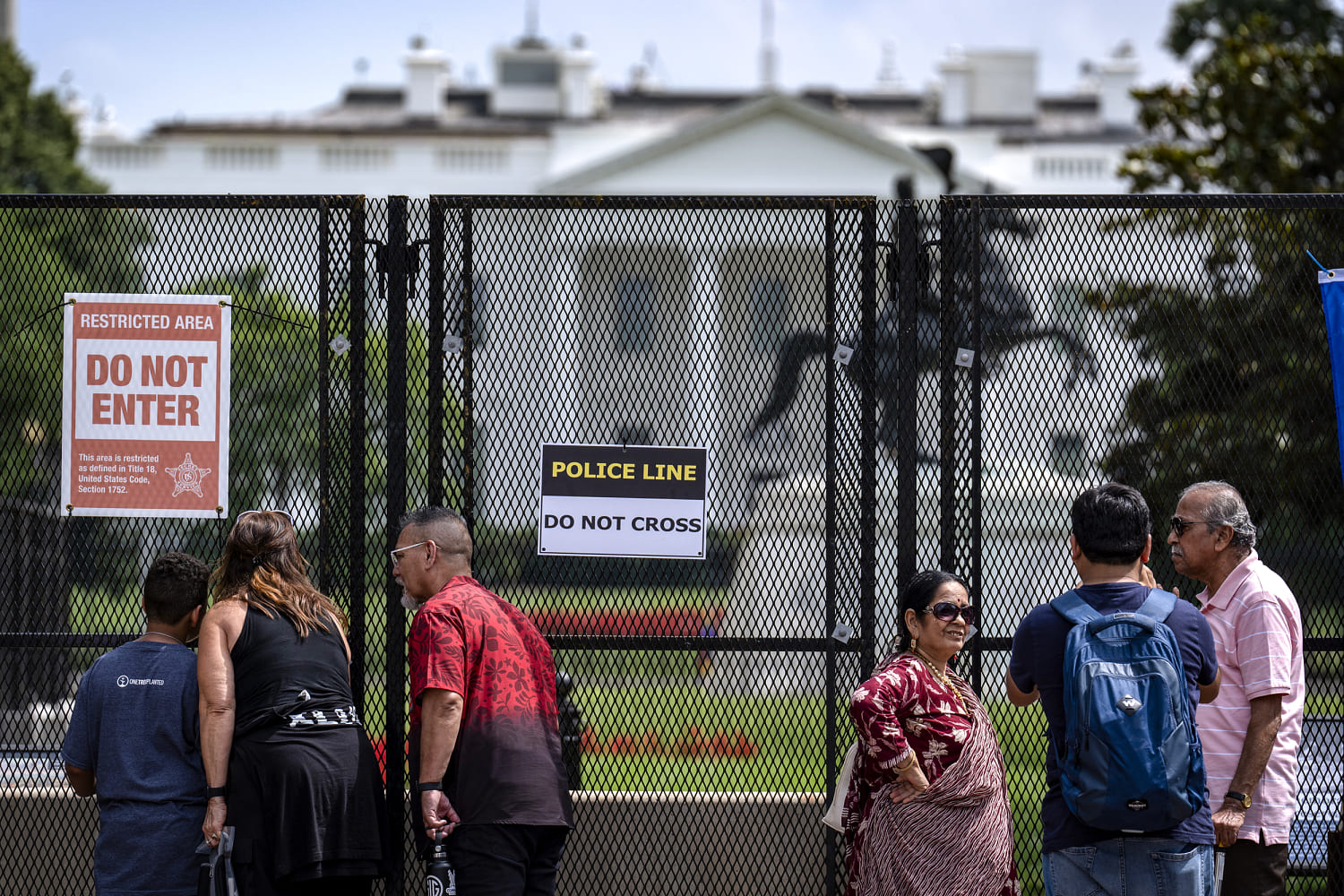
The federal government is moving to install a permanent steel security fence around Lafayette Square, the historic seven-acre park directly across from the White House. Under a proposal presented by the U.S. Secret Service, the National Park Service, and the Executive Office of the President to the Commission of Fine Arts, the new barrier would run along H Street and encircle the public square. Designed to replace the unsightly temporary barricades that have cluttered the area for years, the permanent fence would feature gates that can be locked at a moment’s notice. Opponents warn the plan represents a profound retreat from public accessibility.
For generations, the park has served as America’s public square, a highly visible stage for civil rights marches, anti-war vigils, and individual dissenters looking to make their voices heard by the president. To its advocates, the proposed fence is a common-sense solution to modern security threats. To its critics, it is an admission of fear that signals a democratic society closing in on itself.
A Secret Service Blueprint for Security
The formal presentation to the Commission of Fine Arts on July 16, 2026, laid out a stark rationale for the project. Law enforcement officials argue that the security environment in Washington has shifted dramatically. Recent years have seen demonstrations boil over into direct physical confrontations. Secret Service officials pointed to episodes of vandalism, including graffiti painted on park monuments during protests, as evidence that the status quo is untenable.
The primary tactical argument for the new steel perimeter is safety, both for the public and for law enforcement officers. During past events, the Secret Service has relied on bike racks and chain-link barriers erected on the fly. This creates a chaotic environment where officers find themselves in intense, face-to-face standoffs with crowd members.
A fixed, engineered barrier changes that dynamic. By establishing a permanent physical setback, the agency can manage crowds without resorting to active physical force. The proposed design features a series of integrated gates along H Street. In theory, these gates will remain open during normal operations, allowing tourists and locals to mingle near the statues of Andrew Jackson and the Marquis de Lafayette. If an intelligence report warns of a threat, or if a demonstration turns destructive, security teams can lock down the entire square in minutes.
The administration also highlights the sheer financial and logistical drain of the current system. Constantly trucking, assembling, and dismantling temporary metal barricades for VIP movements and protests costs hundreds of thousands of dollars annually. A permanent installation eliminates those recurring operational costs.
The Battle for the Front Yard of Democracy
While security officials view the fence as a physical and economic upgrade, civil rights advocates and local leaders see it as a dangerous precedent. The park is not merely a patch of green space. It is a physical manifestation of the First Amendment.
The primary legislative challenge to the proposal is led by Representative Eleanor Holmes Norton, the long-serving Democratic delegate representing the District of Columbia. Norton quickly introduced the No Fencing at Lafayette Square Act to legally block the project.
Her argument cuts to the core of how a democratic capital should present itself to the world. Lafayette Square is a place where citizens assemble to confront their government directly. Erecting a permanent steel barrier, even one with gates that are promised to remain open, establishes a psychological wall. It tells the public that they are viewed as a threat first and citizens second.
The White House is already protected by an imposing thirteen-foot-high steel fence that was recently strengthened to resist scaling. Adding another layer of permanent steel around the public park across the street seems, to many critics, like redundant security theater. It risks turning a vibrant public space into a sterile, restricted zone. The visual of citizens peering at the executive mansion through multiple layers of heavy ironwork sends a message of insulation and vulnerability.
From Lafayette Square to Gettysburg and Back
To understand how unusual a permanent fence is, one must look at the history of the square. Lafayette Park has not had a permanent fence since 1889.
In 1853, Congress funded an ornate iron fence to enclose the park, featuring entrance gates topped by eagles. That fence became the backdrop for some of the nineteenth century's most notorious events, including the 1859 murder of Philip Barton Key by Congressman Daniel Sickles. By the late 1880s, however, the consensus in Washington had shifted. The city wanted to open its public spaces. Officials argued that public parks should be welcoming and integrated into the fabric of the community.
In 1889, the iron fence was dismantled. Congress donated the material to the Gettysburg Battlefield Memorial Association. It was shipped to Pennsylvania and installed along the National Cemetery, where it still stands, known to historians as the Sickles Witness Fence.
For more than one hundred and thirty years, Lafayette Square remained open, resisting the urge to lock down even during world wars and domestic crises. The modern push to reverse this nineteenth-century decision highlights a deeper shift in how the state views its relationship with the public.
The Underground Fortress
The fence proposal is only one part of a larger, quiet transformation of the White House grounds. The Commission of Fine Arts also gave preliminary approval to an updated design for a massive underground visitor screening facility.
The project is a thirty-three-thousand-square-foot subterranean facility intended to process the thousands of tourists, contractors, and event guests who enter the White House complex daily. Currently, visitor screening is handled by a series of temporary tents and modular structures that have sat on the south and east sides of the complex for years. These tents are visually unappealing and vulnerable to weather and security breaches.
The new underground complex, slated to open by July 2028, will move these operations entirely out of sight. Originally planned for a spot near the southern end of Sherman Park, officials had to relocate the footprint to the western edge of the park to avoid vital underground utility lines.
While a subterranean screening facility makes operational sense and cleans up the visual landscape, its scale is a reminder of the massive security apparatus required to run the modern presidency. When paired with the proposed Lafayette Square fence, it paints a picture of a presidency increasingly encased in steel and concrete.
A Compromise That Pleases No One
The Commission of Fine Arts did not grant final approval to the Lafayette Square fence design, indicating that they want to see revisions before construction begins. This leaves the project in a bureaucratic gray area.
The Secret Service’s proposed compromise—leaving the gates open during normal hours and locking them only during emergencies—is designed to soothe public access concerns. In practice, however, such compromises rarely satisfy either side. Once a barrier is built, the temptation to close it is constant. A protest does not have to turn violent for authorities to decide that keeping the gates locked is the safest path. Over time, "temporary" closures have a way of becoming permanent.
The debate over Lafayette Square is not just about steel pickets and gate latches. It is about whether a democracy can remain open to its people when the physical world around its leaders is increasingly locked down. As the designs move back to the drawing board, Washington must decide if it is willing to sacrifice the historic accessibility of its public square in the name of a secure perimeter.