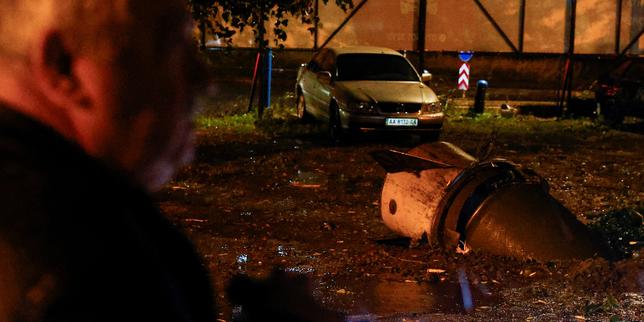
The sirens in Kyiv do not sound like music. They sound like teeth grinding together in the dark.
For months, the rhythm of survival in the capital had settled into a grim sort of muscle memory. People knew the cadence. They knew the dry, coughing bark of air defense batteries punching upward through the smog. They knew the dull, subterranean thud that meant a Shahed drone had met its match in an empty field or a rooftop concrete slab. Residents could tell the difference between outgoing fire and incoming terror by the pitch of the air pressure shift against their eardrums. Building on this idea, you can find more in: Why Hong Kongs Strict Animal Laws Are Making Pets Less Safe.
Then came midnight.
There was no preliminary warning that felt different from any other Tuesday night. The temperature hovered near freezing, leaving a thin glaze of slush on the asphalt of Podil and along the dark, swollen curves of the Dnipro River. In a ninth-floor apartment overlooking a quiet courtyard, a mother named Olena was boiling water for chamomile tea. Her husband was asleep on the sofa, fully clothed in his thermal work gear, a heavy coat draped over his shins like a blanket. They lived in a neighborhood filled with corner bakeries, bookstores that sold translated poetry, and iron park benches where old men played dominoes under the yellow glow of sodium streetlamps. Experts at NBC News have provided expertise on this situation.
Silence. Then the sky ripped open.
It wasn't a thump. It was a physical blow, a concussive shockwave that shattered double-paned glass before the sound waves even reached the walls. The tea kettle slid off the stove and clattered against the linoleum, spilling boiling water into the dark.
Two lives ended in that instant, though the official casualty reports would take hours to filter through the bureaucratic machinery of war. Two people who had names, favorite mugs, unpaid electricity bills, and laundry hanging on a plastic rack in the hallway. By dawn, the courtyard was no longer a place where neighbors greeted one another with a nod of weary solidarity. It was a jagged crater of shredded bricks, insulation foam fluttering like dirty snow, and the sharp, chemical stench of burning rocket fuel.
Wars are written about in broad strokes. We talk about strategic depth, territorial gains, ballistic trajectories, and geopolitical leverage. We measure conflicts in percentages of liberated soil and millions of dollars in aid packages. But war is actually experienced in centimeters. It is the thickness of a brick wall. It is the distance from a shattered window to a child's bed. It is the three seconds of screaming silence between the flash of an explosion and the collapse of a ceiling.
Consider what happens to a city when its night sky is weaponized.
Kyiv is a metropolis of millions, a sprawling engine of commerce, culture, and stubborn normalcy. People still go to work. Baristas still grind espresso beans using backup generators when the grid flickers out. Students still argue about philosophy over cheap beer in damp cellars converted into makeshift cafes. This daily resistance—this refusal to let terror dictate the shape of an hour—is the true backbone of the city. Yet, beneath that defiance lies an exhausting, bone-deep vigilance.
When the air raid sirens wail at two in the morning, the human cost is immediate and profound. It is psychological attrition. Sleep is stolen, minute by minute, night after night. Parents watch their children flinch at the sound of a slamming car door, learning the devastating vocabulary of ballistics before they learn fractions.
The strikes that tore through the city streets overnight were not random anomalies. They were part of a calculated campaign designed to freeze the resolve of a population through sheer exhaustion. Infrastructure targets, residential sectors, commercial blocks—the lines between military necessity and civilian terror blur until they vanish entirely.
Yet, as the smoke cleared over the wreckage, something else happened.
Before the municipal trucks even arrived to clear the rubble, neighbors emerged from basement shelters carrying plastic brooms and metal shovels. They didn't speak much. They didn't need to. They swept the broken glass into neat piles along the curb. They draped heavy plastic sheeting over gaping window frames where families had been sleeping hours earlier. A stray cat picked its way across a mound of shattered drywall, pausing to sniff at a child's stuffed rabbit lying half-buried in soot.
We often look at global conflicts from a distance, safely insulated by oceans and screens, treating human suffering as a distant abstraction. We scroll past headlines about midnight strikes with a fleeting pang of sorrow before moving on to the next notification. But behind every statistic in a morning news bulletin is an empty chair at a kitchen table. Behind every dry casualty count is a universe of unfulfilled conversations, unfinished books, and ordinary dreams cut short by the scream of a falling metal tube.
The night air in Kyiv remains cold. The sirens will sound again. Another midnight will test the fragile boundary between survival and catastrophe in a city that refuses to stop breathing.
In the grey light of morning, the debris is swept away, but the weight remains, hanging heavy in the silent spaces where the walls used to be.