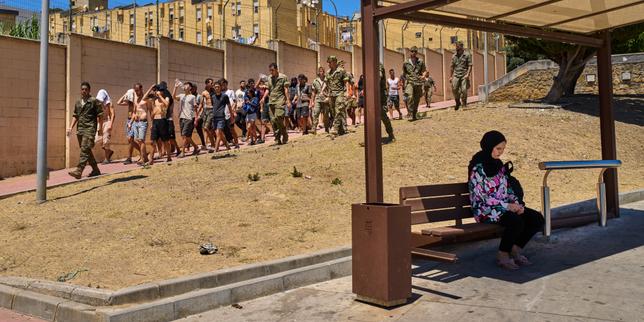
Geopolitical pressure points operate on predictable thermodynamic principles. When an impermeable barrier meets an asymmetric gradient of economic opportunity, stress concentrates at the physical seam. The Spanish autonomous city of Ceuta functions precisely as this type of systemic pressure valve. The local population experiences a three-vector shock composed of economic friction, social anxiety, and humanitarian strain. Analyzing this environment requires moving past emotional journalism to examine the structural mechanics driving migration surges, border management bottlenecks, and the resulting socioeconomic degradation of the enclave.
The Economic Cost Function of Enclave Isolation
Ceuta presents a distinct geographic and economic anomaly. Spliced into the northern coast of Morocco yet governed by Madrid, its economy depends entirely on two variables: public sector employment and cross-border trade. When diplomatic friction between Spain and Morocco introduces border closures, the local market experiences an immediate liquidity crisis.
The traditional arbitrage model relied on heavy informal trade. Goods moved tax-free across the Tarajal border crossing in quantities designed for resale in Moroccan markets, sustaining a high-velocity retail sector in Ceuta. The unilateral closure of these commercial channels by Rabat dismantled this revenue stream.
[Diplomatic Friction]
       │
       ▼
[Border Closure]
       │
       ▼
[Liquidity Collapse in Informal Trade]
       │
       ▼
[Municipal Reliance on Public Sector Subsidies]
Without the buffer of cross-border commerce, the municipal economy contracts into a dependency model. Local businesses face margin compression, forcing reliance on central government fiscal transfers. This creates a fragile municipal budget structure where any disruption in bilateral relations directly translates to local commercial insolvency.
The Structural Mechanics of Border Surges
Migration pressure toward Ceuta is not random. It functions as a response to push factors in sub-Saharan Africa and North Africa, calibrated against the perceived permeability of the European Union perimeter. The physical border—a multi-layered fence system reinforced with surveillance technology—acts as a rigid constraint. When pressure increases beyond the threshold of containment, failure occurs through two distinct pathways: mass land assaults and maritime swimming attempts.
Mass land assaults require coordinated synchronization among population groups gathered in the adjacent Moroccan forests of Beliones and Belyounech. The tactical objective is to overwhelm the reaction time of security forces through sheer volume. Security forces operate under legal frameworks that dictate proportional response, creating a tactical window of opportunity for breach groups.
Maritime migration relies on hydrodynamic variables. Swimmers exploit tidal patterns, fog banks, and the rocky breakwaters flanking the Tarajal crossing or the Benzú side. The physical toll on the human body is severe, dictated by water temperature, exhaustion, and currents generated by the Strait of Gibraltar.
The Social and Psychological Strain Vector
The resident population of Ceuta navigates a unique socio-spatial compression. Confined to an area of roughly 18 square kilometers, residents cannot easily distance themselves from structural friction points. The psychological impact manifests as a constant state of hyper-vigilance among the local populace, driven by three distinct stressors:
- Infrastructure Saturation: Municipal services, particularly emergency healthcare and waste management, absorb sudden surges in demand during border crossing events without proportional scaling of municipal budgets.
- Demographic Polarization: The city’s demographic makeup, characterized by a delicate balance between Christian and Muslim communities, experiences strain when nationalist political rhetoric weaponizes migration crises for electoral leverage.
- Security Visibilities: The constant presence of military personnel, Guardia Civil units, and riot control gear normalizes a state of siege psychology.
This environment fosters civic fatigue. Compassion fatigue sets in when the frequency of humanitarian emergencies outpaces the capacity of local civil society organizations to provide meaningful, long-term integration or repatriation support. Citizens oscillate between empathy for migrants navigating lethal desperate straits and anger at the perceived abandonment of the city by mainland European institutions.
Institutional Friction and Jurisdictional Ambiguity
Ceuta occupies an ambiguous space in European Union structural policy. While legally part of EU territory, its geographic location outside the Schengen area creates complex jurisdictional friction. Spain bears the primary financial and operational burden of border management, yet the security perimeter protects the entire European landmass.
This creates a misaligned incentive structure. Brussels provides border management funding, but the operational decisions remain centralized in Madrid, frequently disconnected from the ground reality experienced by municipal administrators in Ceuta. Local authorities lack the fiscal autonomy to negotiate bilateral solutions with Morocco, rendering them administrative spectators to geopolitical maneuvers executed thousands of kilometers away in foreign ministries.
When diplomatic relations between Spain and Morocco normalize, border management shifts from reactive containment to managed friction. Conversely, when diplomatic alignment breaks down, the border transforms into a political instrument where human migration is leveraged as statecraft. The residents of Ceuta remain structural hostages to this bilateral volatility, absorbing the localized fallout of macro-level diplomatic chess games while local institutions struggle to maintain baseline civic functionality.
Strategic Operational Outlook
Mitigating the recurring crises in Ceuta requires structural decoupling of local economic survival from geopolitical volatility. Municipal diversification away from informal border trade toward digital enterprise, maritime logistics, and green energy infrastructure offers the only viable exit from perpetual economic vulnerability. Until the enclave establishes an independent economic engine, the local populace will continue to oscillate between cyclical economic depression and acute humanitarian shock, bound permanently to the fault line where two continents collide.