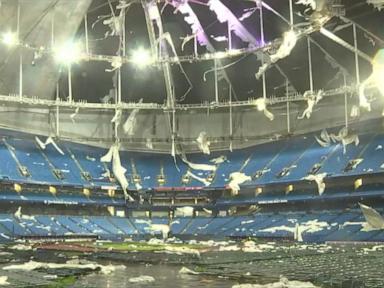
Stop applauding the comeback of a stadium nobody wanted in the first place.
National evening news segments love a tidy feel-good story. Anchor reads the script. Camera pans over crews working on a shredded roof. Music swells about resilience, hometown pride, and a community rallying to bring baseball back. It makes great two-minute television. It is terrible sports economics.
When Hurricane Milton tore 18 of Tropicana Field's 24 roof panels loose in October 2024, the lazy consensus formed almost overnight: the community pulled together to rescue a ballpark and keep the Tampa Bay Rays whole. Even after the stadium reopened for the 2026 season following roughly $55 million to $58 million in repairs and upgrades—and even after hosting baseball's biggest stage again—the warm-and-fuzzy narrative refuses to die.
Here is the cold truth behind that feel-good broadcast. Fixing Tropicana Field wasn't a triumph of civic unity. It was a stopgap patch on a building widely considered one of Major League Baseball's worst venues, layered on top of decades of stadium drama, shifting ownership, and billion-dollar public-private negotiations.
The Question Everyone Is Asking Wrong
People keep asking how Tampa Bay pulled off the Tropicana Field repair. That is the wrong question.
The real question is: Why are taxpayers still bankrolling short-term fixes and mega-deals for an industry that treats municipal budgets like a bottomless checking account?
When storm damage hits a major civic asset, public officials and sports executives immediately wrap routine repairs—and long-term stadium leverage—in the language of community survival. If you push back, you look like a grinch opposing hometown baseball. If you play along, you ignore the math.
Let's break down the mechanics of what actually happens in these situations:
- Sunk cost fallacy on steroids: Spending tens of millions of dollars to restore a ballpark that opened in 1990 and was slated for replacement feels heroic on screen, yet it rarely fixes structural attendance or geography problems on its own.
- Emergency optics vs. ordinary trade-offs: Storm recovery blurs the line between disaster relief and sports subsidy. As St. Petersburg council member Brandi Gabbard bluntly noted during debates over repair spending, cities face competing needs and hard priority choices when public money is on the line.
- Leverage disguised as loyalty: Every crisis gives ownership and local leaders fresh political momentum—whether to patch an aging facility or pivot toward a brand-new ballpark deal.
What "People Also Ask" Gets Backward
Search engines are full of predictable questions around stories like this. Most of them start from a flawed premise.
Did the community save Tropicana Field?
Construction crews, engineers, city staff, insurers, and public funds did the heavy lifting. Calling every repair effort a "community miracle" turns basic municipal contracting and insurance math into a fairy tale. Fans don't weld steel trusses or sign off on roof panels; contractors and government budgets do.
Does fixing an old stadium solve a franchise's long-term stadium problem?
No. A fresh coat of paint, a patched roof, upgraded suites, or new turf makes game day more tolerable. It does not magically erase decades of stadium friction or replace a multi-billion-dollar long-term facility plan.
Is spending public money on stadium repairs ever justified?
Sometimes—strictly when clear contractual obligations, property protection, or verified insurance/disaster funding make it fiscally rational compared to leaving a damaged structure to rot. When officials admit they are spending money simply because of existing contracts rather than because it is the best use of civic funds, honesty beats spin every single time.
Inside the Ballpark Economics Playbook
I have watched cities and franchises fight over stadium money for years, and I have seen municipalities blow tens of millions of dollars chasing economic windfalls that never materialize in the way glossy slide decks promise. Sports economists like Roger Noll, Andrew Zimbalist, and Victor Matheson have documented this pattern across North America for decades: new or renovated stadiums routinely overpromise on net new jobs and tax revenue while shifting financial risk onto local governments.
To understand the incentive trap clearly, define the terms without the PR fog:
- Public subsidy: Direct taxpayer dollars, tax diversion, or public infrastructure commitments used to build, repair, or operate a sports venue.
- Opportunity cost: Every dollar spent patching or subsidizing a ballpark is a dollar not spent on roads, transit, housing, or flood resilience.
- Contractual lock-in: Multi-year lease agreements that force cities to maintain facilities even when both sides know the building has passed its prime.
Imagine a scenario where a city has $55 million sitting on a spreadsheet after a major storm. One path puts that money into restoring a ballpark roof so games return sooner. Another path directs that money into neighborhood drainage, seawalls, or working-class housing. Neither choice is evil, and neither is a magic wand. The mistake is pretending the sports choice is a moral crusade rather than a business and policy trade-off.
Where My Contrarian Take Has Blind Spots
Being contrarian for sport is cheap. Being honest about trade-offs is harder.
There is a real downside to treating every stadium repair story like a cynical spreadsheet audit. Major league sports provide shared civic identity, jobs for gameday workers and local vendors, and rare moments of collective joy after tough stretches. Watching a damaged ballpark come back online genuinely lifts spirits for fans who care deeply about their team. Ignoring that emotional value makes an analyst sound robotic.
Still, emotional value is not a blank check. You can celebrate workers getting a building back into shape without buying the myth that a patched roof solves every underlying business problem.
Actionable Rules Before You Buy the Next Stadium Story
Next time a national broadcast or local press release sells you a heartwarming stadium rescue story, run it through four practical filters:
- Follow the money, not the camera. Check how much comes from insurance, disaster programs, team ownership, and local taxpayers—and read the exact wording of the lease.
- Separate short-term triage from long-term strategy. A roof repair keeps a building standing for a season or two; it does not settle a multi-decade franchise plan.
- Demand net numbers, not gross headlines. Ask what new economic activity would not have happened elsewhere in the metro area if the stadium hadn't been repaired.
- Watch the timing. Notice what proposals or negotiations move forward quietly while everyone is distracted by feel-good recovery coverage.
Turn off the sentimental soundtrack, read the balance sheet, and ask who actually gets paid when the cameras pack up.