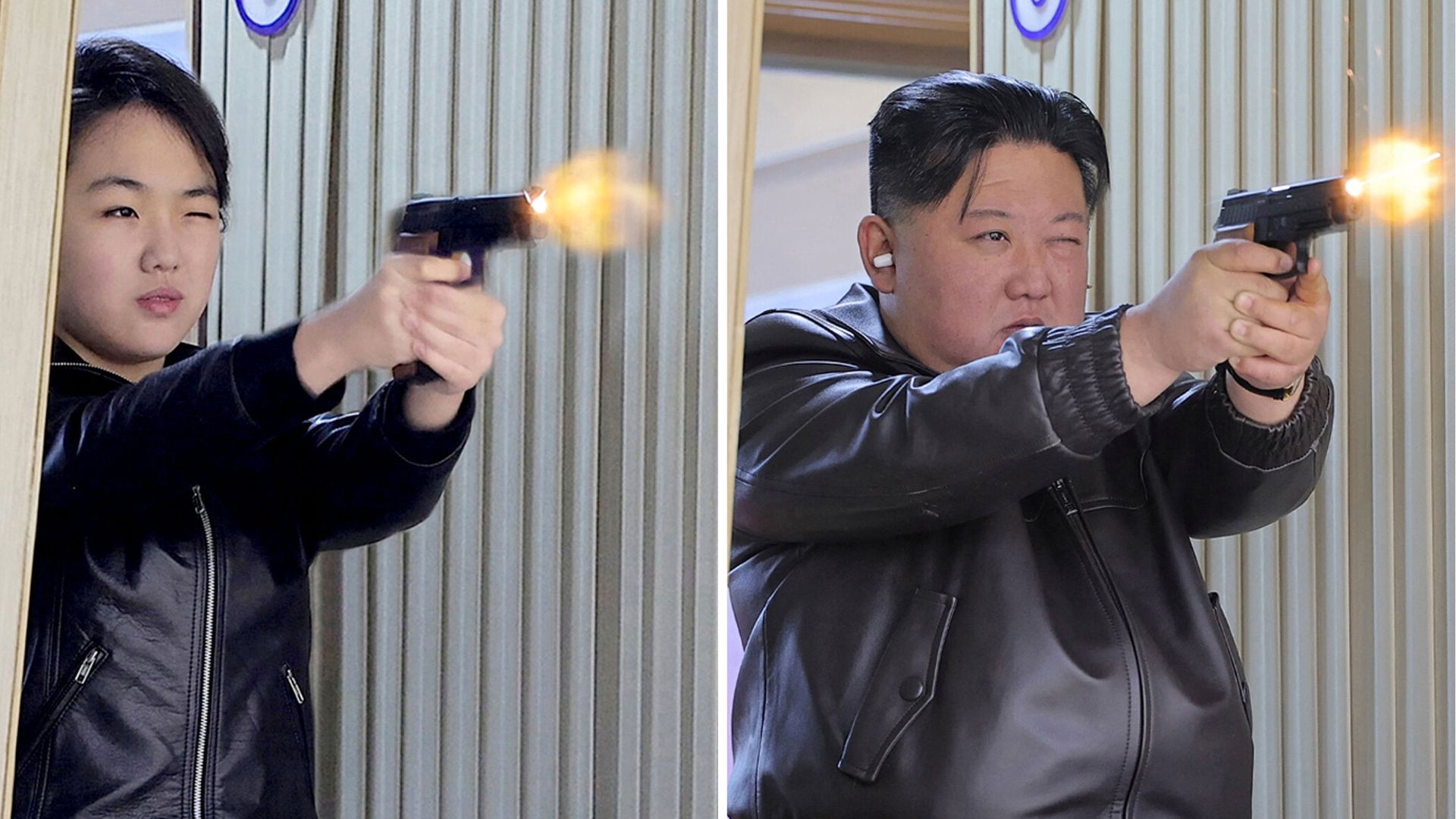
The leather trench coat fits her small frame with a precision that feels scripted. She stands on a windswept tarmac, the grey sky of North Korea pressing down on a row of Hwasong-17 intercontinental ballistic missiles. Beside her, a man whose name makes world leaders sweat holds her hand. He isn't just a father showing his daughter the family business. He is a king presenting an heir.
Kim Ju Ae is likely no older than twelve or thirteen. At an age when most children are navigating the social hierarchies of middle school, she is being groomed to command a nuclear arsenal. This isn't a debutante ball. It is a calculated geopolitical earthquake. For decades, the outside world speculated on the "who" and the "when" of Pyongyang’s succession. We looked for sons in the shadows. We waited for a brother or a general to emerge. Instead, the regime gave us a girl in a faux-fur collar.
The Weight of the Bloodline
Power in North Korea isn't earned; it is inherited through the "Paektu Bloodline." It is a concept as mystical as it is political, tying the Kim family to the sacred mountain where the nation’s founding myths began. To understand Ju Ae’s sudden prominence, one must understand the isolation of the throne.
The North Korean leader lives in a world of absolute devotion and absolute paranoia. There are no true peers. There are only subordinates. In this vacuum, the family is the only unit that matters. When Kim Jong Un disappeared from public view for weeks at a time in recent years, the West spiraled into frantic theorizing. Would the country collapse? Would his sister, Kim Yo Jong, take the reins with an iron fist?
The appearance of Ju Ae provides the answer the regime wanted to send: The line is secure. The future is female, perhaps, but more importantly, the future is Kim. By bringing her to missile launches and military banquets, Kim Jong Un is signaling that his weapons programs are not a short-term gamble. They are a multi-generational legacy. He is telling the world that these missiles will belong to her just as much as they belong to him.
A Masterclass in Visual Sovereignty
State media does nothing by accident. Every photograph is polished, every camera angle debated by a phalanx of propagandists. Notice the way the generals bow to her. These are men with chests full of medals, silver-haired veterans of a thousand ideological battles, and they are bending their backs to a child.
This is visual sovereignty.
In 2023, the language used to describe her shifted. She went from being the "beloved daughter" to the "respected daughter." In the specific, high-stakes vocabulary of North Korean rhetoric, "respected" is an adjective reserved for the highest echelons of leadership. It is a title that carries the scent of incense and the weight of law.
Intelligence agencies in Seoul and Washington have spent thousands of hours analyzing these photos. They look at the way she stands—shoulders back, mimicry of her father’s gait. They look at her clothes, which often mirror the styles of her father or her stylish mother, Ri Sol Ju. It is a branding exercise. If you see her enough times standing in front of a rocket, eventually, the rocket and the girl become inseparable in the national psyche.
The Invisible Stakes of a Childhood
What does it feel like to be the center of such a storm?
Consider a hypothetical afternoon in the life of Ju Ae. While her peers in Pyongyang’s elite schools might be studying revolutionary history, she is likely being tutored in the grim mechanics of statecraft. There are no playdates that aren't monitored. There is no internet that isn't a closed loop. Her childhood is a state secret.
The emotional core of this story isn't the missile. It is the girl. She is a tool of the state, a living symbol used to soften the image of a nuclear-armed autocracy. When she smiles for the cameras while her father smokes a cigarette nearby, the regime is trying to humanize the unthinkable. They want to pair the warmth of fatherhood with the cold steel of an ICBM. It is a jarring, surreal juxtaposition that forces the viewer to reconcile a "family man" with a man who threatens to turn cities into ash.
But the real pressure lies in the shadow of her predecessors. Her grandfather, Kim Jong Il, was hidden from the public for years before being named successor. Her father was a mystery until shortly before he took power. Ju Ae is being forged in the heat of the public eye much earlier. This suggests a sense of urgency. Perhaps Kim Jong Un’s health is a factor, or perhaps he simply wants to ensure that by the time she is ready to rule, the idea of her leadership is so ingrained that a coup becomes unthinkable.
The Sister in the Shadows
No discussion of Ju Ae is complete without mentioning her aunt, Kim Yo Jong. For years, Yo Jong was the "Altar Ego," the sharp-tongued messenger who issued blistering threats to the West. She was the one who seemed poised to take the throne if something happened to her brother.
The dynamic has changed.
Observers have noted a subtle shift in choreography. In recent events, Yo Jong is often seen standing in the background, sometimes holding a coat or standing among the lower-ranking officials, while Ju Ae takes center stage. It is a public demotion in status, if not in actual power. It serves to remind the elite that while Yo Jong is a trusted advisor, she is not the heir. The crown moves vertically, not horizontally.
This creates a fascinating, albeit dangerous, tension within the palace walls. History is littered with the stories of ambitious aunts and uncles who didn't take kindly to being bypassed for a child. In North Korea, where political purges are common and brutal, the stakes of this family drama are literally life and death.
The Logic of the Long Game
Western analysts often fall into the trap of thinking the North Korean regime is irrational. It isn't. It is survivalist.
By positioning Ju Ae as the successor, Kim Jong Un is solving a branding problem. He is transitioning the regime from a "revolutionary" government into a "monarchy." It is much harder to justify a revolution against a king and his young daughter than it is against a mere political leader.
The daughter represents the 2040s and 2050s. She represents a North Korea that has survived sanctions, survived COVID-19, and survived the pressure of the "maximum pressure" campaigns. She is the living proof that the Kim family intends to be here for the next century.
We see a girl in a nice coat. Pyongyang sees a fortress.
The Tarmac and the Truth
On that windy tarmac, the missiles aren't the only things being tested. The world’s reaction is being tested, too. How do we respond to a child-successor? Do we see her as a victim of a bizarre upbringing, or as the future face of a nuclear threat?
The reality is likely both.
Ju Ae is a person being subsumed by a persona. Every time she appears, a little more of the child disappears, replaced by the "Respected Daughter." She is being taught that her value is tied to the strength of the military and the loyalty of the party. She is being raised to believe that the world outside her borders is a predator, and that the only safety lies in the shadow of the Hwasong.
As the cameras click and the state news anchor speaks in that famous, trembling vibrato, the girl stands still. She doesn't fidget. She doesn't look bored. She watches the smoke clear from the launch pad with the practiced gaze of someone who knows exactly what is expected of her.
The transition is already happening. It isn't a sudden event that will occur on the day Kim Jong Un passes away. It is a slow, steady tide. It is the sound of a leather coat rustling as a young girl takes her place at the head of the table, while the world watches, wondering if the child will be any different from the father, or if the cycle is simply beginning again.
There is no room for childhood in a bunker. There is only the weight of the mountain and the cold, hard reality of the bloodline. She is no longer just a daughter. She is the human face of a permanent standoff.