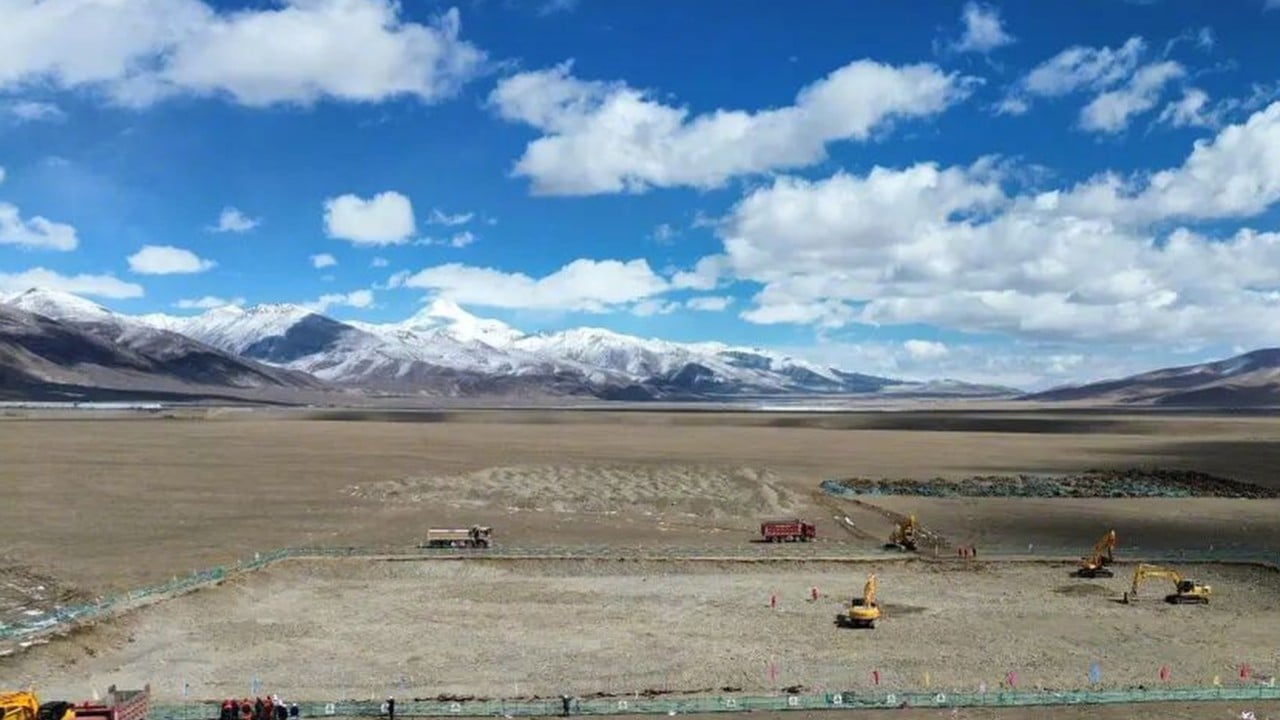
China just started building a massive solar farm in a place most engineers would call a nightmare. It’s high. It’s cold. The air is thin enough to make your head spin. We’re talking about the Tibetan Plateau, specifically the Lianghekou hydropower station area in Sichuan province. This isn't just about sticking some glass in the sun. It's a desperate, brilliant, and incredibly risky gamble to solve an energy crisis that doesn't care about geography.
When you hear "solar plant," you probably think of a flat, baked desert. You don't think of 4,000 meters above sea level where the weather can turn from blistering sun to a blizzard in twenty minutes. Yet, China is pouring billions into these "extreme condition" projects. Why? Because they've run out of easy places to put things, and the world's thirst for power is hitting a breaking point.
Why High Altitude Solar is a Total Nightmare
Building at 4,000 meters isn't just a logistics problem. It's a physics problem. At that height, the air density is significantly lower. This affects how heat dissipates from the equipment. You’d think the cold would help keep the panels cool, but the intense ultraviolet radiation and the way inverters struggle in thin air create a weird technical paradox.
Then there's the human cost. Construction crews are working in an environment where oxygen levels are roughly 60% of what they are at sea level. Imagine trying to haul heavy steel frames and sensitive silicon panels when every breath feels like you're sucking air through a straw. It’s brutal. It’s slow. It’s expensive.
But the payoff is the light. The solar radiation at these altitudes is incredibly "clean." There’s less atmosphere to scatter the photons. You get more bang for your buck per square meter of panel, provided the hardware doesn't crack under the massive temperature swings between day and night. We’re seeing swings of 30 or 40 degrees Celsius in a single twelve-hour cycle. Most materials hate that. They expand, they contract, they snap.
The Secret Weapon Is Water
The Lianghekou project isn't a standalone solar farm. That’s the part most people miss. It’s a "hydro-solar hybrid." This is basically the world's largest rechargeable battery, but instead of lithium, it uses gravity and water.
Solar power has a famous flaw: it disappears when the sun goes down. Wind is the same; it's fickle. But when you pair a massive solar array with a massive hydroelectric dam, you get something stable. During the day, when the sun is blasting those high-altitude panels, the grid uses solar power. While that’s happening, the dam stops letting water flow through its turbines. It "saves" that water in the reservoir.
When the sun sets, or a cloud bank rolls over the plateau, the engineers flick a switch. The dam gates open. The stored water rushes down, spinning the turbines and filling the gap in the power grid. It’s a closed-loop dance that turns "unreliable" green energy into "firm" baseload power. Without the hydro component, this solar plant would be a vanity project. With it, it’s a powerhouse.
Breaking Down the Massive Scale
Let's look at the numbers because they’re frankly ridiculous. We’re talking about a phase-one capacity that contributes to a planned mega-base capable of churning out 100 million kilowatts. To put that in perspective, that’s enough to power a medium-sized country.
- Elevation: 4,000 to 4,600 meters.
- Location: Yajiang County, Sichuan Province.
- Total Investment: Billions of yuan (the exact figures shift as phases expand).
- Objective: Offset millions of tons of coal consumption annually.
China is currently the world leader in renewable installations, but they’re also the world’s biggest coal burner. It’s a weird double life. They are building these extreme plants because their coastal cities—the ones actually using the power—are thousands of miles away from these mountain peaks. This requires another feat of engineering: Ultra-High Voltage (UHV) transmission lines. These are the "electricity highways" that carry the juice from the mountains to the skyscrapers of Shanghai and Shenzhen with minimal loss.
The Real Reason for the Rush
The global energy crisis isn't a backdrop; it’s the driver. When Russia’s invasion of Ukraine sent gas prices into a tailspin, every major economy realized that relying on imported fuel is a death sentence for long-term stability. China saw the writing on the wall earlier than most. They aren't doing this just to be "green." They're doing it for energy sovereignty.
If you own the sun hitting your mountains and the water flowing through your valleys, nobody can turn off your lights by blocking a shipping lane or blowing up a pipeline. That’s the hard truth. This project is as much about national security as it is about carbon credits.
What This Means for the Rest of Us
You might think what happens on a Tibetan mountain doesn't matter to you. You'd be wrong. The tech being tested at Lianghekou—the ruggedized inverters, the reinforced glass, the hybrid grid management software—will eventually become the global standard.
If they can make solar work in a place that tries to kill the workers and the machinery every day, they can make it work anywhere. We are seeing a shift where "impossible" locations are becoming the new frontier for energy production. It makes the solar panels on your roof look like toys.
The Risks Nobody Wants to Talk About
It’s not all sunshine and clean water. There are massive environmental concerns when you mess with the Tibetan Plateau. It’s the "Third Pole" of the world. It holds the headwaters for the Yangtze, the Mekong, and the Yellow River.
Constructing massive infrastructure here disrupts fragile ecosystems. The soil is thin. The vegetation takes decades to grow back if it’s crushed by a truck. There’s also the permafrost issue. As the climate warms, the ground these panels are anchored into is becoming less stable. If the permafrost melts, the mounting racks tilt. If the racks tilt, the panels break. It’s a race against a changing climate to build the very tools meant to stop that change.
Take Action on Your Own Energy Literacy
Stop looking at renewable energy as a "feel-good" story. Start looking at it as heavy industry. If you want to understand where the world is going, stop watching the stock price of tech companies and start looking at where the big concrete is being poured.
- Watch the UHV space. If a country can't move power across a continent, their green energy is useless.
- Monitor hydro-solar integration. This is the only way solar scales to a national level without causing blackouts.
- Track high-altitude patents. The companies winning the bids for these Sichuan projects are the ones who will dominate the global market in five years.
China is building at the edge of the world because they have to. The rest of the world will eventually have to follow suit, or get left in the dark.