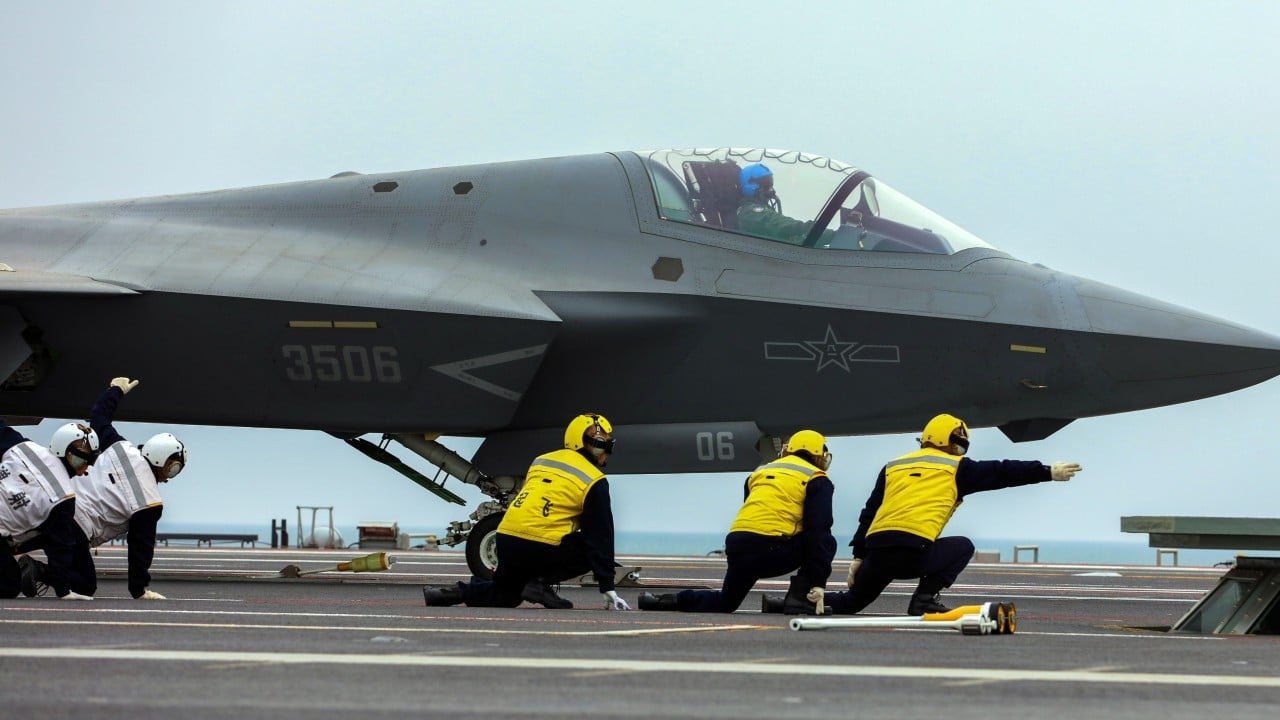
The mainstream defense media is currently obsessed with a narrative that sounds incredibly intimidating on paper. Look at the headlines. They scream about China’s People's Liberation Army Navy (PLAN) launching massive recruitment drives, targeting high school graduates and female cadets to pilot their expanding fleet of aircraft carriers. The lazy consensus among Western think tanks is that this represents a bold, aggressive acceleration of a highly sophisticated blue-water power projection strategy.
It does not.
This recruitment frenzy is not a display of supreme confidence. It is a desperate, frantic scramble to fix a systemic bottleneck that threatens to turn China's multi-billion-dollar aircraft carriers into floating, useless iron targets.
Having spent decades analyzing naval aviation procurement and training pipelines, I can tell you that the loudest commentators usually understand steel but fail to understand the humans who operate it. Building a flat-top is relatively easy if you have the industrial capacity and the cash. Training a carrier aviator is one of the hardest things a military can attempt. China is building ships faster than it can train the pilots to fly off them.
Let’s dismantle the cozy assumptions and look at the structural reality.
The Myth of the Rapid Blue Water Pivot
The dominant defense narrative assumes that because China has three aircraft carriers—the Liaoning, the Shandong, and the electromagnetic catapult-equipped Fujian—it is rapidly closing the gap with the United States Navy.
This is a fundamental misunderstanding of carrier aviation mechanics.
You cannot buy, copy, or steal an operational culture. The United States has been operating carriers continuously since the 1920s. Every piece of deck crew safety protocol, every landing signal officer (LSO) technique, and every pilot's muscle memory is paid for in a century of blood and accidents.
China has zero legacy knowledge here.
When the PLAN started, they tried to train pilots the old-fashioned way: taking experienced land-based fighter pilots from the PLAAF (Air Force) and retraining them for carrier landings. This failed to scale. Land-based pilots have ingrained habits that are lethal on a pitching flight deck. On a normal runway, you flare before touchdown to land smoothly. On a carrier, you fly the aircraft directly into the deck at high speed to catch the arresting wire. You do not flare. If you try to flare, you miss the wire, hit the ramp, or crash.
To break those habits, the PLAN had to start from scratch. Hence, the high school recruitment drive. But this pivot is not a masterstroke of long-term planning. It is a frantic admission of failure.
Why High School Recruiting Is a High-Risk Gamble
The PLAN’s decision to recruit high school graduates directly into naval aviation pipelines is touted as a forward-thinking move to build a "native" generation of carrier pilots.
Here is what the analysts are ignoring: the wash-out rate.
Military aviation training is a brutal funnel. In established programs like the US Navy, candidate pilots already hold college degrees and have undergone rigorous physical, psychological, and initial flight screening before they ever see a military trainer aircraft. Even then, the attrition rate during advanced carrier qualification is notoriously high.
By pulling 17- and 18-year-old high school graduates directly into the pipeline, the PLAN is trying to bypass the standard military officer training timeline. This introduces massive vulnerabilities:
- Immature Psychological Profiles: Carrier landings require a level of split-second risk assessment and emotional regulation that is incredibly rare in teenagers.
- Massive Resource Waste: Training a pilot from scratch is exponentially more expensive than transitioning an existing aviator. If a cadet washes out after three years of basic flight training, millions of yuan are flushed down the drain.
- Instructors are Non-Existent: Who is training these teenagers? China does not have a deep pool of retired, highly experienced carrier aviators to serve as instructors. The handful of experienced pilots they do have are needed at sea to form the operational core of the active air wings. Taking them off the flight deck to teach teenagers basic aviation principles cripples their current combat readiness.
Imagine trying to build an elite Formula 1 team by recruiting teenagers who have never driven a go-kart, while your only three experienced drivers are forced to spend their time teaching those teenagers how to parallel park. That is the actual scale of the PLAN's bottleneck.
The Catapult Conundrum: Fujian's Empty Flight Deck
Let's talk about the Fujian. This is China's newest, most advanced carrier. It abandons the old ski-jump ramp design of the Liaoning and Shandong in favor of an Electromagnetic Aircraft Launch System (EMALS)—similar to the US Navy’s Gerald R. Ford class.
The defense community treats the Fujian like a massive leap forward. But for the PLAN pilot training program, it is a nightmare of complexity.
+-------------------------------------------------------------+
|               THE NAVAL AVIATION PILOT GAP                  |
+-------------------------------------------------------------+
|                                                             |
|  [SKI-JUMP CARRIERS]                 [CATAPULT CARRIERS]    |
|   Liaoning & Shandong                 Fujian (EMALS)        |
|   - Uses J-15 (Heavy FLanker)         - Requires J-15B/T    |
|   - Manual, steep launch              - Catapult launch     |
|   - Highly restrictive payloads       - Heavy payloads      |
|                                                             |
|                        \           /                        |
|                         \         /                         |
|                          V       V                          |
|                 [PILOT TRAINING PIPELINE]                   |
|              - Must train for two entirely                  |
|                different launch systems.                    |
|              - Extremely scarce training assets.            |
|              - Zero legacy operational expertise.           |
+-------------------------------------------------------------+
Because China is transitioning from ski-jumps to catapults, they are running two completely different carrier aviation programs simultaneously.
A pilot trained to launch off the ski-jump of the Shandong in a standard J-15 cannot simply hop into a catapult-launched J-15B on the Fujian and perform a mission. The flight dynamics, launch procedures, G-forces, and emergency protocols are completely different.
The PLAN does not have the luxury of focusing its training on one system. They are forced to split their already scarce training assets, simulators, and instructors between two radically different technologies. This is not efficiency. This is a logistical disaster.
People Also Ask: Dismantling the Copium
Whenever these training bottlenecks are pointed out, defense apologists point to three specific arguments. Let’s dismantle them one by one.
"Can't they just use advanced flight simulators to bypass real-world training?"
No. Simulators are fantastic for procedural muscle memory, instrument flight rules, and emergency drill training. They are useless for simulating the sheer physical terror of landing an aircraft on a dark, wet deck that is moving up and down by fifteen feet while your fuel gauge is ticking toward zero.
That specific psychological pressure cannot be simulated. It has to be survived. You cannot build a carrier force on virtual reality.
"Aren't they recruiting female pilots to expand the pool?"
This is a public relations victory, not an operational solution. While women are fully capable of flying carrier-based aircraft, the total number of female recruits added to the pipeline is minuscule. It does not solve the fundamental math problem.
The bottleneck isn't the gender of the recruits; it is the physical capacity of China's single land-based carrier training facility in Liaoning province. You can recruit every teenager in China, but if you only have a handful of simulated flight decks on land to practice landing, your pipeline remains choked.
"They are building two-seat trainer variants of the J-15, doesn't that solve it?"
The J-15S (two-seat variant) helps, but it introduces its own problems. Carrier-capable trainer aircraft are heavy, complex, and expensive. Every hour a J-15S spends in the air training a novice is an hour of airframe life eaten away on an aircraft that is incredibly difficult to manufacture and maintain.
Furthermore, a two-seat trainer does not solve the lack of experienced Backseaters (Radar Intercept Officers or instructors) who can actually teach from the rear seat.
The Brutal Reality of the Hardware-Software Gap
In technology, hardware is nothing without software. In naval warfare, ships are the hardware, and the crew's operational competence is the software.
China is building world-class naval hardware at an unprecedented rate. But they are trying to run that hardware on a "software" training pipeline that is archaic, fragmented, and severely bottlenecked.
The recruitment drive targeting high schoolers is a high-stakes, long-term bet that might pay off in fifteen years. But right now, and for the next decade, it means the PLAN will possess carriers that are functionally under-crewed, under-trained, and incapable of sustained, high-tempo combat operations against a peer adversary.
Stop looking at the number of hulls in the water. Start looking at the empty cockpits.