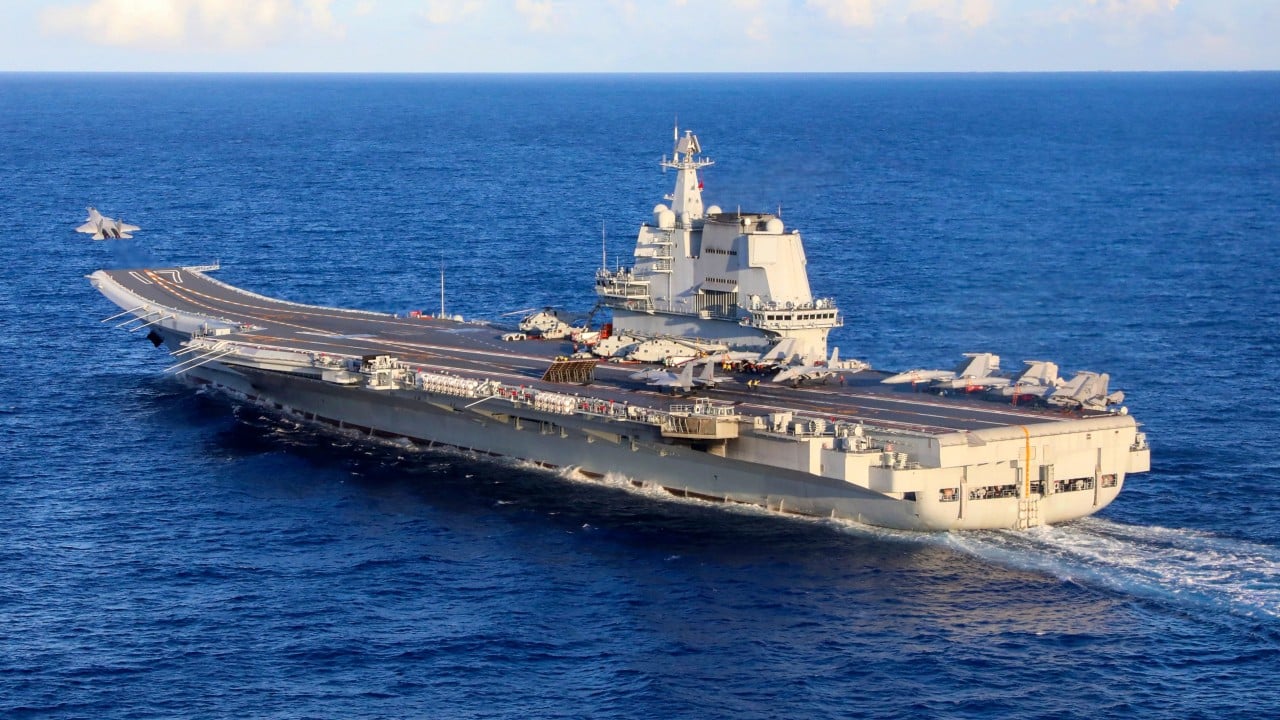
The balance of power in the Western Pacific is shifting faster than most analysts expected. If you think China is building a massive navy just for show, you aren't paying attention to the frantic moves happening right across the East China Sea. Tokyo is quietly transforming its military posture from pure defense to serious counterstrike capability, and Beijing is feeling the heat.
For years, China relied on a strategy called anti-access/area-denial. The plan was simple: pack the mainland coast with missiles to keep American ships far away. But Japan's recent defense pivot completely flips that script. With Tokyo buying long-range Tomahawk cruise missiles and turning its own helicopter carriers into actual flattops for F-35B stealth fighters, China's naval planners realize their current fleet isn't ready for a high-intensity fight.
Chinese military experts are publicly urging Beijing to fast-track upgrades for its aircraft carrier strike groups. They see the writing on the wall. If China wants to protect its maritime lines and project power past Taiwan, it has to move past the era of experimental training ships and build a carrier fleet ready for immediate, offensive operations.
The Reality of Japan's New Strike Capability
Japan isn't just buying new gear; it's changing how it plans to fight. Tokyo's defense budget has skyrocketed, and the old constitutional restrictions on offensive weapons are essentially a thing of the past.
The biggest worry for Beijing is Japan's push for standoff weapons. Tokyo has locked in deals for hundreds of American-made Tomahawk cruise missiles and is actively extending the range of its homegrown Type-12 anti-ship missiles to hit targets over 1,000 kilometers away. This means Japanese forces can strike Chinese ships or even mainland bases without leaving the safety of their home islands.
At sea, Japan is pulling off a massive upgrade of its own. Look at the Izumo-class destroyers. They were called "destroyers" to avoid political backlash, but they are aircraft carriers in everything but name. Japan has already modified the JS Izumo and JS Kaga to operate short-takeoff and vertical-landing F-35B stealth fighters. For the first time since World War II, Japan will have fixed-wing aviation at sea. That directly challenges China's dominance within the First Island Chain.
Why China's Carrier Fleet Is Still Playing Catch Up
On paper, China's naval expansion looks terrifying. It operates three aircraft carriers: the Liaoning, the Shandong, and the technologically advanced Fujian. But a closer look at the People's Liberation Army Navy (PLAN) reveals some glaring operational bottlenecks.
The Liaoning and Shandong are built with ski-jump ramps. It's an outdated design that limits how much fuel and ammunition a fighter jet can carry during takeoff. If a Chinese J-15 fighter can't take off with a full payload, it can't fly as far or hit as hard. It severely limits the strike group's effectiveness in a real conflict.
China's third carrier, the Fujian, changes things with its electromagnetic catapult system—similar to the US Navy's Gerald R. Ford class. This allows the PLAN to launch heavier aircraft, like the new KJ-600 airborne early warning plane. But the Fujian is still a conventional ship, not nuclear-powered. That means it needs a massive logistical train of supply ships to keep it fueled, making the entire strike group vulnerable to submarine attacks.
The big breakthrough happened recently when Chinese state media revealed that the new J-35 stealth fighter has been adapted to fly off the older ski-jump carriers too. It's a huge step forward, but integrating fifth-generation stealth fighters across three different carriers takes years of training, deck management adjustments, and trial by error.
The Battle Beyond the First Island Chain
Why does this matter so much right now? Because any potential conflict over Taiwan or the East China Sea will be won or lost in the deep waters of the Philippine Sea, east of the First Island Chain.
If China wants to isolate Taiwan, it has to send its carrier strike groups out into the Pacific to block American and Japanese reinforcement routes. We saw this in action during recent drills where the Liaoning conducted intense flight operations near Japan's Okinawa islands. Japanese F-15s had to scramble because Chinese pilots were locking their fire-control radars onto Japanese planes. It's an incredibly dangerous game of chicken.
If Japan can deploy F-35Bs from its modified carriers and back them up with long-range land-based cruise missiles, China's carriers become big targets. Without advanced electronic warfare support, integrated airborne early warning systems, and better anti-submarine defenses, a Chinese carrier strike group operating in the Philippine Sea would find itself isolated and outgunned.
What Beijing Needs to Do Next
China's top defense thinkers aren't sitting still. They know the current pace isn't fast enough to match the US-Japan alliance. To close the gap, you can expect the PLAN to focus on a few urgent priorities.
- Accelerate Nuclear Propulsion: China is already planning its next generation of supercarriers, the Type 004. Expect Beijing to go all-in on nuclear power for these ships. Nuclear propulsion gives a carrier unlimited range and frees up massive amounts of internal space for jet fuel and munitions.
- Mass Produce the J-35: Having a stealth fighter doesn't matter if you don't have enough of them. The PLAN needs to rush the J-35 into mass production to replace older J-15 models across all three active carrier decks.
- Build More Support Ships: A carrier is only as good as its escorts. China needs to build more advanced guided-missile cruisers like the Type 055 and its new Type 054B frigates to protect these flattops from Japanese and American attack submarines.
Don't expect China to slow down its naval drills either. The PLAN will keep pushing further into the Pacific, testing out how multiple carriers can operate together simultaneously. They're trying to figure out how to run complex, multi-theater naval operations before Japan fully integrates its new Tomahawk missiles and stealth fleets. The clock is ticking for Beijing, and they know it.