For decades, Chinese defense contractors in Africa operated like budget hardware stores. If an African military needed cheap assault rifles, basic armored trucks, or unguided artillery shells, Beijing was the first call. The big-ticket items—radar-guided air defenses, long-range combat drones, and fighter jets—stayed firmly in the hands of Moscow, Washington, and Paris.
That era is dead.
Over the past two years, China's arms trade in Africa has undergone a dramatic qualitative upgrade. Beijing isn't just peddling surplus infantry gear anymore. It is actively shipping sophisticated air-defense batteries, armed unmanned aerial vehicles (UAVs), and modern fire-support platforms into regions where Russian and Western suppliers have either stumbled or walked away entirely.
You don't need classified intelligence to see the shift. You just need to look at military parades and convoy footage coming out of West Africa and the Sahel.
The Numbers Behind Beijing's Quiet Takeover
If you look at raw volume, China has been creeping up the leaderboard for years. Data released by the Stockholm International Peace Research Institute (SIPRI) in March 2026 shows that between 2021 and 2025, China supplied 17 percent of Africa's total major arms imports. That puts Beijing right behind the United States at 19 percent, and comfortably ahead of Russia at 15 percent.
Zoom in on sub-Saharan Africa, and the picture gets even starker. China claimed 22 percent of all major arms imports in the sub-Saharan region during that same window, making it the single largest supplier. Russia trailed far behind at 12 percent, with Türkiye sitting at 11 percent.
Numbers alone don't tell the whole story, though. A high percentage of cheap trucks means very different things than a high percentage of integrated radar networks. The real story in 2026 is what is actually inside those shipping containers.
From Cheap Trucks to Air Defense and Drones
Historically, Chinese state-owned giants like Norinco (China North Industries Corporation) and AVIC (Aviation Industry Corporation of China) won contracts by undercutting competitors on basic ground vehicles. Take Burkina Faso, for example. Throughout 2024 and 2025, Ouagadougou absorbed a steady stream of Norinco hardware, including VN22 wheeled armored vehicles, WZ-551 personnel carriers, SR5 rocket launchers, and PLL-05 self-propelled mortars.
That was the old playbook. Then came September 2026.
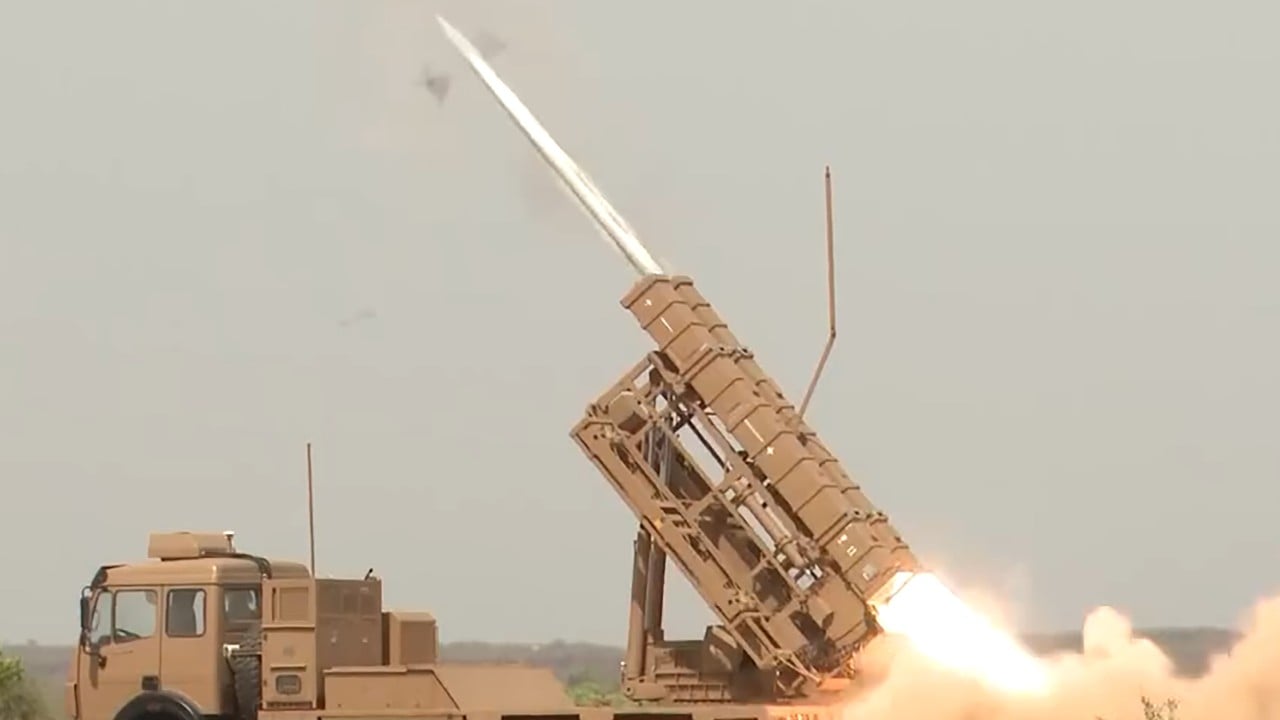
In official footage released by the Burkinabe presidency, defense analysts spotted something entirely new operating alongside a mobile air-surveillance radar and command station. Intelligence firm Janes assessed the canisters and launcher architecture as the Sky Dragon 30, a medium-range surface-to-air missile system built by Norinco.
Think about what that means for a military like Burkina Faso's. Until that video surfaced, their forces had spent years buying offensive strike drones without possessing any organic, radar-cued air defense to protect their own bases from rival reconnaissance UAVs or low-flying aircraft. The Sky Dragon 30—capable of engaging targets at altitudes up to 18 kilometers using missiles derived from the PL-10E air-to-air platform—gave them their first genuine aerial shield.
Neighboring Mali made a similar leap just months earlier. In April 2026, convoy footage confirmed that Bamako had taken delivery of the Yitian-L air-defense system alongside VN22 infantry fighting vehicles and 105mm fire-support variants. Mounted on a high-mobility chassis, the Yitian-L packs a foldable 3D X-band radar that spots fighter-sized targets 18 kilometers out, paired with TY-90 missiles and a passive thermal-laser suite. That passive sensor setup lets Malian crews lock onto and engage aerial threats without ever turning their radar on—a massive survivability advantage when facing enemies equipped with anti-radiation sensors.
Breaking France's Grip in Côte d'Ivoire
This isn't just happening in military-led Sahelian states. Even traditional Western partners are rewriting their procurement rules.
In August 2026, the Armed Forces of Côte d'Ivoire (FACI) released video from Bouaké Air Base showing Ivorian technicians working on two newly delivered Wing Loong II combat drones. Built by AVIC and exported through CATIC, the Wing Loong II is China's direct answer to the American MQ-9 Reaper. It can loiter over a conflict zone for roughly 32 hours on intelligence missions and haul up to 480 kilograms of precision munitions across six underwing hardpoints.
For decades, Abidjan bought almost exclusively from France. Seeing Wing Loong IIs sitting on an Ivorian tarmac—with Chinese K-8 trainer jets also on the horizon—proves that Beijing's defense diplomacy works just as well in coastal democracies as it does in junta-ruled capitals.
Why Russia and the West Left the Door Wide Open
China didn't pull off this expansion in a vacuum. Two massive geopolitical shifts cleared the runway for Beijing's defense firms.
First, Russia's industrial base remains tethered to its war in Ukraine. Moscow still talks a big game about African defense partnerships. At the third Russia-Africa Summit in Moscow in late October 2026, Rosoboronexport touted billions in contractual agreements, and Ethiopia announced a high-profile deal for 12 Su-35 fighter jets and four S-400 air-defense batteries.
There is a massive gap between signing a framework agreement in Moscow and actually getting hardware delivered to an African runway. With Russian factories straining to replace battlefield losses in Eastern Europe, delivery timelines for foreign buyers have stretched indefinitely. In the Alliance of Sahel States—Mali, Burkina Faso, and Niger—a clear division of labor has emerged. Moscow provides mercenary muscle via the Africa Corps and aging airframes, while Beijing supplies the modern wheeled armor and radar-guided air defenses that Russia simply can't spare right now.
Second, Western nations shot themselves in the foot through a mix of political retreat and rigid export controls.
Following a wave of military coups across West Africa between 2020 and 2023, France pulled its troops out of Mali, Burkina Faso, and Niger. The United States followed suit in Niger, vacating its major drone base in Agadez. When Western militaries packed up, Western defense contractors lost their primary diplomatic advocates.
Even where Western governments want to sell weapons, their bureaucracy gets in the way. U.S. Foreign Military Sales (FMS) cases regularly take years to clear congressional notifications, human rights vetting, and end-user monitoring agreements. If an African defense minister needs armed drones or short-range air defense to stop an insurgency this year, waiting until 2029 for Washington to approve an export license isn't an option.
The Real Reasons African Militaries Choose Beijing
If you talk to defense procurement officers or analysts who track African security, they'll tell you it isn't just about default options. China offers a commercial package that Western and Russian firms struggle to match.
Speed and zero political lectures. Beijing operates under a strict policy of non-interference. Chinese state-owned exporters don't condition radar sales on democratic elections, governance reforms, or human rights audits. Once a contract is signed, hardware often arrives in months rather than years.
Flexible financing and resource swaps. Cash-strapped defense ministries rarely have hundreds of millions of dollars sitting in liquid reserves. Chinese lenders frequently structure defense deals with low-interest state loans, extended grace periods, or barter arrangements tied to mining concessions and infrastructure access.
Good-enough tech at a fraction of the price. A single American MQ-9 Reaper system can easily run tens of millions of dollars once you factor in ground control stations and munitions. A Wing Loong II delivers roughly 80 percent of the capability at a fraction of the sticker price. For militaries fighting asymmetric insurgencies rather than peer superpowers, "good enough" wins every time.
Expanding regional interest. The ripple effects are spreading beyond West Africa. The Nigerian Air Force sent delegations to China in 2025 to inspect the Sky Dragon air-defense system, putting Abuja on the shortlist for medium-range Chinese batteries. Further north, Morocco has already integrated Chinese FD-2000B long-range air-defense missiles into its network.
The Catch Nobody Mentions at the Ribbon-Cutting Ceremony
Buying advanced radar and combat drones is the easy part. Keeping them running in the middle of the Sahel is an entirely different headache.
High-tech weapons systems are notoriously fragile. Fine desert dust clogs turbine intakes on Wing Loong drones. Extreme ambient heat degrades sensitive X-band radar electronics and missile propellants. Unlike an AK-47 or a basic armored personnel carrier, a Sky Dragon 30 battery cannot be fixed by a local mechanic with a wrench and a welding torch.
Historically, Chinese defense contractors have struggled with after-sales sustainment—spare parts pipelines, software updates, and deep depot-level maintenance. That wasn't a dealbreaker when China was only selling trucks and artillery shells. If a few trucks broke down, you cannibalized one for parts and kept rolling.
You can't cannibalize a radar fire-control unit.
To make this move up the value chain permanent, Norinco and AVIC have to embed permanent technical support teams inside places like Bamako, Ouagadougou, and Abidjan. That creates a quiet, long-term dependency. Every time an African air force buys a Chinese drone or missile battery, it also buys years of Chinese technician deployments, officer training programs in China, and proprietary ammunition resupply chains.
How to Track What Happens Next
If you're following geopolitical risk, defense markets, or regional security in Africa, don't get distracted by flashy press releases from diplomatic summits. Watch three concrete indicators over the next 12 months instead:
- Watch the March 2027 SIPRI Arms Transfers data. The upcoming Stockholm International Peace Research Institute release will confirm whether high-value radar, missile, and UAV deliveries have officially overtaken ground vehicles in Beijing's export ledger.
- Look for permanent Chinese contractor footprints. Pay close attention to satellite imagery and local reporting around air bases in Bouaké, Ouagadougou, and Bamako. If Chinese technical advisors stay on the ground long after handover ceremonies, Beijing has solved its maintenance bottleneck.
- Monitor Nigeria's next air-defense tender. Abuja is sub-Saharan Africa's largest defense spender. If Nigeria formally signs off on the Sky Dragon system after its 2025 evaluation, expect a domino effect across the rest of the continent.
Beijing figured out a decade ago how to build Africa's roads, ports, and railways. Now it's selling the radar and missiles to guard them.


