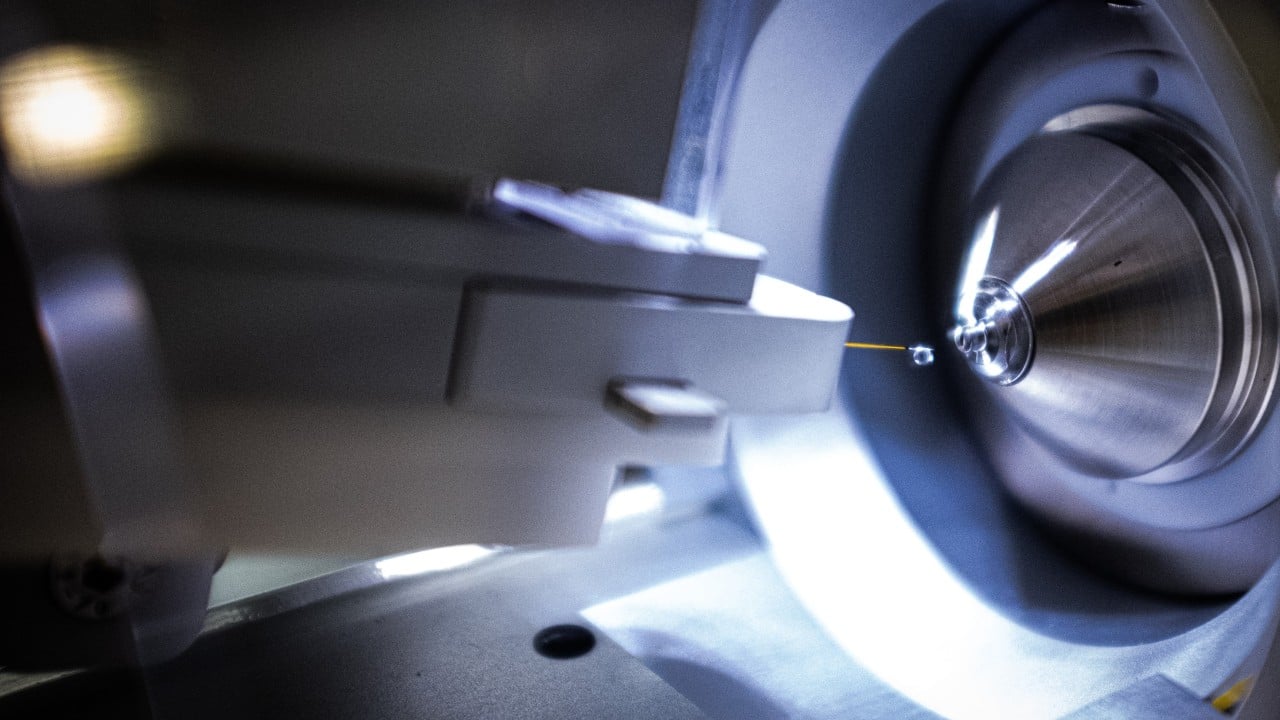
Western analysts love a good chokehold narrative. For the past decade, the consensus across think tanks and tech journalism has been clear: China is deeply vulnerable because it relies on imported scientific instruments. They point to high-end mass spectrometers, electron microscopes, and NMR spectrometers sourced from the US, Europe, and Japan. They argue that without these imported tools, China’s scientific research and AI-driven materials discovery will grind to a halt.
This analysis is wrong. It mistakes a trailing indicator for a permanent bottleneck. For a deeper dive into this area, we suggest: this related article.
The mainstream panic over China’s scientific hardware dependency misses the actual mechanics of technological leapfrogging. Importing precision equipment isn't a vulnerability; it is an arbitrage strategy that China is already outgrowing. The West is cheering for a hardware blockade that is already obsolete.
The Myth of the Hardware Chokehold
The standard argument hinges on market share statistics. It is true that companies like Thermo Fisher Scientific, Agilent, Shimadzu, and ZEISS dominate the high-end instrument market in Chinese labs. In some categories, foreign vendors command over 80% of the market. Analysts look at these numbers and assume a blockade would crush Chinese innovation. For broader information on this issue, extensive analysis can also be found at TechCrunch.
This assumes scientific instruments are static, isolated pieces of hardware. They are not.
Modern scientific discovery is shifting from hardware-constrained experimentation to software-driven simulation and data analysis. The bottleneck is no longer the physical generation of data, but the processing, modeling, and application of that data.
I have watched hardware manufacturers burn through hundreds of millions of dollars trying to perfect the physical alignment of a lens, only to be bypassed by a competitor using cheaper hardware paired with machine learning error-correction algorithms.
When you look closely at how Chinese research institutions operate, you see a deliberate two-step strategy:
- Buy foreign hardware to extract high-quality foundational data rapidly.
- Use that data to train domestic AI models that reduce the need for high-end hardware in the future.
By the time Western export controls completely restrict the shipment of these instruments, the physical hardware will matter far less. The field is moving from raw measurement to predictive modeling.
The Software-Defined Instrument
Let's look at the mechanics of this shift. Consider cryo-electron microscopy (cryo-EM), a field critical for structural biology and drug discovery. Historically, the breakthrough required massive, astronomically expensive physical microscopes from vendors like Thermo Fisher. The value was in the physical optics and the stability of the stage.
Today, the real breakthroughs are happening in the post-processing software. Algorithms can now reconstruct high-resolution 3D structures from noisy, lower-quality 2D images.
Imagine a scenario where a laboratory uses a mid-tier, domestically produced microscope that outputs messy data. Ten years ago, that data was useless. Today, an advanced deep-learning model can denoise that image, correct for optical aberrations, and deliver a structural resolution that rivals a machine costing three times as much.
This is what the hardware-obsessed crowd misses. China does not need to perfectly replicate the manufacturing precision of a German lens maker or a Japanese sensor company. They can compensate for hardware deficiencies with computational power and algorithmic sophistication. It is cheaper, faster, and infinitely more scalable to build better software than it is to build a flawless physical factory.
The Re-Industrialization Trap
A common question found in industry reports is: Can China build its own high-end scientific instruments?
The question itself is flawed. It assumes the goal is replication. If Chinese companies spend the next decade trying to build an exact clone of a high-end Agilent gas chromatograph, they lose. By the time they perfect the valves and columns, the cutting edge of science will have moved on to chip-scale chemical sensors and automated synthetic platforms.
The real disruption happens when you ignore the legacy form factor entirely.
Look at what happened in the drone industry. Western aerospace firms were focused on perfecting traditional, highly engineered military and civilian RC aircraft. DJI built cheap, software-stabilized quadcopters that made traditional aerodynamic perfection irrelevant. The software handled the stability, allowing the hardware to be cheap and mass-produced.
The same transition is hitting laboratory automation. The future belong to closed-loop, AI-driven laboratories—often called "self-driving labs." In these setups, the individual instrument is just a node in a network. It does not need to be the most precise machine in the world; it just needs to be consistent enough for the central AI orchestrator to account for its variance.
The Real Cost of Academic Isolation
If there is a real risk to China's scientific ambitions, it is not a lack of imported metal and glass. It is the decoupling of data pipelines.
Science moves forward through open, global data repositories. If geopolitical tension forces Chinese researchers out of international databases, or if Western journals stop accepting papers from specific institutions, that hurts. The hardware is just a tool to generate data. If you cut off the flow of global data, you slow down the training of the very models that make the hardware obsolete.
However, this risk cuts both ways. Western academic institutions rely heavily on the sheer volume of data and research output coming out of Chinese universities. A clean break doesn't just isolate China; it starves Western AI models of the massive training sets required for next-generation breakthroughs in biology and materials science.
The Actionable Pivot for Tech Leaders
If you are a tech executive or an investor operating under the assumption that China’s lack of domestic precision manufacturing will stymie its tech sector, you need to re-evaluate your thesis immediately.
- Stop tracking hardware shipments. Measuring a nation's scientific capability by how many mass spectrometers it imports is like measuring a tech company's capability by how many desktop computers it buys. Look at the compute capacity allocated to scientific modeling instead.
- Invest in software-defined physical assets. The value is migrating from the physical chassis to the digital twin and the error-correction layers. Companies that manufacture instruments must pivot to becoming software companies, or they will be commoditized by cheaper hardware running superior AI.
- Watch the data generation hubs. The dominant players of the next decade will not be the ones with the cleanest cleanrooms, but the ones with the most automated, data-dense workflows.
The Western focus on restricting scientific equipment export is an attempt to fight the last war. It treats the instrument as the destination, rather than what it actually is: a temporary scaffold for a completely digital scientific architecture. The scaffold is already coming down.