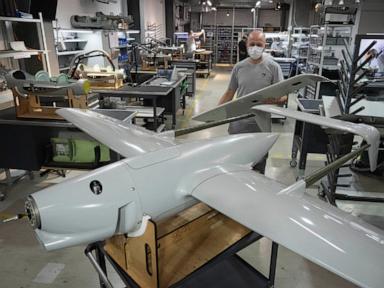
Headline import percentages tell only half the story of Ukraine's unmanned aerial vehicle supply chain. Customs figures showing that direct Chinese-origin drone parts fell from roughly 90% in 2024 to 28% in 2026 create a tempting narrative of industrial independence. Look closer at the bill of materials, and that comfort breaks down. Ukraine has localized low-to-moderate complexity assemblies—frames, basic motors, and certain electronic modules—while high-barrier optical, navigation, and sensor inputs remain concentrated in Chinese manufacturing ecosystems or reliant on cross-border intermediaries.
A superficial reading of this vulnerability treats Chinese sourcing as a binary problem: either Ukraine buys from China or it builds everything at home. In practice, defense supply chains operate across distinct tiers of capital intensity, chemical and metallurgical processing, and semiconductor fabrication. Treating a 28% direct-import figure as proof of resilience ignores both indirect routing through third countries and the extreme asymmetry in upstream chokepoints such as thermal sensors and sintered rare-earth magnets. You might also find this similar article insightful: Why Drone Strikes on Russian Data Centers Miss the Real AI Bottleneck.
Mapping the Competing Thesis and Its Blind Spots
A standard commentary piece on this topic usually builds a straightforward argument: Ukraine entered the war heavily reliant on Chinese commercial drones and parts, Beijing introduced export controls, and now a major foreign supplier represents an existential risk to Ukrainian air and ground operations. That argument identifies a real tension, yet it leaves three analytical gaps that distort how defense planners and operators evaluate risk.
First, it conflates finished-system assembly with upstream input control. Assembling a quadcopter frame or winding copper coils locally differs fundamentally from fabricating infrared detectors or refining battery and magnet precursors. Second, it treats export controls as simple on-off switches rather than porous regulatory regimes shaped by dual-use definitions, third-party transshipment, and asymmetric enforcement toward rival buyers. Third, it reduces component risk to a single variable—usually physical availability or price—while understating data integrity, hardware provenance, and cyber exposure in connected subsystems. As extensively documented in recent coverage by ZDNet, the implications are significant.
To understand where Ukraine's drone arsenal actually faces exposure, the problem must be broken down into four structural mechanics: bill-of-materials stratification, export-control elasticity, cyber and provenance risk, and industrial localization trade-offs.
The Four Structural Pillars of Supply Chain Exposure
1. Bill-of-Materials Stratification and the Chokepoint Hierarchy
Not every part on an uncrewed aircraft carries the same strategic weight. An operational framework separates drone inputs into three tiers based on substitution friction and capital intensity:
- Tier 1: Structural and basic electromechanical parts. Carbon-fiber airframes, basic brackets, wiring harnesses, and standard brushless motor housings have relatively low barriers to local workshop or small-factory production. Ukrainian manufacturers have made substantial progress localizing these items, cutting out direct imports where domestic labor and agile tooling compete effectively.
- Tier 2: Energy storage and magnetic inputs. Lithium-ion cells, graphite anodes, and neodymium-iron-boron permanent magnets sit at an industrial bottleneck where refining and finishing matter more than raw extraction. Even when rare-earth ores or lithium come from outside China, magnet sintering, magnetization, and anode material processing remain heavily concentrated there.
- Tier 3: Precision optical, RF, and navigation sensors. Thermal imaging cores, specialized camera modules, navigation units, and radio-frequency components require high-precision semiconductor and optical manufacturing. Thermal sensors illustrate the scale gap starkly: industry reporting indicates China produces roughly 20 million thermal sensor units annually, whereas combined capacity outside China—centered largely in North America and France—is measured in the low millions.
The cause-and-effect chain here is direct. When a nation localizes Tier 1 parts, its unit count of domestically made components rises fast, which lowers headline import shares. Yet if a single Tier 3 sensor or Tier 2 magnet remains scarce or expensive, total fleet throughput still hits a ceiling set by the tightest bottleneck.
2. Export Control Elasticity and Asymmetric Enforcement
Export controls rarely freeze a supply chain overnight; they reshape transaction costs, lead times, and routing paths. Beginning with restrictions on larger long-range UAVs in 2023 and expanding to broader drone and component controls in September 2024—alongside subsequent updates such as China's November 2026 export control measures—Beijing has used regulatory levers to manage outbound dual-use hardware.
Three mechanisms govern how these controls behave in practice:
- Scope gaps and dual-use ambiguity. Many drone subcomponents—motors, cameras, flight controllers, chips, and radio modules—have civilian commercial equivalents. Export rules often target specific thresholds or categories while leaving adjacent or dual-use parts harder to police cleanly.
- Intermediary routing and multi-country transshipment. When direct exports face scrutiny or customs friction, suppliers and buyers frequently shift to third-party intermediaries or multi-leg logistics chains. Lower direct customs numbers therefore do not guarantee zero indirect Chinese provenance.
- Asymmetric enforcement. Analysts and Ukrainian officials have repeatedly pointed out that Chinese components continue to appear in Russian unmanned systems—such as Shahed/Geran variants—while domestic enforcement against firms supplying Russian defense networks remains limited.
What is a known fact versus an educated hypothesis? It is a documented fact that export restrictions have been introduced and updated, that Chinese electronics appear in Russian systems, and that Ukraine's direct import share from China has fallen sharply. By contrast, predicting the exact timing or completeness of a total cutoff on any specific subcomponent remains an educated hypothesis because commercial incentives, customs enforcement, and diplomatic signaling interact dynamically.
3. Cyber Risk, Telemetry, and Hardware Provenance
As drones become more autonomous, networked, and sensor-heavy, supply chain risk stops being purely a logistics problem and becomes a security problem. A camera, navigation module, or communication link is not just a piece of metal and silicon; it is an interface where firmware, data streams, and signal pathways meet.
Consider a reconnaissance or strike drone operating under heavy electronic warfare. If an operator relies on off-the-shelf optical or navigation hardware with opaque firmware or unverified supply provenance, potential failure modes include unintended telemetry leakage, susceptibility to signal spoofing or exploitation, or hidden behavioral quirks under specific operating conditions. Even without assuming malicious backdoors in every part, unvetted commercial electronics introduce configuration drift, undocumented dependencies, and firmware blind spots that complicate battlefield security.
Compliance labels such as U.S. National Defense Authorization Act (NDAA) restrictions address certain procurement boundaries, yet defense analysts emphasize that certification alone does not eliminate operational risk in an active, contested electronic environment. Hardware assurance requires architectural inspection, firmware control, and operator awareness of how data moves through the airframe.
4. The Cost Function of Localization
Why hasn't Ukraine simply replaced every remaining Chinese part overnight? Because localization obeys a strict economic and engineering cost function:
$$\text{Localization Viability} = f(\text{Unit Volume}, \text{CapEx Lead Time}, \text{Yield/Precision}, \text{Unit Cost Delta})$$
In plain operational terms, moving a component onshore makes sense fastest when:
- Frontline burn rates create massive, continuous demand. High consumption amortizes tooling and setup costs across large batches.
- Iteration speed beats static import lead times. Ukrainian defense manufacturers have demonstrated that rapid field-driven iteration—incorporating lessons from daily combat use—can outperform slow external procurement cycles.
- Capital intensity is manageable. Building a composite or electronics assembly line takes far less time and capital than scaling specialized thermal sensor fabrication or building competitive rare-earth magnet refining.
Even when allied or domestic alternatives exist, price and timeline penalties are real. Analysts note that European rare-earth magnet production scaling toward commercial volume in the early 2030s is expected to carry a 15% to 30% cost premium over Chinese supply. Under wartime budget constraints, paying a steep premium or waiting years for factory expansion forces painful trade-offs between fleet scale today and supply sovereignty tomorrow.
Why Common Questions Around This Issue Need Nuanced Answers
When policymakers, founders, and observers ask how vulnerable Ukraine's drone fleet really is, four practical questions tend to surface. Answering them structurally prevents oversimplification.
Has Ukraine already solved its China dependency? No. Reducing direct Chinese component imports from near 90% in 2024 to 28% in 2026 is a major industrial shift, especially in frames, motors, and basic modules. However, critical bottlenecks remain in high-value sensors, optics, navigation components, and upstream materials, and indirect sourcing through intermediaries still occurs.
Which parts are hardest to replace locally? Thermal imaging sensors, specialized cameras, navigation modules, and magnet/battery supply chains pose the toughest hurdles. Thermal sensors require specialized semiconductor capabilities where global capacity outside China is comparatively small, while rare-earth magnets and battery materials depend on capital-heavy processing and refining infrastructure.
Why does allied funding sometimes lag behind battlefield needs? Wartime drone engineering moves in weeks and months, whereas traditional government grants, multi-country procurement rules, and industrial subsidy programs often move on multi-year administrative cycles. Defense tech leaders have pointed out that slow funding disbursements and narrow industrial policy scopes—such as excluding dual-use tech from chip initiatives—can delay domestic alternatives when frontline demand is immediate.
Does using Chinese parts automatically mean a drone is compromised? Not automatically, which is why treating every part as identical creates noise. A passive structural bracket or basic wire carries a very different cyber and data profile than an active optical sensor, radio link, or navigation module. Risk depends on component function, network connectivity, firmware control, and operational security discipline on the ground.
Tactical Playbook for Reducing Exposure Without Stalling Output
A pragmatic practitioner does not try to rip out every foreign component in a single sweep if doing so grounds fleets or inflates unit costs beyond sustainability. Instead, a disciplined engineering and procurement sequence manages risk in stages:
- Map every bill of materials down to sub-tier origins. Audit each drone variant by subsystem—airframe, propulsion, power, optics, navigation, and comms—and flag items with single-country concentration or opaque intermediary routing.
- Segment components by risk and replaceability. Pair high cyber/telemetry exposure with high supply concentration to set priority order. Target connected sensors, navigation units, and radios for hardened firmware and verified sourcing before spending scarce capital on low-risk passive hardware.
- Qualify dual-source and allied alternatives in parallel. Maintain qualified secondary suppliers across partner countries so a sudden export restriction, price spike, or customs hold triggers an immediate switch rather than a production halt.
- Reinvest operational margins into high-leverage domestic nodes. Direct domestic manufacturing revenue and specialized investment toward high-value bottlenecks—such as domestic camera/sensor engineering, hardened electronics, and ruggedized subsystems—where local iteration pays off.
- Enforce network isolation and operator hygiene. Treat untrusted or legacy hardware as untrusted on the network: isolate sensitive data paths, audit firmware updates, and train operators on how specific modules behave under jamming or capture.
Limitations and Edge Cases of a Localization Strategy
Every supply chain strategy carries trade-offs, and pretending localization is a cure-all creates blind spots. First, unit economics can bite hard: localized or allied components—especially in magnets, specialty chips, and precision optics—can cost substantially more or scale more slowly than mass-produced Asian equivalents. In attrition warfare where mass and cost-per-effect matter, a more expensive domestic drone can mean fewer total airframes in the sky if budgets stay flat.
Second, geographical dispersion does not guarantee immunity. Shifting from one dominant supplier to a small handful of Western or regional fabs still leaves concentrated nodes that can face backlogs, export bottlenecks of their own, or slow ramp-up curves. Third, adversarial adaptation never stops: as electronic warfare, GPS-denied navigation, and AI-assisted targeting evolve, a component deemed secure today may face new exploitation vectors or obsolescence tomorrow.
The Strategic Play Moving Forward
Ukraine and its defense partners should treat component localization as a tiered risk-reduction portfolio, not an all-or-nothing ideological purge. The highest-leverage move over the next 12 to 24 months is to concentrate capital, fast-track allied co-production, and streamline dual-use industrial financing specifically around the hardest bottlenecks—thermal and optical sensors, navigation modules, and resilient communications—while keeping flexible, multi-sourced procurement channels open for commoditized inputs so frontline mass never stalls while sovereign capacity catches up.


