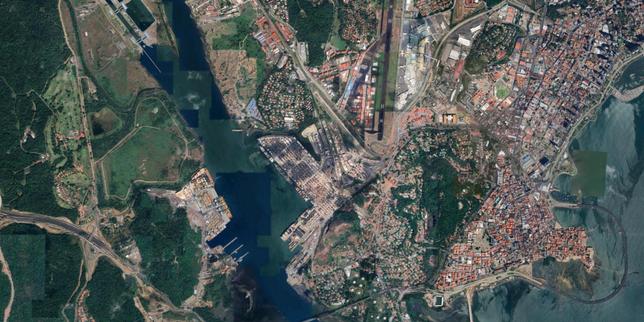
The heat in the Gatun Locks does not just sit on your skin. It heavy-presses into your lungs, thick with the scent of scalded grease, brackish water, and the faint, metallic tang of frying electronics.
Stand on the concrete apron long enough, and you will feel the vibration before you see the ship. It is a low, sub-audible shudder that rattles the soles of your shoes. Then, the bow appears. A wall of rusted steel towers twelve stories above the jungle canopy, squeezing through a gap with mere inches to spare on either side.
This is the Panama Canal. For over a century, it has functioned as the literal plumbing of global capitalism. Water goes up, water goes down, and cheap goods move from east to west. We take it for granted. We assume that when we click a button on a screen, a plastic toy or a semiconductor will seamlessly arrive at our doorstep because the map says it should.
But the map is lying.
Today, this forty-eight-mile ribbon of water is no longer just a engineering marvel struggling with a changing climate. It has become something far more dangerous. It is the primary theater of a cold, quiet, and terrifyingly complex proxy war between Washington and Beijing.
The Ghost Fleet at Anchor
To understand how a local chokepoint becomes a global flashpoint, you have to look at the water. Or rather, the lack of it.
Let us trace a hypothetical but entirely accurate journey. Meet Captain Chen. He commands a 1,200-foot Neo-Panamax container vessel laden with billions of dollars in consumer electronics destined for Savannah, Georgia. Under normal circumstances, Chen’s biggest worry is the grueling shift schedule of his crew.
Not anymore.
As his ship approaches the gulf, the radar screen lights up with dozens of stationary blips. It is a parking lot of titans. Dozens of vessels are bobbing aimlessly in the open ocean, burning fuel, losing money, waiting for permission to cross.
The problem is deceptively simple. The Panama Canal does not use seawater to lift its ships; it uses fresh water from Gatun Lake. Every single transit swallows roughly fifty million gallons of this fresh water, spitting it out into the ocean. When severe droughts strike the region, the lake shrinks. When the lake shrinks, the canal authority has to slash the number of daily transits.
This is where the math turns brutal.
When capacity drops, a bidding war begins. The Panama Canal Authority operates a secretive, high-stakes auction system for transit slots that went unbooked months in advance. If you cannot afford to wait three weeks in the burning sun, you pay.
In recent months, companies have paid upwards of four million dollars just to skip the line. That is four million dollars on top of the standard transit fees. Who can afford that? Mega-corporations backed by state subsidies. Who gets left behind? The independent logistics firms, the smaller nations, the everyday consumer who will eventually see that four-million-dollar surcharge tacked onto the price of their groceries.
But this isn't just an economic squeeze. It is a geopolitical trapdoor.
The Soft Invasion
Walk away from the locks and take a short drive to the ports at either end of the canal—Balboa on the Pacific side, and Cristobal on the Atlantic. Look closely at the logos on the towering shore cranes. Look at the names on the terminal management offices.
You will see the name Hutchison Ports.
Hutchison is a Hong Kong-based conglomerate. To the casual observer, it is just another maritime logistics giant. To the pentagon planners in Washington, it represents a permanent Chinese flag planted at both mouthpieces of America’s most vital strategic waterway.
The transition happened without a single shot being fired. Decades ago, when the United States finally handed control of the canal back to Panama, the local government needed massive foreign investment to modernize the infrastructure. Washington, comfortable in its post-Cold War hegemony, hesitated. Beijing did not.
China approached Panama with open checkbooks. They built bridges. They expanded ports. They laid down fiber-optic cables through the state-owned telecom companies like Huawei. They offered low-interest loans that looked like philanthropy but functioned like golden handcuffs.
Consider what happens next when a nation becomes economically dependent on a single superpower. In 2017, Panama abruptly broke diplomatic ties with Taiwan, recognizing Beijing instead. Suddenly, Chinese state-owned enterprises weren't just renting dock space; they were sitting at the table where the rules of the canal are written.
For Washington, this is a nightmare realized. The Monroe Doctrine—the centuries-old American policy that foreign powers must stay out of the Western Hemisphere—has been quietly dismantled by accountants and construction crews.
The Tech Underbelly of the Jungle
The conflict isn't just about who owns the concrete; it is about who controls the data flowing through it.
Modern shipping is no longer an industry of ropes and canvas. It is a game of predictive algorithms. A container ship is a floating data center. It constantly transmits information about its cargo, its fuel efficiency, its crew, and its exact GPS coordinates via automated systems.
Every time a ship passes through a port managed by a Chinese company, that data enters a ecosystem controlled by Beijing. The platform is called LOGINK. It is a state-sponsored, public logistics information network that aggregates data from ports across the globe.
Think about the leverage this provides. If you know exactly what raw materials are moving to which American factories three weeks before they arrive, you don't need to win a war on a battlefield. You have already won the economic war. You can underbid competitors, manipulate supply chains, or strategically delay shipments of critical components under the guise of "administrative maintenance."
The United States has tried to push back. American diplomats regularly descend on Panama City, whispering warnings about debt traps and espionage into the ears of Panamanian officials. They offer alternative investment packages, trying to match China’s financial muscle.
But the Americans are playing catch-up in a game they forgot they were playing.
The Human Toll of the Choke
It is easy to get lost in the grand strategy of empires, to view this purely as a game of Risk played by suits in Washington and Beijing. But look back down at the water. Look at the people trapped in the gears.
The Panamanian pilots who board these massive ships to guide them through the treacherous, narrow cuts of the canal are exhausted. The stress is immense. If a pilot makes a single error in judgment, a 150,000-ton ship hits a concrete wall, blocking the canal for days and sending shockwaves through the global stock markets.
Because of the reduced transits and the geopolitical tension, these pilots are working longer hours under heavier pressure. They watch the skies for rain that doesn't come, and they watch the horizons for naval vessels that look increasingly ominous.
Then there are the crews. Merchant mariners are already some of the most invisible workers on earth. Now, they are stuck at anchor for weeks on end in the middle of a diplomatic cold war. Supplies run low. Fresh water on board must be rationed. The tension on the bridge escalates as they watch vessels with deeper pockets or better political connections leapfrog them in the queue.
We live in an era that worships the cloud, the wireless, the instantaneous. We like to believe that our world is weightless.
The Panama Canal is the stubborn, heavy refutation of that myth. It reminds us that global civilization is still bound to the physical earth, to narrow ditches dug through tropical mud, and to the volatile whims of human greed.
The water in Gatun Lake continues to drop, inch by agonizing inch. As the space inside the locks grows smaller, the friction between the world's two largest empires grows tighter. The rope is stretching. You can hear the individual strands snapping if you listen closely enough over the sound of the engines.
The next time you hold a piece of technology in your hand, remember the hot, greasy air of the canal. Remember the line of ghost ships waiting in the dark. The system isn't broken yet, but the machinery is groaning under a weight it was never designed to bear.


