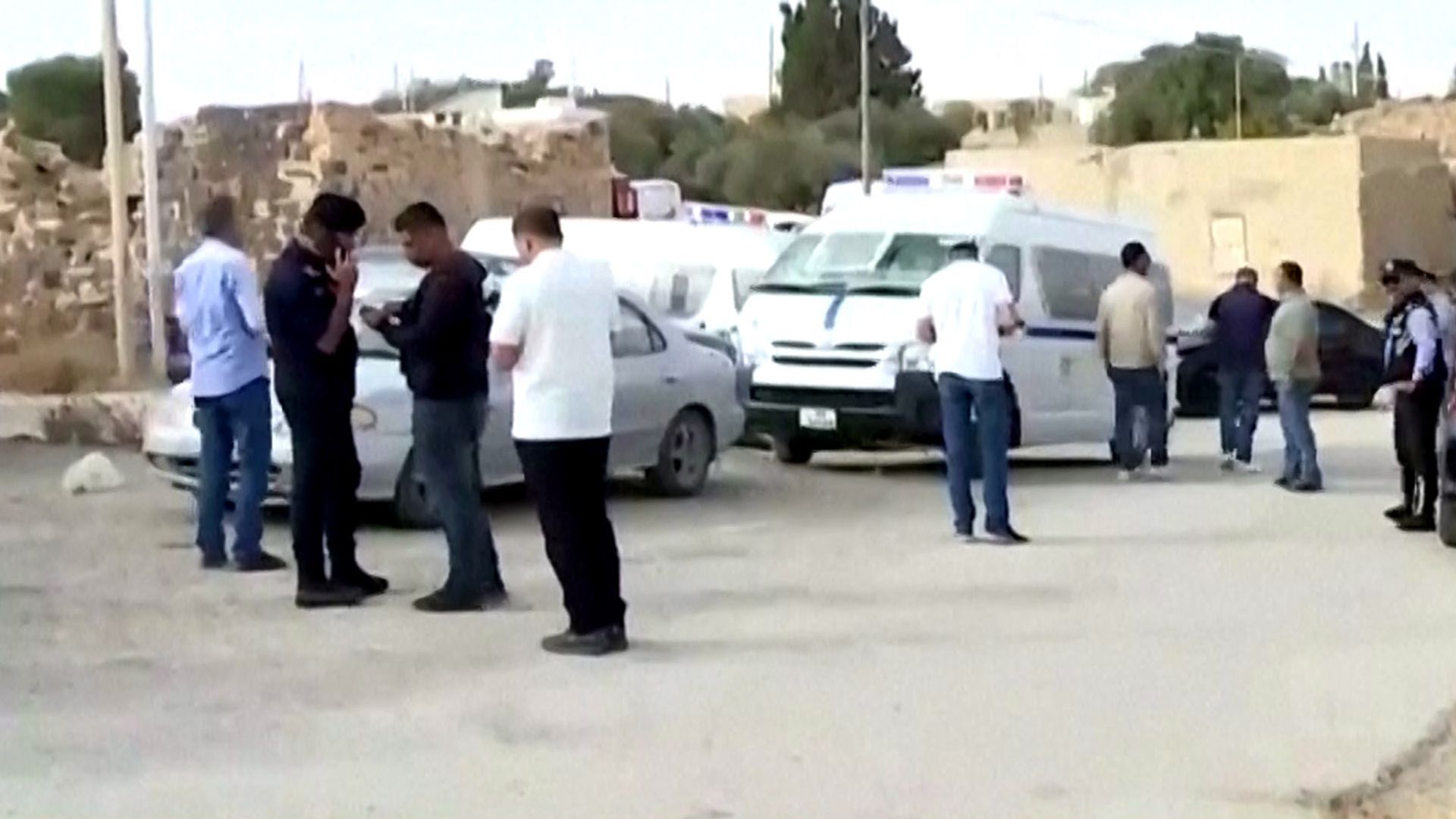
Seven dead. Thirty-four injured. A church in Jordan becomes the focal point of global news coverage, and within hours the usual scripts start rolling out.
Watch those scripts closely. They almost always flatten a complex security reality into a neat story about a lone gunman, a soft target, or an isolated religious flashpoint. That framing is lazy. It feels complete on a breaking-news chyron, yet it leaves readers blind to how armed threats actually evolve in Jordan and across the wider Levant. You might also find this similar story useful: Illegal Great White Shark Capture Exposed The Brutal Truth Behind Felony Cruelty Charges.
I have spent years analyzing regional security reporting, counter-terrorism doctrine, and crisis response across the Middle East. I have watched analysts burn credibility by treating every violent incident as an identical repeat of the last one. Headlines about a shooting at a church in Jordan often trigger a predictable reflex: talk about religious tolerance in the kingdom, list the casualty count, and treat the attacker's motive as the entire story.
That is rarely the whole picture. A mass casualty attack at a house of worship is an event, not an explanation. If you stop at the headline, you miss the operational mechanics that let an attacker reach a high-visibility site, the structural pressures acting on Jordan's security apparatus, and the practical realities of how communities protect themselves without turning sanctuaries into fortresses. As extensively documented in latest articles by The New York Times, the effects are worth noting.
What Standard Reporting Gets Wrong About Attacks in Jordan
Standard breaking coverage relies on a few comfortable assumptions. First, it treats Jordan as an island of calm punctuated by occasional, inexplicable shocks. Second, it frames attacks on Christian spaces primarily as sectarian clashes, even when the operational and ideological drivers are broader and messier.
Let's be precise about terms before going further. Secularism in state governance is not the same thing as pluralism in everyday society, and neither is identical to counter-terrorism resilience. Jordan has a long-standing legal and political framework that recognizes Christianity as an official religion and protects church institutions under state patronage. That institutional recognition matters, and Jordanians across faiths frequently emphasize shared civic identity. Pretending that legal recognition guarantees immunity from violent extremism is wishful thinking.
At the same time, treating every attack on a church in Jordan as a simple two-sided religious war distorts the threat environment. Extremist actors often pick symbolic targets—churches, tourist sites, checkpoints, security patrols—because symbolic targets maximize international shockwaves and test state authority. Attacking a church does not require a deep local sectarian grudge if the goal is to destabilize public confidence, draw heavy security crackdowns, or signal regional reach.
Imagine a scenario where a security analyst looks at a church shooting in Karak or Amman and concludes only that "Christian-Muslim relations are under strain." If their next briefing focuses solely on interfaith dialogue while ignoring border spillovers, smuggling corridors, economic strain, or local radicalization networks, they are solving the wrong equation. Interfaith solidarity can be genuine and strong while a violent cell still targets a visible symbol of state-protected diversity. Both facts can exist at once.
Another lazy assumption is that a high casualty count—seven dead and thirty-four injured, for example—automatically proves a massive, sophisticated conspiracy. Sometimes it reflects careful planning and inside knowledge. Other times it reflects a grim combination of close quarters, crowd density during a service or gathering, delayed perimeter reaction, and high-capacity firearms. Confusing impact with sophistication leads to bad intelligence and exaggerated fear.
The Wrong Questions People Ask After a Church Attack
When a major shooting hits a church in Jordan, search behavior spikes around a predictable set of questions. Most of them point in the wrong direction.
"Why wasn't the church guarded like a military base?"
This question sounds practical until you look at how places of worship actually operate. A church is a civic and spiritual space meant to welcome people, not an airbase. Turning every church, mosque, or community hall into a hardened compound is financially unsustainable, socially alienating, and operationally unrealistic in a country with finite policing resources.
Even where guards are stationed outside, an attacker who arrives early, blends into traffic, targets an unguarded side entrance, or overwhelms a small security detail can create chaos in seconds. Security is a series of layers and probabilities, not an impenetrable wall. Asking why a church wasn't fortified like a bunker misses the real operational question: how did the threat bypass early detection, and how fast did local responders close the gap?
"Does this mean Jordan is about to collapse into wider instability?"
No—and saying "yes" for clicks is a staple of lazy commentary. Jordan faces real structural pressures: economic headwinds, high unemployment among young people, refugee hosting burdens, and volatile neighbors along its northern and eastern frontiers. Scholars and security practitioners who study the region seriously—figures like Marc Lynch on Middle East politics or security analysts tracking Levant border dynamics—have long pointed out that Jordan's resilience is tested continuously rather than all at once.
Resilience does not mean zero attacks. A state can absorb a horrific attack, mobilize intelligence and police forces rapidly, maintain basic public order, and still suffer serious reputational and psychological blows. Predicting imminent collapse after every serious incident has a terrible track record. Overstating collapse is just as inaccurate as pretending nothing changed.
"What does this say about the future of Christians in Jordan?"
This is a question that deserves blunt honesty rather than platitudes. Christians in Jordan are a small minority—often cited in rough estimates around a few percent of the population—with deep historical roots and a visible presence in education, commerce, and civic life. An attack on a church hits that community directly. Fear after a shooting is rational, not melodramatic.
At the same time, reducing Jordan's Christian community to a perpetual victim statistic strips away their agency and flattens their lived reality. Many Jordanian Christians view the country as home, push for equal citizenship and opportunity alongside fellow citizens, and reject being used as pawns in foreign culture wars. The real test after an attack is whether the state pairs firm security with consistent protection of minority rights and open public life, rather than responding with heavy-handed restrictions that make everyone feel less free.
Breaking Down the Real Mechanics of Threat and Response
To understand what happens around a shooting at a church in Jordan, you have to look at four interlocking mechanics instead of chasing single-cause explanations.
| Analytical Lens | Lazy Media Take | Sharper Operational Reality |
|---|---|---|
| Target Selection | Proof of an all-consuming local religious feud | Symbolic leverage to shock audiences and challenge state security |
| Casualty Scale | Automatic proof of a vast, masterminded network | Driven by crowd density, timing, weapon lethality, and response speed |
| State Posture | Either "unbreakable fortress" or "on the brink" | Stretched across multiple internal and border pressures with uneven friction points |
| Community Impact | Uniform panic or effortless harmony | Real grief and caution alongside everyday civic persistence |
1. Time and Distance Decide Survival
In almost every mass shooting, the decisive clock runs in the first three to five minutes. Where was the first armed responder? How quickly could ambulances reach a crowded street or courtyard? How clear were exit routes inside the building?
When an attack leaves seven dead and thirty-four injured, the gap between the first shot and effective containment—or between injury and trauma care—tells you far more about real-world vulnerability than broad geopolitical speeches do. A delay of a few minutes in perimeter lockdown or hospital triage can turn wounded victims into fatalities.
2. Information Fog Always Beats Early Reports
In the first hours after a shooting, casualty numbers fluctuate, witness accounts conflict, and rumors sprint ahead of verified facts. A church shooting in Jordan immediately attracts social media speculation, partisan spin, and unverified claims of responsibility.
Disciplined observers wait for consistent corroboration before locking onto a narrative. Early certainty in a chaotic security event is almost always premature certainty.
3. Over-Policing Can Backfire
When a high-profile attack occurs, governments face intense pressure to look tough immediately. Checkpoints multiply, searches intensify, and speech tightens. Some of those measures disrupt active plots or deter copycats.
Others create friction with ordinary citizens, slow down commerce, or breed resentment in already strained neighborhoods. Counter-terrorism works best when intelligence is surgical and public trust is preserved; blanket crackdowns often trade long-term legitimacy for short-term theater.
4. Trauma Outlasts the News Cycle
Once the international cameras move on to the next crisis, the families of the dead, the thirty-four or more injured survivors, and the local congregation keep living with the aftermath. Physical rehabilitation, psychological trauma, economic loss for families who lost a breadwinner, and neighborhood tension do not resolve when a news story drops off the front page.
Any serious conversation about security and stability has to account for the long tail after the sirens stop.
Where My Contrarian Take Can Go Wrong
Being contrarian for its own sake is just another form of bias. Pushing back against simplistic "sectarian shock" or "imminent collapse" narratives carries its own blind spots.
First, downplaying religious or ideological motivation can be a mistake when an attacker explicitly targets a church because of what it represents. Even if broader geopolitical or operational factors matter, ignoring ideology leaves you blind to how extremist narratives recruit and justify violence.
Second, caution against overreacting should never slide into minimizing the horror of the event. Seven people killed and thirty-four injured is a devastating blow to dozens of families. Treating a tragedy purely as a case study in risk analysis can sound cold if you lose sight of the human cost.
Third, arguing that Jordan is not on the verge of collapse does not mean its problems are minor. Chronic economic pressure, regional conflict spillover, and governance challenges compound over time. Calling out exaggeration is not the same as giving a clean bill of health.
What Actually Works Instead of Performative Outrage
If you want to understand—or respond to—a shooting at a church in Jordan with clarity rather than noise, skip the hot takes and focus on concrete actions.
- Track patterns across incidents, not single headlines. Compare response times, target types, security gaps, and regional spillover over years rather than reacting to one shock in isolation.
- Separate motive, capability, and opportunity. Ask who wanted the attack, how they got weapons and access, and what security gap made the strike possible.
- Prioritize practical site hardening over theatrical security. Focus on access control, sightlines, lighting, communication lines, and medical readiness rather than performative guards that look good without stopping a determined attacker.
- Support local capacity and accurate reporting. Back credible journalism, emergency medical readiness, and community support networks that keep working long after the breaking-news alert fades.
Stop letting lazy headlines do your thinking for you. Look at the mechanics, question the easy answers, and judge every claim by what actually holds up under pressure.