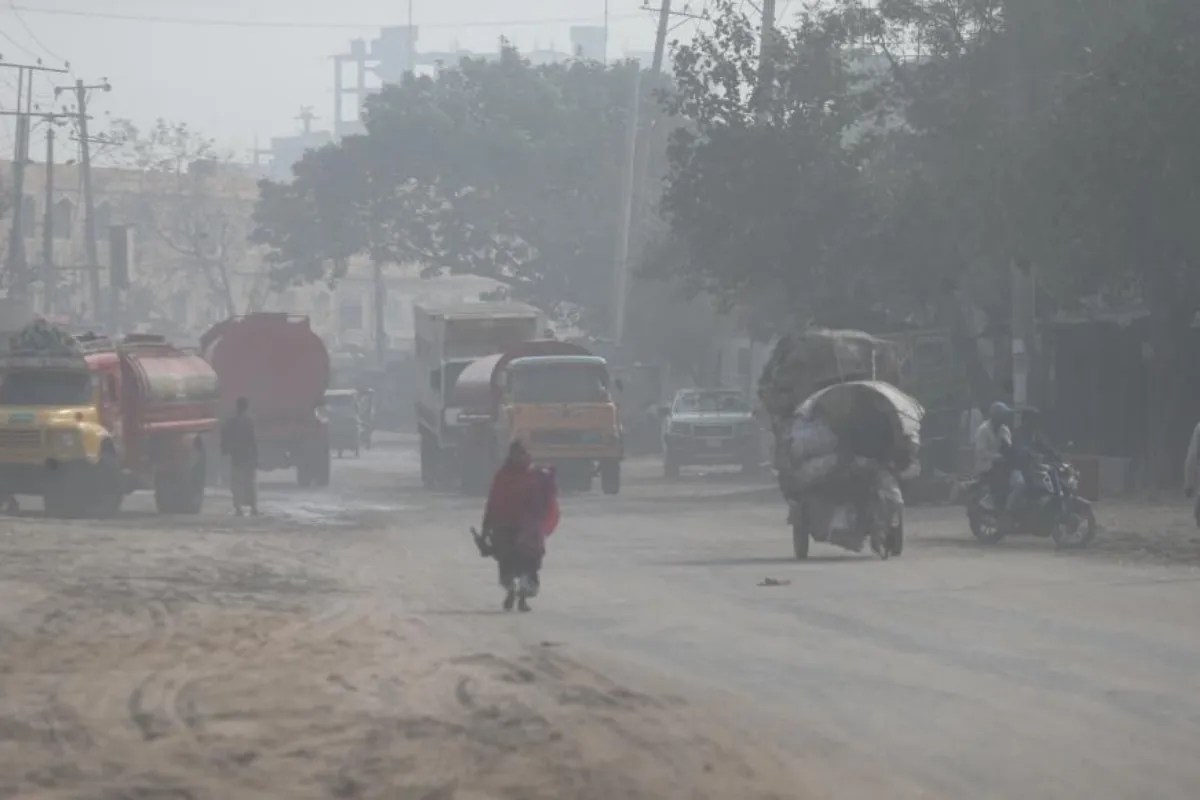
Dawn in Dhaka does not arrive with the gold and amber of an open horizon. It arrives as a slow, heavy bruise.
Before the first rickshaw-puller loops his gamcha around his neck, before the tea stalls lift their iron shutters to hiss of boiling milk and ginger, the sky has already surrendered. It is a thick, milky gray—the color of wet cement suspended in air. It presses down on the rooftops of old Dhaka, settles into the narrow alleys of Puran Dhaka, and coats the tongues of millions before they have even taken their first step outside. If you liked this post, you might want to read: this related article.
To read a weather report is one thing. To live it is another.
In the standardized language of air quality indexes, Dhaka is frequently crowned with an ugly, recurring distinction: the most polluted city in the world. Numbers flash on monitors—AQI readings pushing past 300, sometimes flirting with 400 or higher, deep into the hazardous maroon zone. For an office worker half a world away, those numbers are data points on a screen, a temporary blip to be scrolled past. But for the twenty-two million people who call this dense, relentless delta metropolis home, those numbers are the weight in their chests. They are the scratch in the throat that never quite goes away. They are the invisible architect of a daily life lived behind a cloth mask, or worse, no mask at all. For another angle on this story, refer to the latest update from The Guardian.
Consider Rahim.
Rahim is a fictional composite drawn from the real, breathing lives of thousands who navigate the city's arteries every single morning. He is thirty-four, a father of two, and a mechanic whose workshop sits near a choked intersection in Tejgaon. By noon, the air around him is a dense soup of exhaust from aging buses, particulate matter kicked up from unpaved construction sites, and the acrid, metallic tang of burning plastic drifting from the city's sprawling outskirts.
Rahim does not talk about particulate matter 2.5. He does not reference micro-grams per cubic meter. He simply knows that by four o'clock in the afternoon, his eyes will burn as if he has been peeling onions in a gale-force wind. He knows that his youngest daughter, seven-year-old Farida, has had a persistent dry cough for three weeks, and that the neighborhood pharmacy has become a second home where he buys syrup by the bottle.
"It is just the dust," neighbors tell each other, shrugging with the exhausted fatalism of people who have survived floods, political upheavals, and economic squalls. They call it dust because dust is familiar. Dust is old. Dust belongs to the earth.
But this is not dust. This is the byproduct of a relentless, frantic expansion.
Dhaka is growing at a breathless pace, a magnet drawing people from the rural fringes faster than its infrastructure can possibly absorb them. Every day, thousands arrive from districts battered by river erosion or shifting agrarian economies, seeking the fragile promise of work in the garment factories, the markets, and the informal sector. They come looking for a livelihood, and in doing so, they swell a container that is already overflowing.
To understand why the air has turned to poison, you have to look at the anatomy of the city itself. Imagine a massive, throbbing engine that is constantly being fed poor-grade fuel while its exhaust pipes are welded shut. That is Dhaka's reality. Brick kilns operating on the city's periphery during the dry winter months burn low-grade coal and wood, sending immense plumes of black carbon drifting inward on the northern winds. Thousands of diesel vehicles—many of them decades old, poorly tuned, and stripped of emission controls—belch black smoke into narrow corridors where high-rise buildings trap the fumes like canyon walls.
Add to this the dust of endless construction. Everywhere you look, concrete skeletons rise into the gray haze. Metro lines, flyovers, commercial towers, and residential blocks are being hammered into existence simultaneously. Piles of sand and excavated earth sit uncovered on sidewalks, waiting for the next gust of wind to scatter them across millions of windshields, balconies, and lungs.
The scientific reality behind this is stark and unforgiving. When air quality reaches the hazardous levels frequently recorded in Dhaka, the microscopic particles—PM2.5—do not merely irritate the nose. They are so small, roughly thirty times smaller than the width of a human hair, that they bypass the body's natural defense filters. They slip deep into the bronchioles, cross the barrier into the bloodstream, and travel to the heart and brain. Over time, they act like a slow-acting poison, thickening blood vessels, triggering strokes, accelerating cardiovascular disease, and permanently reducing lung capacity in children whose lungs are still forming.
Yet, life continues with a fierce, astonishing resilience.
Walk through Curzon Hall or the sprawling green of Ramna Park in the early morning before the traffic hits its deafening crescendo. You will see elderly men walking briskly in tight circles, trying to catch the cleanest air the city has to offer. You will see university students sitting on benches under the banyan trees, laughing over cups of lal cha, their laughter cutting through the haze. There is a deep, stubborn joy here, a refusal to let the environment dictate the spirit of the people.
But joy and resilience cannot filter nitrogen dioxide or sulfur dioxide.
When international environmental agencies rank Dhaka at the top of the global pollution charts, it is often treated as a seasonal headline. The narrative usually spikes during the dry winter months from November to February, when temperature inversions trap pollutants near the ground like a lid on a boiling pot, and then fades when the torrential monsoon rains arrive in June to wash the skies clean.
Relying on the monsoon to save a city is not a policy. It is a gamble with millions of lives.
The solutions are not mysterious, though they are monumental. They require a ruthlessness of will that few urban administrators have yet mustered. They demand the systematic replacement of archaic, polluting brick kilns with modern, energy-efficient technologies. They require rigorous emissions testing for every vehicle that crosses city limits, and the rapid expansion of a mass transit system that is clean, reliable, and accessible enough to pull commuters out of private cars and auto-rickshaws. They demand that construction sites be legally mandated to wet down their earth and shroud their scaffolding, treating dust not as an inevitable nuisance, but as a public health hazard.
Change is difficult when a city is running at a hundred miles an hour just to keep its economy afloat. Every regulatory crackdown on a polluting factory risks jobs. Every push to restrict old diesel trucks threatens the livelihoods of drivers who live hand-to-mouth. The crisis is not merely technical; it is a tangled web of economics, migration, and municipal capacity.
But the cost of inaction is written in the emergency rooms of Dhaka Medical College, in the quiet suffering of children with chronic asthma, and in the shortened lives of people who built this city with their bare hands.
Evening falls over the Buriganga River, though you can barely tell where the sky ends and the water begins. Both are stained the same bruised, murky shade. A lone ferry cuts through the dark water, its engine coughing rhythmically against the current. On the deck, a young woman leans against the railing, pulling her scarf a little higher over her nose and mouth, staring out toward the silhouette of the old city lights bleeding softly through the fog.
The air is heavy, unyielding, and thick with the smoke of a million fires. And still, beneath the haze, the city breathes.