The Mistral does not just blow through Marseille. It scours it. It is a violent, cleansing wind that rattles the shutters of the Vieux-Port and sends the scent of salt and grilled sardines deep into the limestone alleys of Le Panier. But for decades, if you stood on the edge of the Mediterranean and looked down into the turquoise shallows, the wind couldn't hide the truth.
The water was dead. Building on this topic, you can find more in: The Night the Sea Turned to Smoke.
Not just quiet. Not just murky. It was a liquid graveyard of rusted refrigerators, leaden sediments, and the grey, ghostly remains of what used to be a thriving marine ecosystem. For the people of Marseille, the sea was a backdrop, a postcard, a place to tan—but you didn't dare wonder what lived beneath the surface. Because the answer was: almost nothing.
The Concrete Shroud
Thirty years ago, a fisherman named Jean-Claude (let’s call him that, for he represents a thousand men like him) would pull his boat into the harbor and stare at his empty nets. He remembered his grandfather talking about the meadows of Neptune grass—Posidonia oceanica—that used to sway like underwater wheat fields. Experts at The Points Guy have provided expertise on this situation.
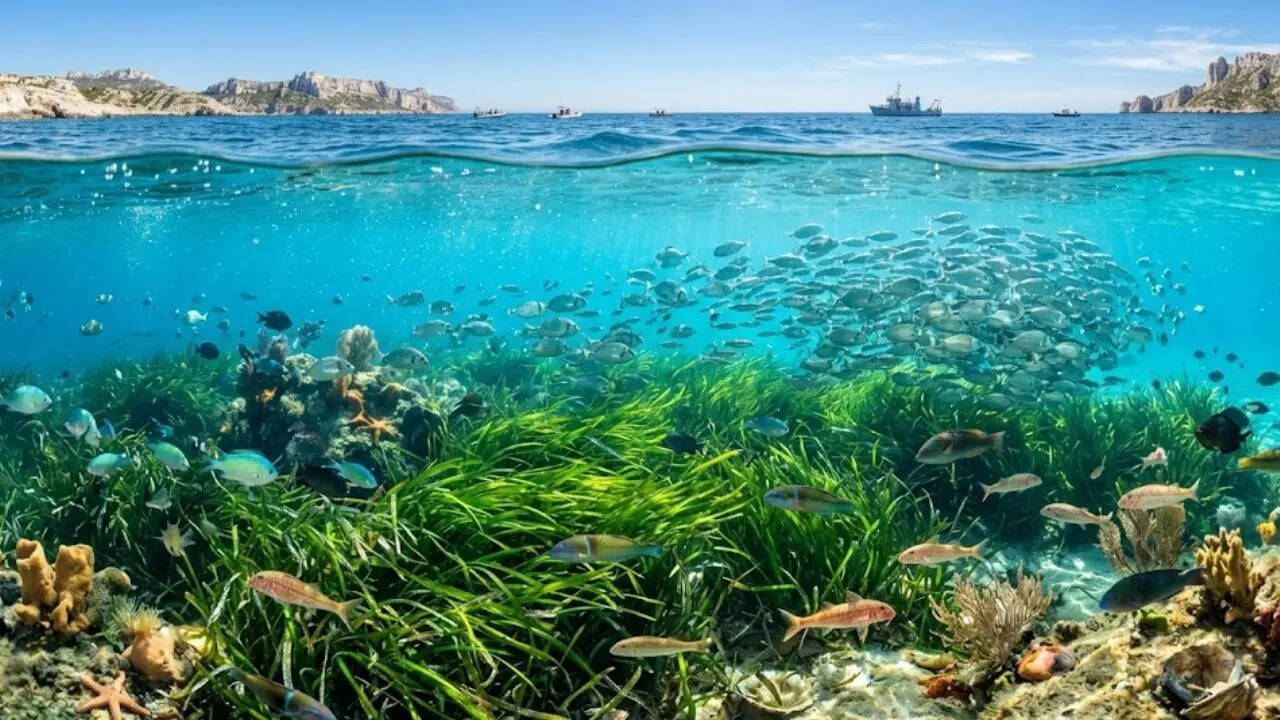
Those meadows are the lungs of the Mediterranean. They breathe life into the water, trapping carbon and providing a nursery for everything from tiny seahorses to silver-sided sea bream. But industrial runoff and untreated sewage had turned the water into a toxic soup. The meadows suffocated. When the grass dies, the fish leave. When the fish leave, the soul of a coastal city begins to wither.
Marseille had a problem that wasn't just environmental. It was an identity crisis. A city defined by the sea had poisoned its own lifeblood. The "miracle" didn't happen because of a sudden wave of environmental altruism. It happened because the city realized it was drowning on dry land.
The Great Diversion
The turning point wasn't a speech or a protest. It was a massive, invisible feat of engineering. For over a century, the city’s waste flowed directly into the Cortiou cove, right in the heart of what is now the Calanques National Park. It was an ecological crime hidden by the sheer beauty of the surrounding white cliffs.
Then came the Géolide.
Buried deep beneath the city, next to the orange-tinted stadium of Olympique de Marseille, lies one of the world's largest underground water treatment plants. It is a cathedral of concrete and pipes, processing the waste of nearly a million people. But the technology wasn't the hero. The hero was the decision to stop treating the Mediterranean as an infinite trash can.
The city began to move the outfalls, filtering the grime and the heavy metals. They stopped the "black tides" of sewage that used to follow heavy rains. Slowly, the chemical composition of the water began to shift. The acidity dropped. The clarity returned. But the fish didn't come back right away. You can’t just clean a room and expect the guests to return if you’ve already burned all the furniture.
Building an Apartment Complex for Cod
This is where the story shifts from plumbing to architecture.
In the mid-2000s, a group of marine biologists and engineers looked at the barren, sandy floors of the Marseille coast and realized they needed to build a city under the city. They began dropping massive, 3D-printed concrete structures into the water. These weren't just blocks; they were intricate, honeycomb-like reefs designed to mimic the natural crevices of a rocky shore.
Imagine a silent, submerged construction project. Over 27,000 cubic meters of artificial reefs were lowered into the Prado Bay. They were designed to break the currents and provide "apartments" for different species. Small holes for the fry. Large caverns for the groupers.
Jean-Claude watched from his boat, skeptical. He had seen the sea be abused for so long that he didn't believe it could forgive us.
But the sea has a short memory for pain and a long memory for life.
Within months, a thin film of algae began to coat the concrete. Then came the bryozoans—tiny, lace-like animals. Then the sponges. These are the pioneers. They are the first to move into a frontier town. Once they established a foothold, the food chain followed. Crustaceans crawled into the cracks. Small forage fish arrived to eat the larvae. And then, finally, the predators.
The Return of the King
The ultimate sign of a recovered sea is the return of the Apex predators. In Marseille, that means the Dusky Grouper. These are massive, grumpy-looking fish that can live for fifty years and grow to the size of a small person. They are the lions of the Mediterranean reef.
For decades, they were gone. Hunted out, poisoned out, squeezed out.
Now, if you dive in the Calanques, you might see one. It will hover there, golden-brown and ancient, watching you with a prehistoric eye. Its presence is a certificate of health. It says the water is rich enough, clean enough, and stable enough to support a king.
The statistics back up the sightings. Biodiversity in the protected zones around Marseille has surged by over 30% in the last decade. The Posidonia meadows are slowly, agonizingly creeping back across the seabed, reclaiming the territory they lost to the grey sludge of the 1970s.
The Invisible Stakes
Why does this matter to someone who never puts on a wetsuit?
It matters because a dead sea is a silent neighbor. When the water is healthy, the local economy shifts. The fishermen don't have to travel as far, burning less fuel. The restaurants serve local red mullet instead of frozen fillets flown in from halfway across the globe. The air smells different—cleaner, sharper, more vibrant.
There is also a psychological weight that lifts. To live next to a dying body of water is to live with a quiet sense of shame. It is a constant reminder of our capacity to destroy. But to see the sea come back—to see the blue deepen and the life return—is a reminder of our capacity to heal.
Marseille isn't perfect. It is still a gritty, chaotic, loud, and often dirty city. Plastic still finds its way into the gutters. Cruise ships still loom like floating apartment blocks in the harbor. The battle isn't over. It will never be over.
But something has changed in the relationship between the people and the blue.
On a Sunday morning at the Anse des Catalans, the small beach near the city center, the water is packed with swimmers. Not just the brave ones, but families, elderly couples, and teenagers jumping off the rocks. They aren't afraid of what’s in the water anymore. They are part of it.
Jean-Claude doesn't go out to the deep water as often now. He doesn't have to. Sometimes, he just sits on the pier and watches the light play on the surface. He knows that beneath that shimmering skin, the meadows are breathing. The groupers are lurking in their concrete castles. The sea is no longer a graveyard.
It is a home again.