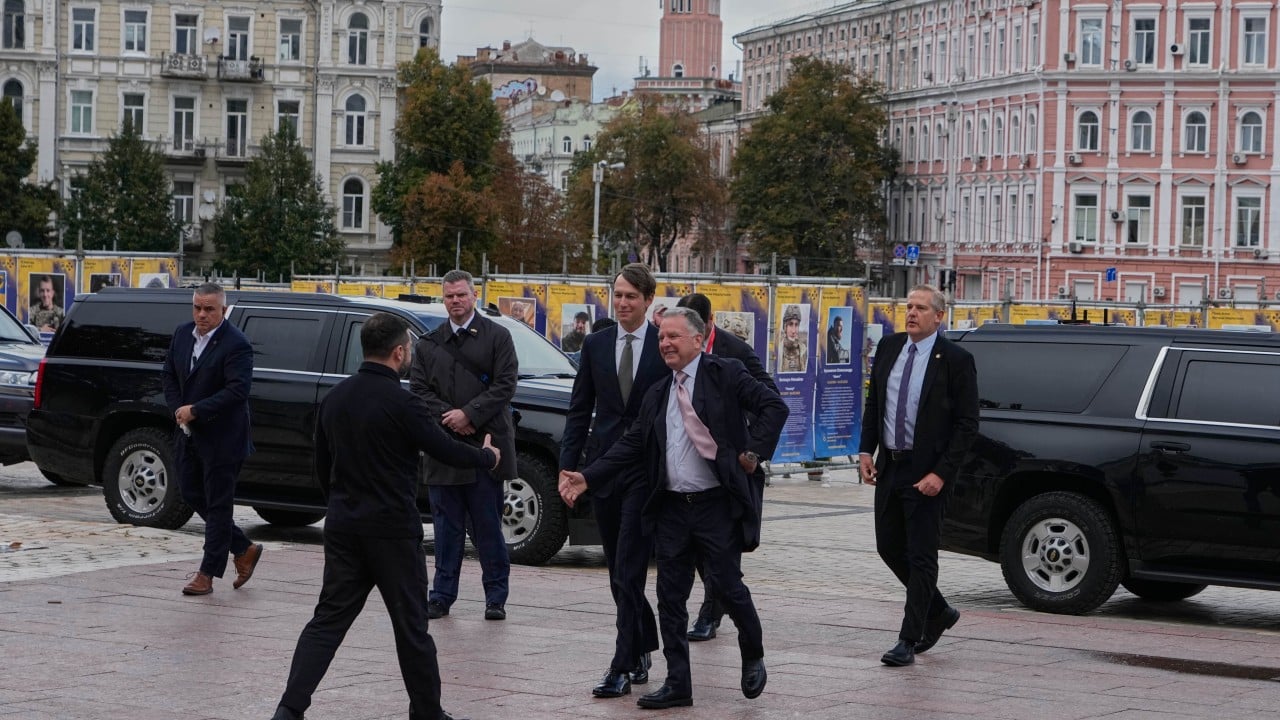
Diplomacy rarely operates in the harsh glare of public press conferences. More often, it moves through shaded corridors, private terminals, and hurried midnight arrivals in Eastern European capitals. When special envoys Steve Witkoff and Jared Kushner touched down in Kyiv, their physical presence sent shockwaves across European capitals and Washington power circles alike. They arrived fresh from closed-door sessions in Moscow, carrying the heavy baggage of preliminary Russian terms, backchannel compromises, and the quiet anxieties of a Western coalition beginning to fracture under the weight of prolonged conflict.
This unannounced diplomatic shuttle is not merely another routine stop in an endless war. It represents a profound shift in how backchannel negotiations bypass traditional State Department machinery. To understand why this particular delegation matters, one must examine the mechanics of the meetings in Moscow that preceded it. Witkoff and Kushner did not fly to Ukraine simply to deliver messages. They arrived to test whether the gap between Russian territorial demands and Ukrainian sovereignty can be bridged through transactional dealmaking or if the chasm remains entirely uncrossable. For another view, consider: this related article.
The Architecture of the Shadow Track
Official diplomatic channels follow strict protocols. Ambassadors communicate with foreign ministries, cables are drafted, vetted, and translated into bureaucratic language that often obscures intent. Shadow diplomacy works differently. It relies on personal networks, real estate instincts, and the language of commercial negotiation rather than traditional statecraft.
Witkoff, a fixture in high-end real estate and private investment, brings a specific mindset to international crises. He approaches geopolitical standoffs through the lens of distressed assets and forced compromises. Kushner, drawing from his previous portfolio in Middle Eastern diplomatic maneuvers, favors economic incentives and direct leader-to-leader alignment over multilateral consensus-building. Further reporting on this matter has been published by USA Today.
When these figures sit across the table from Kremlin insiders, they are not debating the finer points of international law or historical grievance. They are trading in concrete variables. Security guarantees, economic reconstruction contracts, and mineral rights form the currency of these discussions. Moscow understands this language well. By engaging with American intermediaries outside standard bureaucratic channels, the Russian leadership seeks to bypass European resistance and negotiate directly with a perceived center of gravity.
Yet, translating a real estate negotiation framework into a sovereign territorial dispute creates massive friction. Ukraine is not a commercial property facing foreclosure. Millions of lives, national identity, and the security architecture of the entire European continent hang in the balance. When the envoys arrived in Kyiv, they brought these raw, unpolished proposals straight to the Ukrainian leadership, forcing a confrontation between pragmatic compromise and existential survival.
The European Anxiety and Washington Friction
The sudden movement of American envoys through Moscow and Kyiv has triggered alarm bells across European foreign ministries. For months, European allies have preached a unified front under the banner of unconditional support. They fear that a transactional approach to the war could result in a partitioned Ukraine, leaving a weakened European Union to manage the security fallout on its eastern flank.
This friction exposes a deep ideological divide within Western strategy. Traditional foreign policy establishments argue that any peace built on territorial concessions rewards aggression and invites future instability. They point to historical precedents where appeasement failed to satisfy expansionist powers. Conversely, the proponents of backchannel negotiation argue that continuing a war of attrition indefinitely leads to mutual exhaustion, economic ruin, and an increased risk of catastrophic escalation.
The delegations arrival in Kyiv forces Ukrainian President Volodymyr Zelenskyy into an agonizing position. On one hand, Ukraine remains utterly dependent on American intelligence, financial aid, and military hardware. On the other hand, accepting terms that legitimize territorial loss carries immense domestic political risk. Every kilometer of recognized border relinquished threatens to ignite internal political upheaval and fractures public morale.
The Economics of Reconstruction as Leverage
Underneath the immediate military calculus lies a massive economic incentive structure. Reconstruction estimates for Ukraine run into the hundreds of billions of dollars. This financial reality forms a cornerstone of the private envoy strategy.
By tying future reconstruction funds, infrastructure rebuilding contracts, and resource access to a potential settlement, the architects of this backchannel hope to create economic gravitational pull. In theory, both sides are offered a stake in a prosperous post-war future that outweighs the immediate utility of continued fighting.
However, this commercial logic assumes that the primary drivers of the conflict are rational calculations of profit and loss. History demonstrates that existential conflicts are rarely resolved through spreadsheets alone. Identity, security fears, and historical memory routinely override economic self-interest. When Witkoff and Kushner laid out their framework in Kyiv, Ukrainian officials scrutinized every line for hidden traps, acutely aware that an economic promise is only as reliable as the enforcement mechanisms backing it up.
The Limits of Transactional Statecraft
The presence of American envoys in Kyiv highlights the enduring tension between professional diplomats and political fixers. Career diplomats warn that bypassing institutional structures creates dangerous ambiguities. When agreements are negotiated by individuals without clear accountability to legislative bodies or allied coalitions, misunderstandings multiply.
Furthermore, Putin's administration is notorious for pocketing concessions while offering very little in return. Moscow views Western diplomatic initiatives through the prism of strategic patience, calculating that Western political cycles will eventually erode support for Kyiv. If the envoys' mission is perceived as a sign of American impatience, the Kremlin may harden its posture rather than softening it.
The meetings in Kyiv ultimately served as a reality check for the visiting delegation. European capitals watched closely, wondering whether the talks yielded any breakthrough or merely exposed the limits of attempting to solve a historic geopolitical crisis through corporate dealmaking strategies. The silence from both the Ukrainian presidential office and the envoys following the meetings speaks volumes about the delicate and precarious nature of the discussions currently underway behind closed doors.
The armored cars rolled through the rain-slicked streets of Kyiv, past concrete barriers and anti-tank defenses, carrying men whose vision of peace relies on ledgers and leverage. Yet, as the motorcade departed for the airport, the fundamental reality of the conflict remained unchanged. Steel and blood dictate terms on the front lines, and no amount of backchannel diplomacy can easily erase the profound scars carved across a sovereign nation.