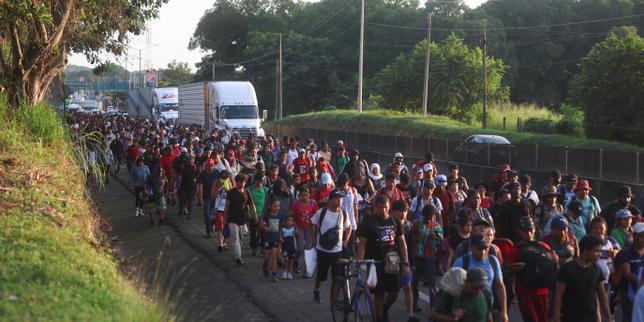
Linking bilateral customs duties to transient migration flows represents a structural mismatch between macroeconomic policy instruments and localized enforcement realities. On November 12, 2026, U.S. President Donald Trump threatened to immediately double existing tariffs on Mexican imports unless Mexican authorities halted a northward-moving migrant caravan originating in southern Mexico. While standard news coverage treats this ultimatum as a linear cause-and-effect negotiation tactic, operational trade economics and migration data reveal a multi-layered failure mode. Using broad-spectrum customs levies to compel immediate border interdiction introduces severe supply chain friction while ignoring the actual legal, demographic, and institutional constraints governing North American trade and migration.
The Structural Mismatch of Coercive Tariffs
Deploying import duties as a rapid-response tool for immigration enforcement violates the fundamental mechanics of supply chain architecture. Tariffs are slow-moving fiscal taxes paid by domestic importers at the port of entry, whereas migrant caravans are fluid, decentralized human movements occurring thousands of miles away in states like Chiapas.
To evaluate this policy mechanism, strategists must separate the political signaling from the actual economic transmission channels:
- The Incidence Fallacy: Public rhetoric frequently frames tariffs as a direct financial penalty levied against the exporting sovereign state. In operational practice, customs duties are collected by U.S. Customs and Border Protection from the U.S.-based importer of record. Because North American manufacturing relies on tightly integrated cross-border production loops—particularly in the automotive, aerospace, and electronics sectors—doubling a baseline tariff (such as the 10% duty applied to Mexico earlier in 2026 following forced-labor investigations) immediately inflates the cost of intermediate goods for domestic American manufacturers.
- Asymmetric Elasticity: Cross-border supply chains exhibit low short-term price elasticity. An American automotive assembly plant in Michigan cannot re-source wire harnesses or engine blocks from a non-Mexican supplier within days or weeks. Doubling the duty rate does not instantaneously shift sourcing behavior; it acts as an immediate working-capital tax on domestic firms, compressing operating margins or forcing downstream price increases onto consumers.
- The Legal and Statutory Bottleneck: Executive tariff threats frequently outpace statutory authority. Following the November 2026 midterm elections, which shifted the balance of power in Congress toward the Democratic Party, unilateral executive trade actions face heightened legislative and judicial friction. Pending congressional legislation—specifically Senate bills S. 5390 and S. 1272, alongside House bill H.R. 7557—targets the restriction of unilateral presidential tariff powers. Furthermore, any sweeping tariff escalation collides directly with the dispute-resolution mechanisms codified in the United States-Mexico-Canada Agreement (USMCA), which underwent a formal review initiation by the U.S. Trade Representative in October 2026.
Deconstructing the Migration Variable
A rigorous assessment requires separating headline figures from verified ground metrics. Initial media reports and political statements characterized the November 2026 movement as a massive surge of roughly 2,000 migrants marching toward the U.S. southern border. Operational reporting from Mexican authorities and international wire services provides a sharply different empirical baseline.
- Caravan Attrition Mechanics: Large migrant groups forming in southern hubs like Tapachula or Arriaga experience rapid demographic decay. Physical exhaustion, extreme heat, lack of potable water, and the absence of transit visas cause continuous attrition long before groups reach central Mexico. Mexican President Claudia Sheinbaum confirmed on November 12, 2026, that while one caravan in Arriaga initially formed with roughly 500 to 600 individuals, natural attrition and persuasion reduced its active headcount to fewer than 100 people. Another group, operating under the name Dios con Nosotros, navigated through Huehuetán, Chiapas, facing identical logistical bottlenecks.
- The Containment Baseline: Threatening punitive economic measures to force enforcement presupposes that the target state is currently failing to contain flows. However, bilateral enforcement metrics indicate that southern border encounters had already dropped by 97% from peak levels, reaching their lowest historical volume since 1959. Mexican enforcement relies on a strategy of attrition and non-violent containment—offering return transit and informing migrants stranded in Chiapas that entry into the United States remains functionally closed—rather than high-visibility kinetic crackdowns.
- The Political Expectation Loop: Migration surges are heavily influenced by information asymmetries and perceived policy windows. Migrants stranded in southern Mexico with limited access to local employment, healthcare, and education closely monitor U.S. electoral cycles. The November 2026 midterm results—which saw Democrats gain control of Congress and win key state-level races, such as Gina Hinojosa unseating Texas Governor Greg Abbott and Nathan Johnson winning the Texas Attorney General race—created a false signal among migrant networks that federal border restrictions would immediately soften in January 2027. In reality, executive control over federal border enforcement agencies, including U.S. Border Patrol and Immigration and Customs Enforcement, remains entirely with the White House. While state-level legal defenses of local statutes like Texas Senate Bill 4 may shift under new state attorneys general in 2027, federal entry restrictions remain unaltered.
The Three-Stage Risk Transmission Model
When a sovereign executive links trade policy to non-trade geopolitical outcomes, corporate supply chain operators and institutional investors must model the resulting risk across three distinct stages. Relying on binary assumptions—either ignoring the threat as pure bluster or liquidating Mexican operations—leads to suboptimal capital allocation.
Stage 1: Volatility Pricing and Inventory Front-Loading
The immediate consequence of an unscheduled tariff threat is not the tariff itself, but the spike in policy uncertainty. Logistics managers react to sudden Truth Social pronouncements by accelerating cross-border shipments to clear customs before a theoretical deadline. This artificial demand surge congests land ports of entry along the Texas and California borders, drives up short-term spot rates for cross-border freight, and forces companies to tie up liquidity in safety-stock inventory.
Stage 2: Regulatory Arbitrage and Rule-of-Origin Audits
If an administration attempts to bypass congressional constraints by attaching new duties to existing trade investigations—such as the March 2026 U.S. probes into manufacturing overcapacity and forced labor—compliance burdens multiply. Importers face heightened scrutiny over USMCA rules of origin. A product assembled in Monterrey or Tijuana using Asian sub-components becomes an immediate target for punitive reclassification, stripping away preferential duty-free treatment even if a broad, across-the-board tariff hike is blocked by federal courts.
Stage 3: Retaliatory Targeting and Cross-Sector Contagion
Sovereign trade retaliation rarely mirrors the initial tariff structure. If Washington doubles duties on Mexican industrial goods, Mexico City will not respond with symmetrical industrial tariffs that harm its own manufacturing base. Instead, retaliatory tariffs are precision-engineered to inflict maximum political friction on the issuing administration's domestic coalition. Historically and structurally, this means targeting U.S. agricultural exports—specifically corn, soybeans, dairy, and pork—originating from politically sensitive American farm states. This creates cross-sector contagion where a dispute over migrant caravans in Chiapas directly erodes the net farm income of grain producers in the American Midwest.
Operational Playbook for Cross-Border Enterprises
Enterprises exposed to U.S.-Mexico trade lanes cannot afford to treat political rhetoric as noise, nor can they restructure physical manufacturing footprints every time a diplomatic ultimatum is issued. Supply chain and finance leaders must execute a disciplined, four-part hedging protocol.
- Audit Harmonized Tariff Schedule (HTS) Exposure: Map all active cross-border SKUs against existing Section 301, Section 232, and recent 2026 forced-labor or overcapacity tariff classifications. Identify which products rely on USMCA preferential status versus Most Favored Nation (MFN) rates, as executive actions frequently target MFN baselines first.
- Implement Dynamic Customs Valuation: Review transfer pricing agreements between U.S. parent companies and Mexican maquiladora subsidiaries. Ensure that non-dutiable costs—such as certain post-importation logistics, engineering services, and software licensing—are legally unbundled from the transaction value declared at the border, reducing the ad valorem base upon which any doubled tariff would be calculated.
- Establish Nearshore Buffer Liquidity: Maintain dedicated credit facilities or foreign exchange hedges to absorb sudden 30-to-60-day spikes in customs bond requirements. When tariff rates double overnight, U.S. Customs requires importers to post larger continuous bonds to cover the increased duty liability, which can freeze liquidity for mid-sized firms even before goods are sold.
- Separate Legislative Noise from Executive Action: Track the committee progress of congressional tariff-restriction bills (S. 5390, S. 1272, and H.R. 7557) alongside federal court injunctions. Understand that while a divided Congress in 2027 will slow down permanent statutory trade changes, the executive branch retains broad temporary emergency authorities that can disrupt cash flow for weeks before judicial review intervenes.
Strategic Forecast
The November 2026 ultimatum will not result in a sustained, across-the-board doubling of tariffs on all Mexican imports. The economic self-harm to U.S. industrial output, combined with the active USMCA review process and impending legislative pushback from an incoming Democratic congressional majority, makes a permanent doubling of duties politically and economically untenable. Furthermore, because the underlying migrant caravans are already dissolving due to distance, resource scarcity, and quiet Mexican containment in Chiapas, Mexico City can easily claim compliance without altering its existing operational posture.
However, the era of predictable, rules-based North American free trade is permanently suspended. Coercive tariff threats have become the default diplomatic currency for resolving non-trade domestic friction. Organizations operating across the U.S.-Mexico corridor must permanently price a 10% to 20% regulatory risk premium into their cross-border unit economics, shifting from just-in-time inventory models to tariff-resilient financial architectures.
For additional context on the immediate diplomatic reaction and border enforcement metrics surrounding this ultimatum, review Trump threatens to double tariffs on Mexico over group of migrants headed for southern border, which outlines the timeline of the Truth Social announcement and initial federal agency responses.