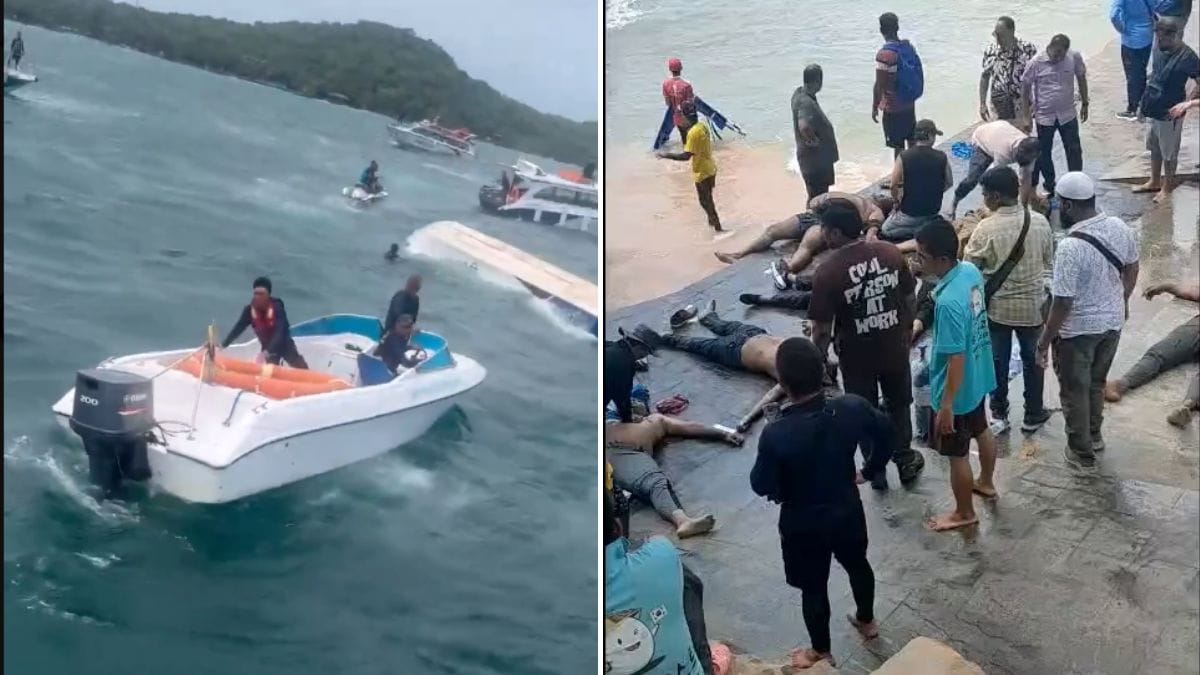
The water in the Gulf of Thailand is usually the temperature of a lukewarm bath. It is thick, salty, and slows you down when you try to swim against it. On a clear evening, it looks entirely harmless. It looks like a playground.
But when a hull cracks and the generator dies, that same water turns into an anchor. Expanding on this topic, you can find more in: Why National Physics Olympiad Triumphs Are Actively Ruining Real Science.
We tend to measure maritime disasters in percentages and timelines. We ask how many life jackets were on board, what time the distress call was logged, and how many miles the nearest patrol boat had to travel. Bureaucrats love these metrics because they can be filed into neat spreadsheets. They treat a tragedy like a math problem where the variables just need to be balanced.
The people screaming in the dark do not care about spreadsheets. Experts at Al Jazeera have also weighed in on this trend.
Consider a hypothetical traveler named Linh. She is not a statistic. She is twenty-four, saving up from a grueling job in Ho Chi Minh City to take her family on a weekend getaway. She is sitting on the deck of a wooden tourist boat, watching the lights of the coastline fade into a smudge of purple and orange. She feels safe because the brochure told her she was safe. The crew smiled. The engine hummed.
Then comes the sound. It is not an explosion. It is a wet, heavy thud, followed by the immediate, terrifying sound of rushing water.
Within ninety seconds, the deck tilts at an angle that turns floorboards into walls. The lights flicker once, twice, and snap into total darkness.
This is where the standard news reports usually falter. They tell you that a boat sank off the coast of Vietnam. They tell you that survivors alleged flaws in the emergency response. They might even quote an official saying an investigation is underway. But they omit the sensory reality of the failure. They leave out the smell of diesel fuel mixing with salt water, choking people as they try to breathe. They leave out the weight of a waterlogged cotton shirt pulling a child downward.
The real crisis in these moments is almost never a lack of equipment. It is a breakdown of system logic.
When a vessel begins to founder, a terrifyingly predictable sequence of human errors begins to unfold. Survivors from recent accidents in the region describe a chaotic vacuum where protocol should be. On paper, every commercial boat operating in these waters is required to have a manifest, a trained crew, and an immediate line of communication to shore-based rescue coordinators.
In reality, the communication often looks like a frantic deckhand using a personal cellphone, trying to get a signal with wet fingers, calling a cousin on land because they do not know the direct frequency for the regional coast guard.
Minutes vanish.
In maritime rescue, minutes are the only currency that matters. If a rescue boat leaves the pier five minutes after a hull breach, the operation is a salvage mission for survivors. If it leaves forty-five minutes later, it is a recovery mission for bodies.
Imagine standing on a sinking deck, holding a child, and watching the crew fumble with the knots on a fiberglass life raft that has been painted over so many times the release mechanism is rusted shut. This is not a failure of technology. It is a failure of imagination. The people who maintained that boat could not imagine the scenario where those knots actually needed to untie. They saw maintenance as a regulatory chore, a box to check to keep the inspectors happy, rather than the thin line between life and suffocating darkness.
The bureaucratic aftermath is always a performance of righteous anger. Local authorities vow to crack down on unlicensed operators. They suspend permits. They hold press conferences in air-conditioned rooms, pointing at maps with laser pointers.
But the maps are misleading. They show a coastline dotted with rescue stations, implying a network of safety. What they do not show is that many of these stations are understaffed, or that the rescue boats lack basic night-vision equipment, or that the personnel have never done a live-drills exercise in rough seas at 2:00 AM.
It is easy to blame a rogue captain or an unexpected squall. It is much harder to admit that the entire ecosystem of coastal tourism relies on a gamble that the weather will always be good and the engines will always run.
The survivors do not forget the silence that follows the screaming. Once the boat goes under, the noise stops. The sea swallows the grinding metal and the breaking glass, leaving only the sound of chopping waves and people trying to keep their noses above the swell. If you are lucky, you have a life jacket. If you are unlucky, you are clawing at a piece of floating plastic debris, wondering if anyone on the shore even knows you are missing.
True safety does not come from a stricter law passed in a capital city hundreds of miles away. It comes from the unglamorous, repetitive work of checking the valves, training the deckhands until their hands bleed, and building an emergency response system that treats a distress call like an existential emergency rather than an administrative task.
The sun eventually comes up over the Gulf. The water turns blue again. The tourists return to the piers, looking at the boats with cameras around their necks, entirely unaware of the depth beneath them.
Linh’s family survived their ordeal, but they do not go near the water anymore. They look at the ocean from the safety of the hotel balcony, understanding what the crowds below do not: the sea never makes mistakes, but the people who build boats do.


